

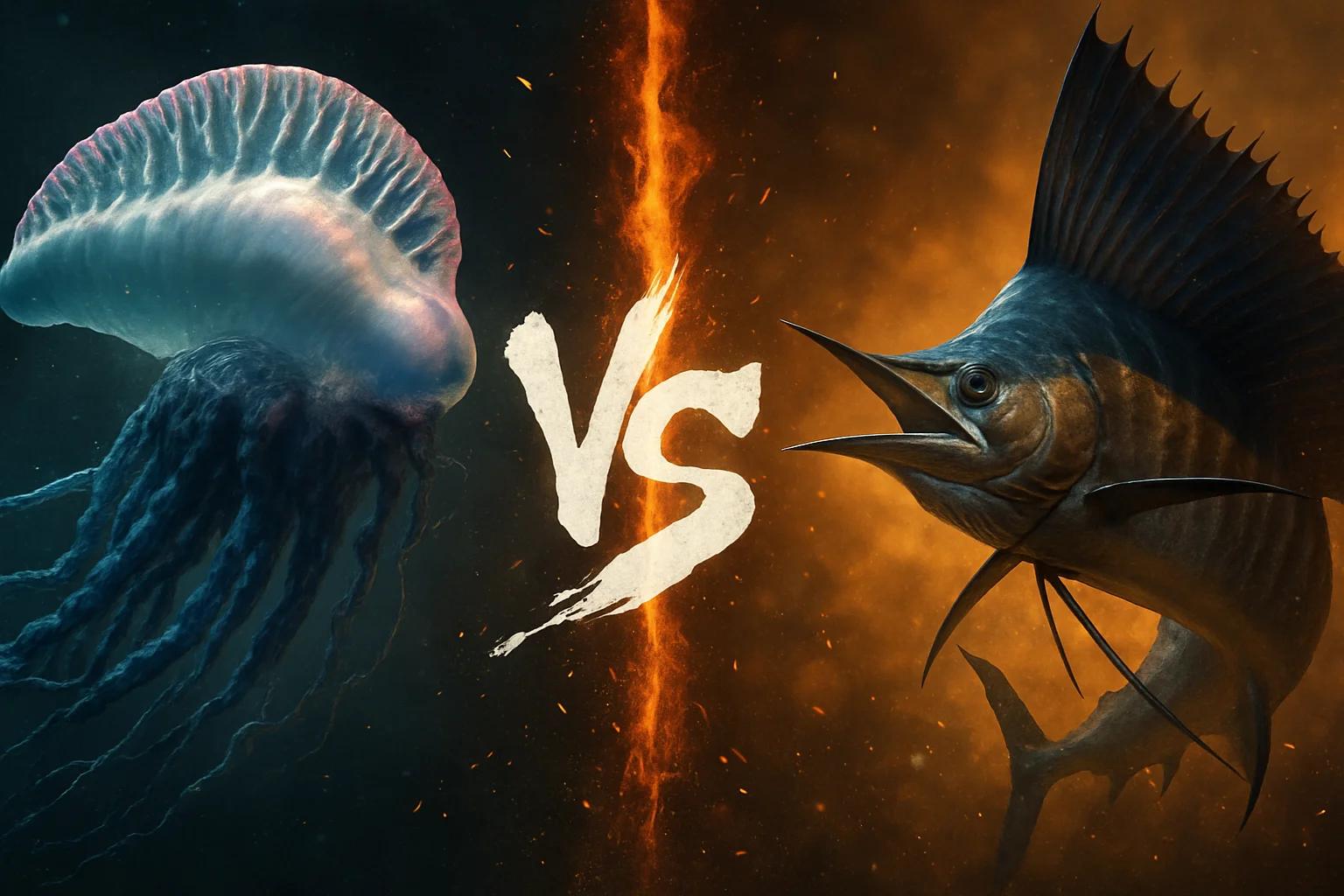
Portuguese Man o' War vs Sailfish: Who Actually Wins?
Portuguese Man o' War vs Sailfish: venom-laced drifting colony vs the ocean's fastest-accelerating billfish. See who wins, why, and when the man o' war still stings back.
Portuguese Man o' War vs Sailfish
Matchup winner
Sailfish
Quick verdict
Start with the direct answer, then use the structured comparison below to see what changes the outcome.
The sailfish wins, and it isn't close. A Portuguese man o' war is a siphonophore, a floating colony of specialized zooids that cannot steer itself. It drifts on a gas-filled float, pushed by wind, and catches only what blunders into its trailing tentacles. Those tentacles can reach 10 meters or more and carry nematocysts, stinging cells that fire venom on contact and paralyze small fish. A sailfish is a 2–3 meter predator built for burst speed, maneuvering and choosing where it goes. It also has the eyes and judgment to stay away from things that sting. The man o' war can't chase, can't aim and can't force an engagement. The sailfish decides whether contact happens at all. The real danger is accidental: a juvenile sailfish or a careless lunge through a tentacle curtain can end badly. An adult sailfish that keeps its distance takes no damage and can leave whenever it likes.
Read the full explanation
Sailfish wins: it controls range, speed and whether any contact happens at all.
The man o' war is a passive drifter. Its venom only works if prey swims into it.
Tentacle stings can paralyze small fish, so juvenile sailfish are genuinely at risk.
An adult sailfish has the size and avoidance behavior to treat the man o' war as a hazard, not a rival.
Reader vote
Who do you think wins?
Pick a side — no account needed. Results update live.
No votes yet — be the first to call it.
Editorial note
Why people disagree
Venom hype: people read 'deadly sting' and assume it beats any fish. But venom with no way of delivering it to a target is a defense, not a weapon.
Mobility control
The animal that controls distance decides whether the encounter happens. The sailfish holds every bit of that control.
Venom payload
This is the man o' war's only real edge, and it works purely on contact. That makes it a threat zone, not an attack.
Passive reach
The long trailing curtain is why careless fish die. Range without the ability to aim only catches the unwary.
Read the full explanation +
Size confusion: very long tentacles make the man o' war seem large, but its living mass is small and fragile next to a muscular billfish.
'Fight' framing: the man o' war doesn't fight. It's a drifting trap, so the honest question is whether the sailfish ever blunders into it.
Comparison FAQ
Short, direct answers to the next questions readers usually ask after the headline verdict.
Would a Portuguese man o' war beat a sailfish?+
No. An adult sailfish wins almost every realistic encounter because it controls distance and can avoid the tentacles entirely. The man o' war only wins against small or juvenile sailfish that swim into its tentacles.
Which is stronger, a sailfish or a Portuguese man o' war?+
The sailfish, by far. It is a muscular fish that can weigh many tens of kilograms. The man o' war is a lightweight gelatinous colony with no structural strength.
Can a man o' war sting kill a sailfish?+
It can kill small juveniles. An adult may suffer painful stings, but its body size dilutes the venom's effect, so death is unlikely.
Why is the man o' war still dangerous if it loses?+
Its tentacles trail roughly 10 meters or more and are nearly invisible. Each nematocyst fires venom automatically on contact, even after the animal washes ashore or the tentacles break off. Careless or small animals, including humans, can be seriously hurt.
Is the Portuguese man o' war a jellyfish?+
No. It is a siphonophore, a colony of specialized organisms called zooids working together as one drifting unit.
How fast is a sailfish?+
Sailfish are famous for explosive bursts and are often cited among the fastest fish. Older claims of 110 km/h are disputed, but their acceleration and maneuvering are elite.
Head-to-head species stats
These are the same core AnimalDex stat dimensions used on the dedicated animal pages, pulled side by side so the matchup is faster to scan.
Portuguese Man o' War
Tier CSailfish
Tier BTrait-by-trait comparison
Only the categories that matter to this matchup are included. The goal is not filler stats, but the real design differences that change the result.
Wind-driven drift, no steering toward prey
Mobility control
Sailfish
Among the fastest bursting fish in the sea
Mobility control
Sailfish
Nematocyst-loaded tentacles that paralyze small fish
Venom payload
Portuguese Man o' War
No venom
Venom payload
Portuguese Man o' War
Tentacles trailing roughly 10 m or more below the float
Passive reach
Portuguese Man o' War
Bill reach of about 1 m
Passive reach
Portuguese Man o' War
Soft gelatinous colony that tears easily
Close-range durability
Sailfish
Dense muscle, scales, tough body
Close-range durability
Sailfish
No brain, distributed nerve net
Situational awareness
Sailfish
Large eyes, fast threat assessment
Situational awareness
Sailfish
Small float and a light colony
Body mass
Sailfish
Up to around 90 kg in big adults
Body mass
Sailfish
How the verdict forms
Verdict timeline
01 · Mobility control
Sailfish
02 · Venom payload
Portuguese Man o' War
03 · Passive reach
Portuguese Man o' War
04 · Close-range durability
Sailfish
05 · Situational awareness
Sailfish
06 · Body mass
Sailfish
Change the conditions
Scenario breakdown
This is where shallow battle content usually fails. Terrain, spacing, timing, and engagement style can change the answer.
Scenario lean
Sailfish
Verdict confidence
82%
Sailfish simply avoids or disrupts it.
In open ocean the sailfish has unlimited room and sharp eyes. The man o' war can't pursue, so the encounter happens on the sailfish's terms or not at all. An adult will usually just swim past, and the outcome is zero damage for the fish.
AnimalDex field profiles
Explore these animals
Portuguese Man o' War
Physalia physalis
open ocean surface waters and warm pelagic currents
Sailfish
Istiophorus platypterus
warm ocean surface waters and offshore pelagic zones
Systems Intelligence & Hidden Purpose
See the animals behind this comparison as engineered biological systems: what each one is built to do, where it gains leverage, and why the matchup changes by scenario.
Specialized Hardware
gas-filled floating sail, stinging trailing tentacles, and colonial body made of specialized parts give the Portuguese Man o' War a body plan tuned for its niche.
Systems Script
Portuguese Man o' Wars operate through open ocean surface waters and warm pelagic currents Their design links movement, shelter, and feeding into one workable survival system.
Strategic Insight
A coordinated system can look like one body even when it is really many specialists combined.
Specialized Hardware
towering dorsal sail, high-speed open-water pursuit, and bill used in coordinated feeding give the Sailfish a body plan tuned for its niche.
Systems Script
Sailfishs operate through warm ocean surface waters and offshore pelagic zones Their design links movement, shelter, and feeding into one workable survival system.
Strategic Insight
At high speed, even small design advantages compound quickly.
Final take
The Portuguese man o' war is one of the ocean's most effective passive traps. Its strength lies in being impossible to see in time, not in winning contests. Against a fast, perceptive, heavily built predator like the sailfish, a trap with no steering and no armor loses whenever the sailfish chooses to avoid or overpower it.
Read the full explanation
Overall winner: Sailfish. The man o' war's best result is an ambush by accident, most realistically against a juvenile. For an adult sailfish it is a hazard to swim around, not an opponent.
Collect both animals in AnimalDex
Track the species behind this matchup, compare their real traits, and build the rivalry into your AnimalDex collection.
Related comparisons
Continue with nearby matchups to compare more real-world animal traits without dropping into junky who-wins filler.
Humpback Whale vs Portuguese Man o' War: Who Actually Wins?
The humpback whale wins clearly. A Portuguese man o' war is not a single animal that can pursue, grapple, or inject a lethal dose into something the size of a school bus. It is a siphonophore, a floating colony of specialized zooids that drifts wherever wind and current push its gas-filled float. Its nematocyst-loaded tentacles can trail 10 meters or more and deliver a sting that cripples small fish and seriously hurts humans. A humpback, though, carries thick skin, a deep blubber layer, roughly 30 to 40 tons of mass, and the agency to simply avoid it. Whales do occasionally take incidental stings around the mouth and eyes, and those are painful irritations. Against a whale's body they are not a fight-ending weapon. The man o' war has no way to choose a target, chase, or escalate. The whale controls every encounter, and the worst realistic outcome for the whale is a stinging nuisance.
Read comparison
Oceanic Whitetip Shark vs Sailfish: Who Actually Wins?
The oceanic whitetip shark wins a committed fight. It is typically far heavier than a sailfish, often around 70–170 kg against roughly 25–60 kg. It carries a serrated, prey-processing bite, a cartilage-and-dermal-denticle body built to absorb contact, and the dogged, opportunistic temperament that makes it one of the open ocean's most persistent hunters. The sailfish is the better sprinter and the more agile turner. Its bill is a real tool, but evolution shaped it to slash and stun small schooling fish, not to win sustained combat against a large predator. If the sailfish keeps its distance, it escapes. If the encounter becomes physical, the whitetip's mass and jaws decide it.
Read comparison
Sailfish vs Tiger Shark: Who Actually Wins?
The tiger shark wins, and it isn't especially close. A big adult tiger shark is commonly 3.5–4.5 m long and several hundred kilograms, often five or more times the mass of a large sailfish. It carries a broad, serrated bite built to saw through sea turtle shells. The sailfish is a sprint-and-slash specialist: a slender, lightly built hunter whose bill is designed to stun small schooling fish, not to injure an armored, thick-skinned predator. The sailfish's real edge is acceleration and maneuverability, which means it is far better at escaping a tiger shark than at beating one. In any frame where they actually make contact, mass, bite mechanics and durability decide it for the shark.
Read comparison
Discussion
What do you think?
Share your reasoning with other readers. Be civil and stick to the animals.
Sign in to join the discussion.
Sign inNo comments yet. Start the conversation.