

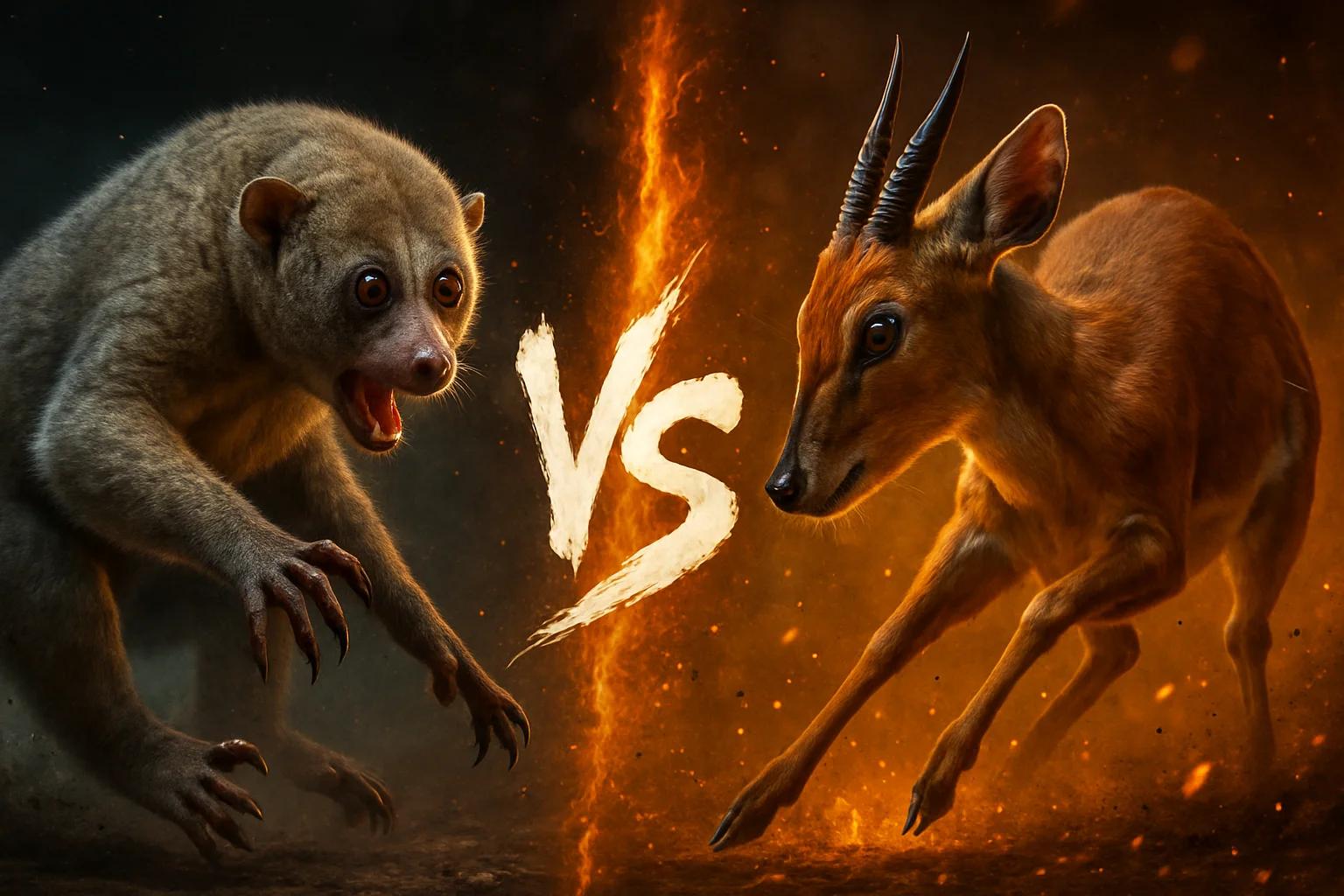
Potto vs Royal Antelope: Who Actually Wins?
Potto vs royal antelope: a slow, iron-gripped primate meets the world's smallest antelope. See who wins, why, and how each survives the West African forest night.
Potto vs Royal Antelope
Matchup winner
Potto
Quick verdict
Start with the direct answer, then use the structured comparison below to see what changes the outcome.
The potto wins a true confrontation, but narrowly. The royal antelope is the larger animal at roughly 2–3 kg versus the potto's 1–1.5 kg, and it is vastly faster, with explosive leaps that can clear more than 2 metres. It is built to escape, though, not to fight. Its horns are tiny spikes about 2.5 cm long that only males carry, and its delicate legs are made for bounding rather than brawling. The potto is slow but almost impossible to dislodge once it grips. It has a vise-like hold, a sharp defensive bite, and a bony 'scapular shield' of raised neck vertebrae that it thrusts toward attackers while tucking its head. In any scenario where the two actually make contact, the potto controls the exchange and the antelope's best move is to leave. If the antelope can simply bolt, it never loses, which is why this is a low-confidence win.
Read the full explanation
Overall winner: the potto, because it has real defensive weapons (grip, bite, neck shield) and the antelope has almost none.
The royal antelope is heavier and far faster, but it is wired to flee, not fight.
On open ground the antelope 'wins' by escaping. In contact or in the trees, the potto dominates.
Neither animal hunts the other, so this is a thought experiment about defensive design.
Reader vote
Who do you think wins?
Pick a side — no account needed. Results update live.
No votes yet — be the first to call it.
Editorial note
Why people disagree
The antelope is about twice the potto's weight, and many readers assume size decides small-animal fights.
Explosive power
The antelope can create distance instantly. That power drives escape, not attack.
Grip and clinch control
Once contact happens, only the potto can hold onto and control its opponent.
Close-range durability
The potto can absorb a hit and stay in the exchange. A bite to the antelope's leg could be decisive.
Read the full explanation +
Speed looks like power. The antelope's leaps are spectacular, but escape speed does not translate into fighting ability.
Some readers count fleeing successfully as a win. Under battle framing, avoiding the fight is not the same as winning it.
Comparison FAQ
Short, direct answers to the next questions readers usually ask after the headline verdict.
Would a potto beat a royal antelope in a fight?+
Yes, if they make contact. The potto's grip, bite, and bony neck shield outclass the antelope's tiny horns and fragile legs. The antelope's real counter is to run.
Which is stronger, a potto or a royal antelope?+
The antelope has more raw leg power and about twice the body mass. The potto has far stronger grip and more useful fighting strength at close range.
Why is the royal antelope still dangerous to the potto?+
It can kick hard and sharply, and males carry small spike horns. Its speed also means it can strike and leave before the potto can respond.
Do pottos and royal antelopes meet in the wild?+
Their ranges overlap in West African forests. However, the potto lives in the trees and the antelope lives on the forest floor, and neither preys on the other.
What is the potto's scapular shield?+
It is a set of elongated neck vertebrae covered by thick skin. The potto can thrust it toward an attacker while protecting its head.
Head-to-head species stats
These are the same core AnimalDex stat dimensions used on the dedicated animal pages, pulled side by side so the matchup is faster to scan.
Potto
Tier CRoyal Antelope
Tier BTrait-by-trait comparison
Only the categories that matter to this matchup are included. The goal is not filler stats, but the real design differences that change the result.
Near zero; deliberate, slow movement
Explosive power
Royal Antelope
Elite bounding leaps from a standstill
Explosive power
Royal Antelope
Vise-like hands and feet with a reduced index finger built for clamping
Grip and clinch control
Potto
Hooves with no grasping ability
Grip and clinch control
Potto
Bony scapular shield and thick neck skin
Close-range durability
Potto
Fragile, slender limbs and a light frame
Close-range durability
Potto
Sharp defensive bite
Weaponry
Potto
Tiny spike horns on males only, plus kicks
Weaponry
Potto
Freezes and clings rather than running
Escape tempo
Royal Antelope
Darts into undergrowth in a heartbeat
Escape tempo
Royal Antelope
About 1–1.5 kg
Body mass
Royal Antelope
About 2–3 kg
Body mass
Royal Antelope
How the verdict forms
Verdict timeline
01 · Explosive power
Royal Antelope
02 · Grip and clinch control
Potto
03 · Close-range durability
Potto
04 · Weaponry
Potto
05 · Escape tempo
Royal Antelope
06 · Body mass
Royal Antelope
Change the conditions
Scenario breakdown
This is where shallow battle content usually fails. Terrain, spacing, timing, and engagement style can change the answer.
Scenario lean
Potto
Verdict confidence
82%
Potto by clinch.
In tight brush the antelope has no room to use its leaps. The potto grips, presents its shield, and bites. An animal with weapons and anchoring beats one built only for running.
AnimalDex field profiles
Explore these animals
Potto
Perodicticus potto
rainforest canopy and dense tropical woodland
Royal Antelope
Neotragus pygmaeus
rainforest edge, dense thicket, and low woodland
Systems Intelligence & Hidden Purpose
See the animals behind this comparison as engineered biological systems: what each one is built to do, where it gains leverage, and why the matchup changes by scenario.
Specialized Hardware
slow grasping nocturnal body, dense woolly fur, and branch-hugging stealth give the Potto a body plan tuned for its niche.
Systems Script
Pottos operate through rainforest canopy and dense tropical woodland. Their design links movement, feeding, shelter, and timing into one workable survival system.
Strategic Insight
Dense environments reward precision, patience, and the ability to read layered cover.
Specialized Hardware
pinhead-sized antelope frame, delicate spindle legs, and leaf-litter hiding give the Royal Antelope a body plan tuned for its niche.
Systems Script
Royal Antelopes operate through rainforest edge, dense thicket, and low woodland. Their design links movement, feeding, shelter, and timing into one workable survival system.
Strategic Insight
Dense environments reward precision, patience, and the ability to read layered cover.
Final take
The potto wins. This is not about strength or speed. It is about being designed for contact. Its grip, bite, and shielded neck give it a toolkit, while the royal antelope's whole design is about not being there when contact happens.
Read the full explanation
Respect the antelope anyway. Its escape system is one of the best in the forest at its size, and in open space the potto cannot touch it. The potto's win comes with a big footnote: the fight has to actually happen.
Collect both animals in AnimalDex
Track the species behind this matchup, compare their real traits, and build the rivalry into your AnimalDex collection.
Related comparisons
Continue with nearby matchups to compare more real-world animal traits without dropping into junky who-wins filler.
Bay Duiker vs Royal Antelope: Who Actually Wins?
The bay duiker wins, and it isn't close. An adult bay duiker typically weighs about 15–24 kg, roughly six to eight times the 2–3 kg royal antelope, the smallest antelope on Earth. The duiker carries sturdy spike horns on a thick-necked, wedge-shaped body built for driving through dense undergrowth, and it has the bulk to shove a rival off a fruit patch. The royal antelope's best weapon is leaving: explosive standing leaps of over 2.5 m and a hare-like dash into tangles where a larger animal can't follow. In any contest about holding ground or forcing contact, the duiker controls the outcome. The royal antelope wins only the contests that are really about vanishing.
Read comparison
Blue Duiker vs Royal Antelope: Who Actually Wins?
The blue duiker wins. At roughly 4–9 kg against the royal antelope's 1.5–3 kg, the blue duiker carries two to four times the mass. Both sexes usually have short, sharp spike horns, and the species defends small territories in pairs, driving off rivals with butts and horn jabs. The royal antelope is the world's smallest antelope. It is built for one job: vanishing. It freezes in leaf litter and then explodes away in bounds that can reportedly cover around 2.5 m. Only males have horns, and they are tiny. In any forced confrontation, such as a shared trail or a contested fruit fall, the duiker's weight, armed females and habit of defending ground decide it. The royal antelope's real victory condition is never being there when the duiker arrives.
Read comparison
Discussion
What do you think?
Share your reasoning with other readers. Be civil and stick to the animals.
Sign in to join the discussion.
Sign inNo comments yet. Start the conversation.