

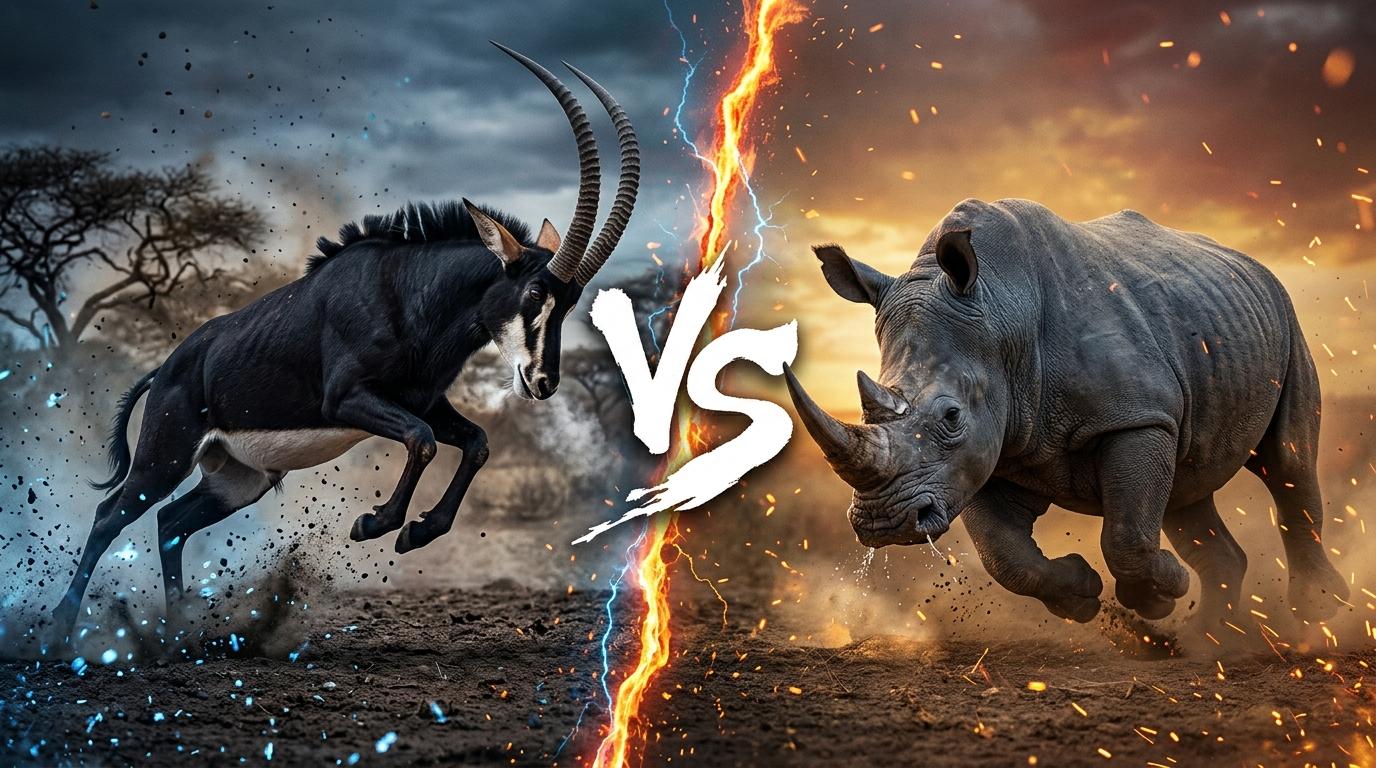
Sable Antelope vs White Rhinoceros: Who Actually Wins?
Sable antelope vs white rhino: who would win? A biology-first breakdown of size, horns, armor and defensive behavior shows why the rhino holds the clear edge, and why the sable is no pushover.
Sable Antelope vs White Rhinoceros
Matchup winner
White Rhinoceros
Quick verdict
Start with the direct answer, then use the structured comparison below to see what changes the outcome.
The white rhinoceros wins, and it isn't close. An adult white rhino weighs roughly 1,800–2,300 kg against a sable's 200–270 kg, an eight-to-tenfold mass gap. The rhino carries a front horn that can top 1 meter, skin up to about 5 cm thick across the shoulders and flanks, and a low, planted build that turns a charge into a moving wall. The sable antelope is one of Africa's boldest antelopes. Its scimitar horns, often over a meter long, and its kneeling, sweep-and-stab defense have injured and even killed lions. But those weapons are tuned to hit predators with soft hides and to settle ritual contests between sables. They are not built to get through rhino armor. The sable's realistic best outcome is a successful retreat, not a victory.
Read the full explanation
White rhino wins overall: massive weight advantage, thick protective hide, and a horn backed by two tonnes of momentum.
Sable antelope horns are dangerous to lions and other sables, but poorly matched against rhino skin.
Sable is faster over distance and more agile, so it survives encounters by leaving, not by winning.
Real-world conflict between them is rare. Both are grazers, and sables usually step aside at water and grass.
Reader vote
Who do you think wins?
Pick a side — no account needed. Results update live.
No votes yet — be the first to call it.
Editorial note
Why people disagree
Sable antelope have a famous reputation for impaling lions, so people assume they can hurt anything. Rhino hide is a very different target from a cat's ribcage.
Raw mass & momentum
At an eight-to-tenfold weight gap, any collision transfers overwhelmingly into the lighter animal. The sable cannot brace against a rhino shove.
Weapon design
The sable's horns are elegant precision tools. The rhino's horn is a battering ram driven by two tonnes.
Close-range durability
Durability decides close fights. The rhino can absorb the sable's best strikes, while the sable can't absorb even one solid rhino strike.
Read the full explanation +
White rhinos are calm grazers rather than notoriously aggressive like black rhinos, which makes some readers underestimate them. Temperament isn't capability.
Agility fans argue the sable could dart in and out, but repeated horn hits on rhino armor do little, and one connected rhino charge ends the contest.
Comparison FAQ
Short, direct answers to the next questions readers usually ask after the headline verdict.
Would a sable antelope beat a white rhino?+
No. A white rhino is roughly eight to ten times heavier, far better armored, and carries a horn backed by enormous momentum. A sable's best outcome is escaping.
Which is stronger, a sable antelope or a white rhinoceros?+
The white rhino, by a wide margin. It is one of the largest land mammals and can shove, lift and gore with force no antelope can match.
Can sable antelope horns pierce rhino skin?+
Rarely in any meaningful way. Rhino skin over the flanks and shoulders can be about 5 cm thick and densely layered with collagen. Sable horns are lethal to soft-bodied predators but poorly suited to that armor.
Why is the sable antelope still dangerous even though it loses?+
Its long curved horns and aggressive kneeling defense can gore lions, hyenas, dogs and people. A rhino would avoid the risk of eye or soft-tissue wounds, and the sable's nerve means it won't be bullied as easily as most antelope.
Do sable antelope and white rhinos fight in the wild?+
Serious fights are essentially undocumented. They overlap in parts of southern Africa and share water and grazing, but sables typically yield space to rhinos.
Head-to-head species stats
These are the same core AnimalDex stat dimensions used on the dedicated animal pages, pulled side by side so the matchup is faster to scan.
Sable Antelope
Tier BWhite Rhinoceros
Tier BTrait-by-trait comparison
Only the categories that matter to this matchup are included. The goal is not filler stats, but the real design differences that change the result.
~200–270 kg, lean and leggy
Raw mass & momentum
White Rhinoceros
~1,800–2,300 kg, low and planted
Raw mass & momentum
White Rhinoceros
Long, backward-curved ringed horns for sweeping stabs
Weapon design
White Rhinoceros
Massive keratin front horn, sometimes over 1 m, used to lift and gore
Weapon design
White Rhinoceros
Ordinary antelope hide; relies on horns to keep threats away
Close-range durability
White Rhinoceros
Collagen-dense skin up to ~5 cm on flanks and shoulders
Close-range durability
White Rhinoceros
Fast over distance (around 55–57 km/h), quick pivots
Mobility & escape speed
Sable Antelope
Explosive short charges (~40–50 km/h) but poor turning
Mobility & escape speed
Sable Antelope
Famously stands ground, kneels and sweeps horns at predators
Defensive nerve
Sable Antelope
Calm but decisive; adults face few threats except humans
Defensive nerve
Sable Antelope
Dominant bulls hold territories against rival sables
Dominance & space control
White Rhinoceros
Few animals contest its space; even elephants usually give a measured berth
Dominance & space control
White Rhinoceros
How the verdict forms
Verdict timeline
01 · Raw mass & momentum
White Rhinoceros
02 · Weapon design
White Rhinoceros
03 · Close-range durability
White Rhinoceros
04 · Mobility & escape speed
Sable Antelope
05 · Defensive nerve
Sable Antelope
06 · Dominance & space control
White Rhinoceros
Change the conditions
Scenario breakdown
This is where shallow battle content usually fails. Terrain, spacing, timing, and engagement style can change the answer.
Scenario lean
White Rhinoceros
Verdict confidence
82%
Rhino wins: tight space removes the sable's escape edge.
Sables favor miombo woodland, so cover is home ground. But dense bush shortens sightlines and reduces the room for evasive pivots. If the sable is caught at close range, its horn sweep must land on armored flanks or a heavy skull, while a rhino charge pins and crushes. Close quarters magnify mass and durability, which are the rhino's two dominant traits.
AnimalDex field profiles
Explore these animals
Sable Antelope
Hippotragus niger
savannah woodland, dry grassland, and mopane country
White Rhinoceros
Ceratotherium simum
Open grassland, savannah, floodplain, and lightly wooded grazing country with access to water and wallows.
Systems Intelligence & Hidden Purpose
See the animals behind this comparison as engineered biological systems: what each one is built to do, where it gains leverage, and why the matchup changes by scenario.
Specialized Hardware
sweeping scimitar horns, dark glossy coat, and powerful herd defense posture give the Sable Antelope a body plan tuned for its niche.
Systems Script
Sable Antelopes operate through savannah woodland, dry grassland, and mopane country Their design links movement, shelter, and feeding into one workable survival system.
Strategic Insight
Some systems look refined because their structure is already doing the heavy work.
Specialized Hardware
Square grazing lip, heavy neck support, thick skin, and horn-forward charge mechanics make white rhinoceroses bulk-feeding hardware built for open ground.
Systems Script
White rhinoceroses convert large grass volumes into megaherbivore pressure across savannah systems. They reshape short-grass structure, path use, and wallow zones while forcing the landscape to make room for body scale.
Strategic Insight
Scale is powerful when it is paired with a simple repeatable operating loop. Do the basic high-value action well enough, and the whole environment starts bending around it.
Final take
The white rhinoceros is the clear winner. Size, armor and a horn powered by two tonnes of momentum form a package that a 250 kg antelope cannot answer. This isn't a knock on the sable: its sweeping horns and refusal to panic make it one of the most formidable antelopes alive, and lions treat a standing sable bull with real caution.
Read the full explanation
The sable's survival strategy against something this large is escape, and it is good at it. In open country it will almost always get away unhurt. But in any frame where the two must make contact, whether close cover, a contested waterhole or a cornered defense, physics favors the rhino every time.
Collect both animals in AnimalDex
Track the species behind this matchup, compare their real traits, and build the rivalry into your AnimalDex collection.
Related comparisons
Continue with nearby matchups to compare more real-world animal traits without dropping into junky who-wins filler.

Impala vs Sable Antelope: Who Actually Wins?
The sable antelope wins, and it is not especially close in a true confrontation. An adult sable bull stands roughly 1.3–1.4 m at the shoulder and weighs around 200–270 kg, about four times the mass of a 50–75 kg impala ram. It also carries scimitar-curved horns that can exceed a meter in length. More important than size alone, sables are famous for standing their ground: they kneel and sweep those horns at attackers and have killed lions in documented encounters. The impala's genius is the opposite strategy. It relies on spectacular leaps of up to about 3 m high and 10 m long, quick acceleration, and herd-wide alarm signals that let it avoid fights entirely. If the impala can disengage, it survives. If it has to trade blows, the sable's mass, reach, and willingness to fight decide the outcome.
Read comparison
Plains Zebra vs Sable Antelope: Who Actually Wins?
The sable antelope wins this one. A plains zebra is tough, fast, and armed with kicks and bites that are hard to underestimate. But a sable bull carries one of Africa's most dangerous horn sets: ringed scimitars often over a metre long, backed by a dense neck and a fighting style built around kneeling, sweeping, and stabbing. Sables have a strong reputation among ungulates for standing their ground and seriously injuring lions. The zebra's main weapon is the rear kick, which requires turning away from the threat. Against a horned animal that attacks head-on, that posture exposes its flank and hindquarters to the very horns it needs to avoid. Weight is roughly even, so the decisive factor is reach. The sable's horns land before the zebra's teeth do, and the zebra's best move, which is running, wins it a separation rather than a fight.
Read comparison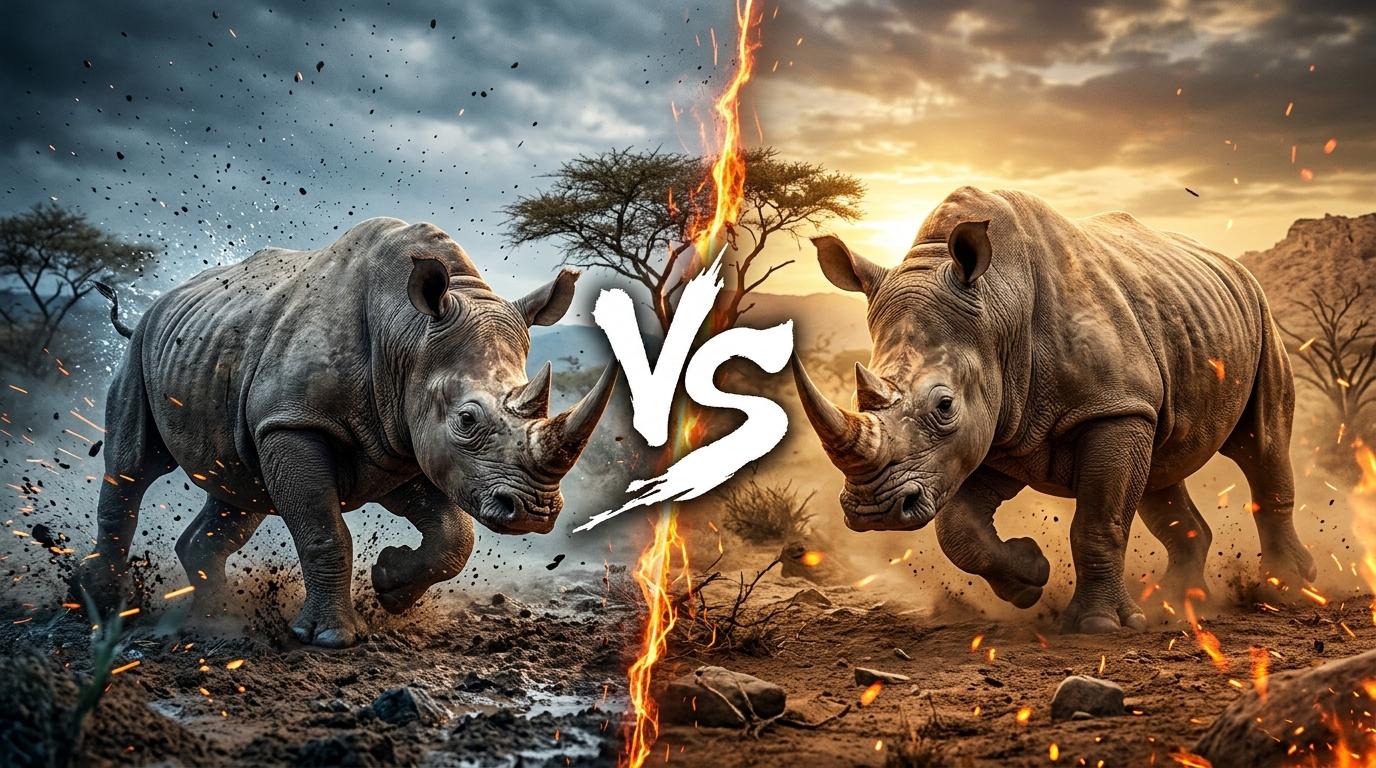
Black Rhinoceros vs White Rhinoceros: Who Actually Wins?
The White Rhinoceros wins most serious fights, though not by a landslide. A mature white rhino bull typically weighs about 1,800 to 2,300 kg, roughly 1.5 to 2 times the mass of a black rhino bull at about 800 to 1,400 kg. It also tends to carry a longer front horn and a broad, low-slung frame built for shoving. The Black Rhinoceros is the more volatile, quicker-turning and more fight-practiced species. Black rhinos have one of the highest rates of fatal combat injury of any large mammal, and they can open with a ferocious first charge. But in a sustained horn-to-horn contest, momentum and sheer weight decide who gets pushed off balance and who gets gored in the flank. Expect the black rhino to win the opening seconds and the white rhino to win the fight.
Read comparison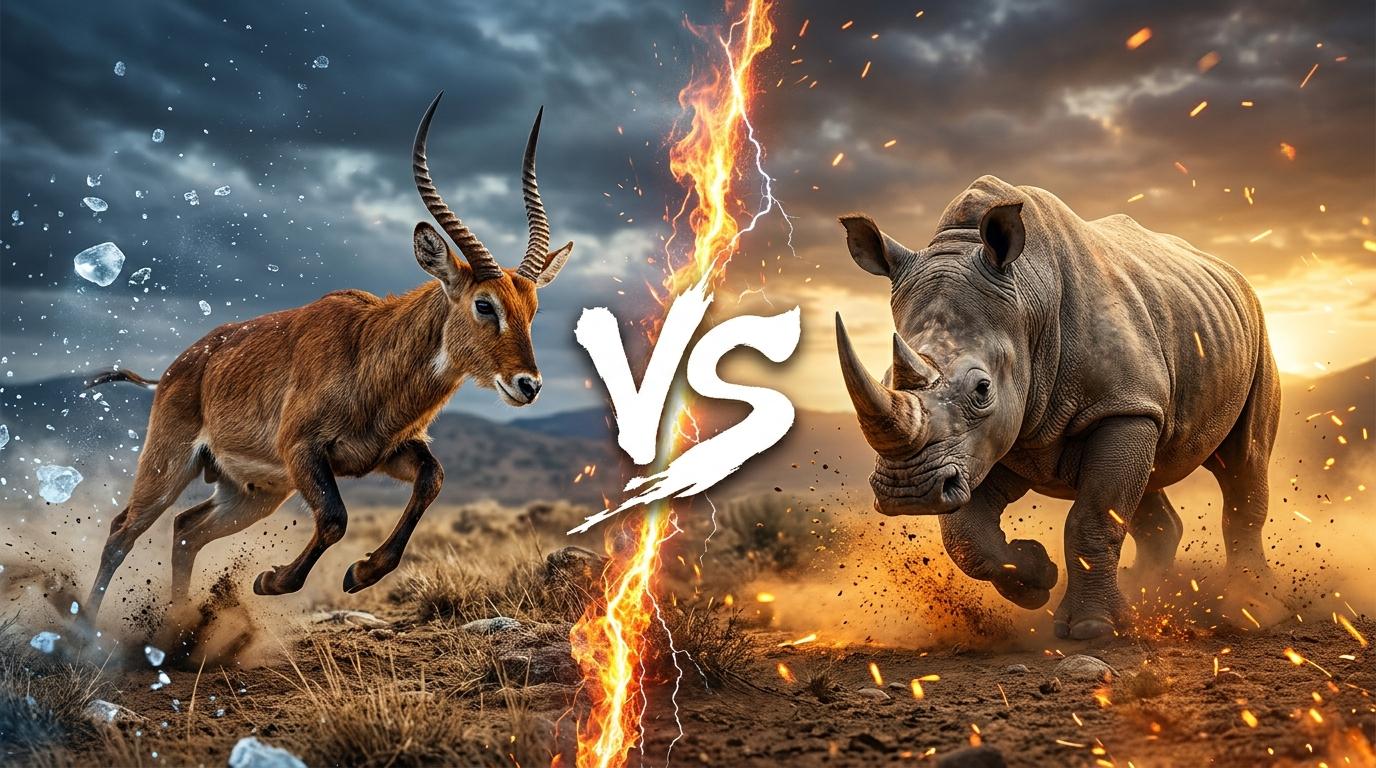
Puku vs White Rhinoceros: Who Actually Wins?
The white rhinoceros wins, and it is not close in a direct confrontation. An adult white rhino weighs roughly 1,800–2,500 kg against a puku's 60–90 kg, which is a mass gap of more than twenty to one. The rhino also carries a front horn that can exceed 60 cm, a thick dermal shield, and the ability to charge at around 40 km/h over short bursts. The puku is a wetland-edge antelope built for vigilance, quick acceleration and escape. Only males carry horns, and those are ridged and used mainly in ritual sparring with other puku. Whenever the question is who controls the space, the rhino owns it. The puku's real victory condition is never fighting at all: it reads the threat early and leaves.
Read comparison
Discussion
What do you think?
Share your reasoning with other readers. Be civil and stick to the animals.
Sign in to join the discussion.
Sign inNo comments yet. Start the conversation.