

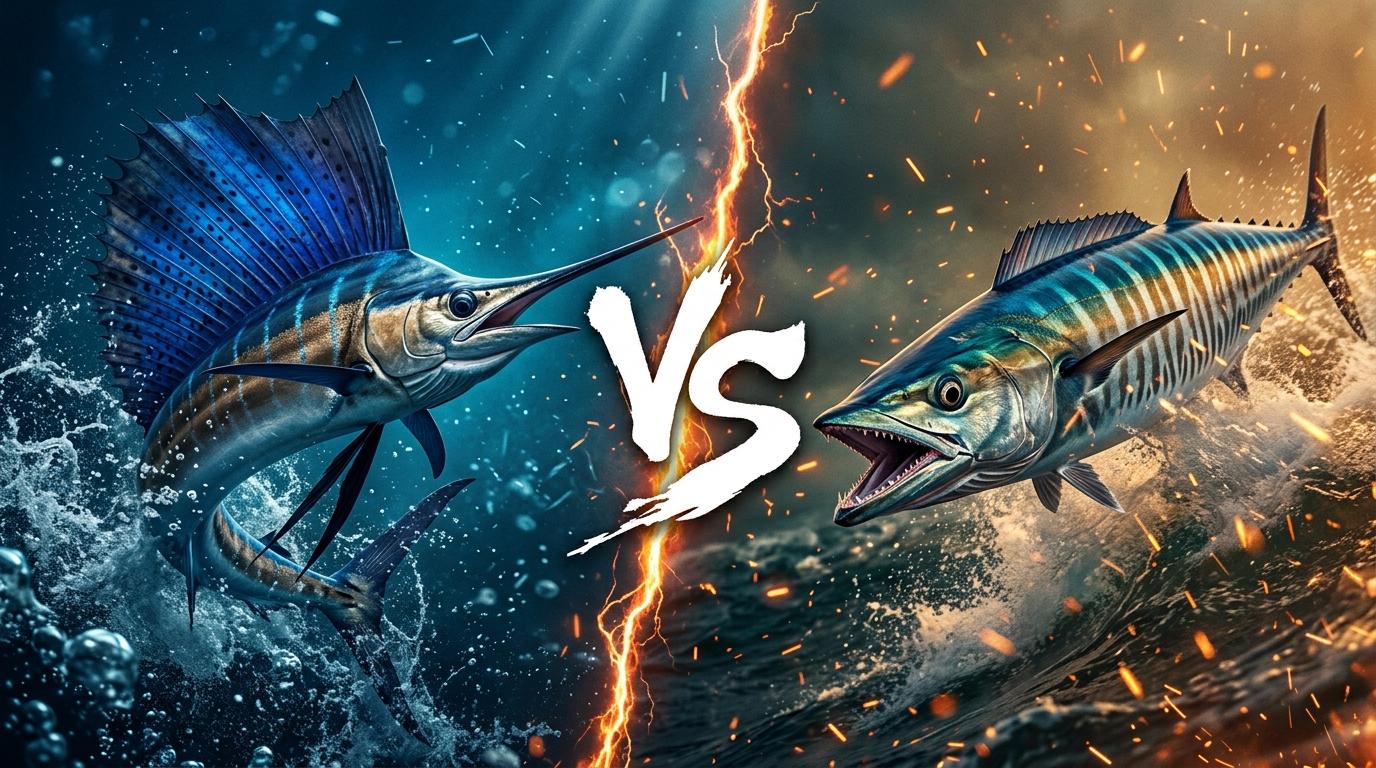
Sailfish vs Wahoo: Who Actually Wins?
Sailfish vs wahoo: a biology-first breakdown of size, bill, speed, bite, and stamina to decide which ocean speedster wins a head-to-head clash.
Sailfish vs Wahoo
Matchup winner
Sailfish
Quick verdict
Start with the direct answer, then use the structured comparison below to see what changes the outcome.
The sailfish wins most realistic confrontations. It is the larger animal, often 1.5–3 m including its bill and up to around 90 kg, against a wahoo that typically runs 1–2 m and 15–40 kg. It also carries a reach weapon the wahoo cannot match. The sailfish's rostrum is built to slash and stun, and its raised sail lets it brake, turn, and loom bigger than it is. The wahoo is a true sprint specialist with razor-edged, interlocking teeth that can shear flesh in a single pass. But its strategy is hit-and-run predation on smaller fish, not sustained combat against a heavier, armed billfish. In a contest of mass, reach, and maneuvering control, the sailfish holds more of the decisive cards. The wahoo's best outcome is a quick slashing bite followed by disengagement, which is a draw-or-escape plan rather than a win condition.
Read the full explanation
Winner: Sailfish, thanks to its larger body, longer reach, and a bill evolved to strike.
The wahoo is likely quicker in a straight-line burst and has the more dangerous bite.
The sailfish's sail and bill give it braking, turning, and stunning tools the wahoo lacks.
In open water the wahoo can simply refuse the fight. When forced to engage, the sailfish usually prevails.
Reader vote
Who do you think wins?
Pick a side — no account needed. Results update live.
No votes yet — be the first to call it.
Editorial note
Why people disagree
Speed rankings are messy. The famous 110 km/h sailfish figure is widely disputed, and wahoo bursts near 75–80 km/h are better supported, so many readers assume the wahoo is the faster, stronger fish.
Body mass and frame
In fish-on-fish contact, mass decides who gets shoved off line and who holds position.
Reach weaponry
The bill lets the sailfish strike before the wahoo's mouth is in range.
Shearing bite
One clean wahoo pass can cause a serious wound. It is the loser's most credible threat.
Read the full explanation +
The wahoo's teeth look far scarier than a bill. But a bite needs closing distance, and the bill reaches first.
Neither species naturally hunts the other, so any 'fight' is hypothetical. Avoidance often matters more than offense.
Comparison FAQ
Short, direct answers to the next questions readers usually ask after the headline verdict.
Would a sailfish beat a wahoo in a fight?+
Usually yes. Its larger size, bill reach, and maneuvering control give it the edge in a sustained encounter.
Which is stronger, a sailfish or a wahoo?+
The sailfish is generally stronger overall because it is heavier and more powerfully built. The wahoo is strong for its size and explosively fast.
Is a wahoo faster than a sailfish?+
Probably in measured bursts. Sailfish speed claims of 110 km/h are disputed, while wahoo sprints near 75–80 km/h are well supported.
Why is the wahoo still dangerous to a sailfish?+
Its razor-edged teeth can inflict deep wounds in one pass, and its speed lets it strike and escape before the sailfish can bring its bill around.
Do sailfish and wahoo fight in the wild?+
Rarely, if ever, as rivals. They share warm offshore waters and prey, so any interaction is more likely competition at feeding sites than direct combat.
Head-to-head species stats
These are the same core AnimalDex stat dimensions used on the dedicated animal pages, pulled side by side so the matchup is faster to scan.
Sailfish
Tier BWahoo
Tier CTrait-by-trait comparison
Only the categories that matter to this matchup are included. The goal is not filler stats, but the real design differences that change the result.
Up to ~90 kg, deep laterally compressed body
Body mass and frame
Sailfish
Typically 15–40 kg, slim torpedo
Body mass and frame
Sailfish
Long rostrum used to slash and stun
Reach weaponry
Sailfish
No reach tool, must close to bite
Reach weaponry
Sailfish
Small rasp-like teeth, gripping only
Shearing bite
Wahoo
Scalpel-edged, tightly packed teeth that shear
Shearing bite
Wahoo
Very fast, but top-speed claims are contested
Straight-line burst
Wahoo
Elite sprinter with a deeply forked tail
Straight-line burst
Wahoo
Sail and fins act as brakes and rudders
Maneuver control
Sailfish
Built for straight runs, wider turns
Maneuver control
Sailfish
Raised sail roughly doubles apparent size
Intimidation display
Sailfish
Minimal display, relies on speed
Intimidation display
Sailfish
How the verdict forms
Verdict timeline
01 · Body mass and frame
Sailfish
02 · Reach weaponry
Sailfish
03 · Shearing bite
Wahoo
04 · Straight-line burst
Wahoo
05 · Maneuver control
Sailfish
06 · Intimidation display
Sailfish
Change the conditions
Scenario breakdown
This is where shallow battle content usually fails. Terrain, spacing, timing, and engagement style can change the answer.
Scenario lean
Sailfish
Verdict confidence
82%
Sailfish controls the space.
When neither fish can flee, mass and reach dominate. The sailfish can brake hard with its sail, keep its bill oriented, and slash repeatedly. The wahoo has to cross the bill's arc to bite, so it absorbs strikes on every approach.
AnimalDex field profiles
Explore these animals
Sailfish
Istiophorus platypterus
warm ocean surface waters and offshore pelagic zones
Wahoo
Acanthocybium solandri
bluewater current, offshore reef edge, and pelagic sea
Systems Intelligence & Hidden Purpose
See the animals behind this comparison as engineered biological systems: what each one is built to do, where it gains leverage, and why the matchup changes by scenario.
Specialized Hardware
towering dorsal sail, high-speed open-water pursuit, and bill used in coordinated feeding give the Sailfish a body plan tuned for its niche.
Systems Script
Sailfishs operate through warm ocean surface waters and offshore pelagic zones Their design links movement, shelter, and feeding into one workable survival system.
Strategic Insight
At high speed, even small design advantages compound quickly.
Specialized Hardware
torpedo-shaped blue body, tiger-like flank bars, and blistering open-water chase give the Wahoo a body plan tuned for its niche.
Systems Script
Wahoos operate through bluewater current, offshore reef edge, and pelagic sea. Their design links movement, feeding, shelter, and timing into one workable survival system.
Strategic Insight
In moving water, the best systems use flow, visibility, and depth instead of fighting every current.
Final take
The sailfish is the more complete combatant. It brings more mass, a weapon with reach, and the braking and turning control needed to keep that weapon aimed. The wahoo is the purer athlete, faster in a straight line and armed with one of the ocean's sharpest bites.
Read the full explanation
Most forced matchups favor the sailfish, while open water favors the wahoo's choice to avoid the fight. Our overall pick is the sailfish at about 70% confidence. Respect the wahoo's first strike, but bet on the billfish.
Collect both animals in AnimalDex
Track the species behind this matchup, compare their real traits, and build the rivalry into your AnimalDex collection.
Related comparisons
Continue with nearby matchups to compare more real-world animal traits without dropping into junky who-wins filler.
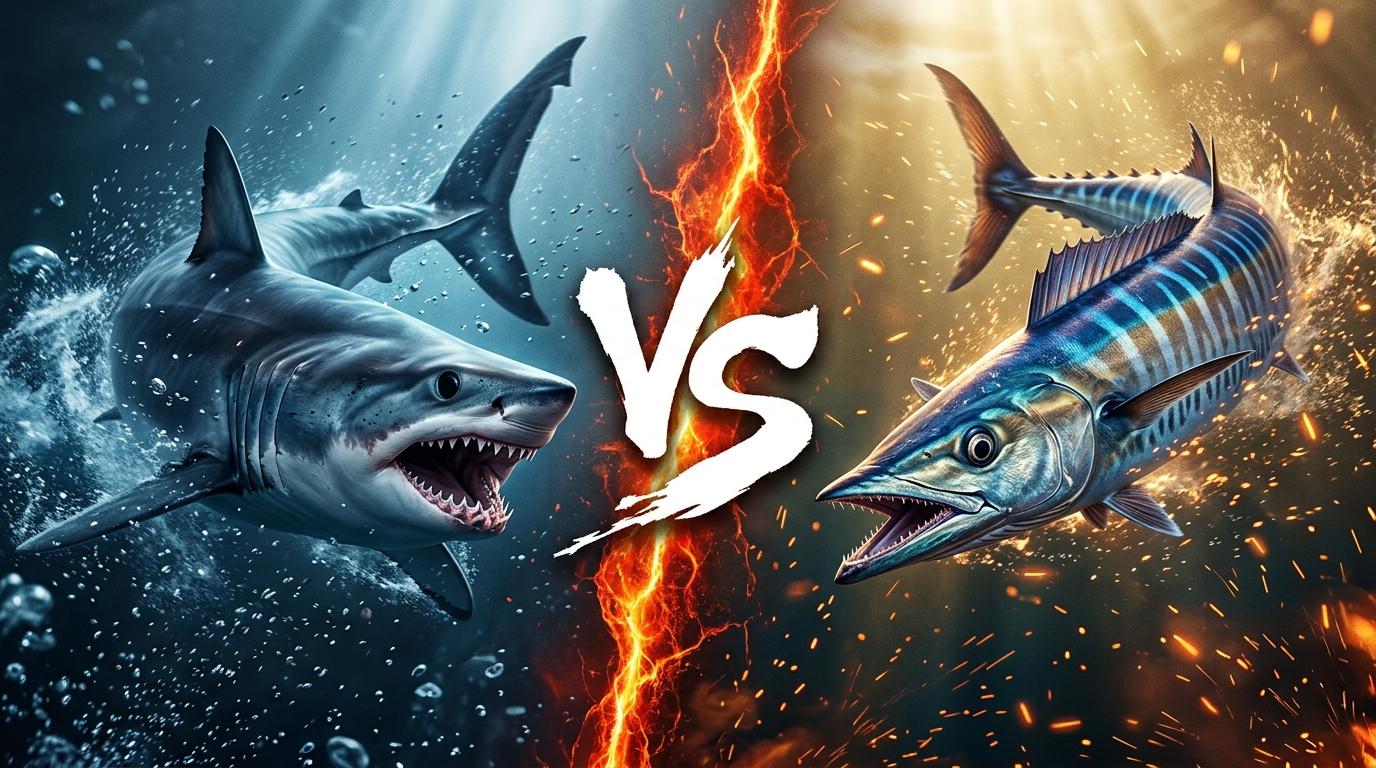
Shortfin Mako vs Wahoo: Who Actually Wins?
The shortfin mako wins, and it is not especially close once contact happens. Both are elite open-ocean sprinters. The wahoo may match or edge the mako in short straight-line bursts, and it has a mouth full of razor-edged teeth. But the mako is a regionally endothermic shark that can outweigh a large wahoo several times over, with a jaw built to seize and shear large, fast fish. Wahoo is the bigger fish's prey archetype, not its rival. Makos are known to eat fast pelagic fish such as tuna and billfish, and a wahoo fits that menu. The wahoo's best outcome is escape, not victory.
Read comparison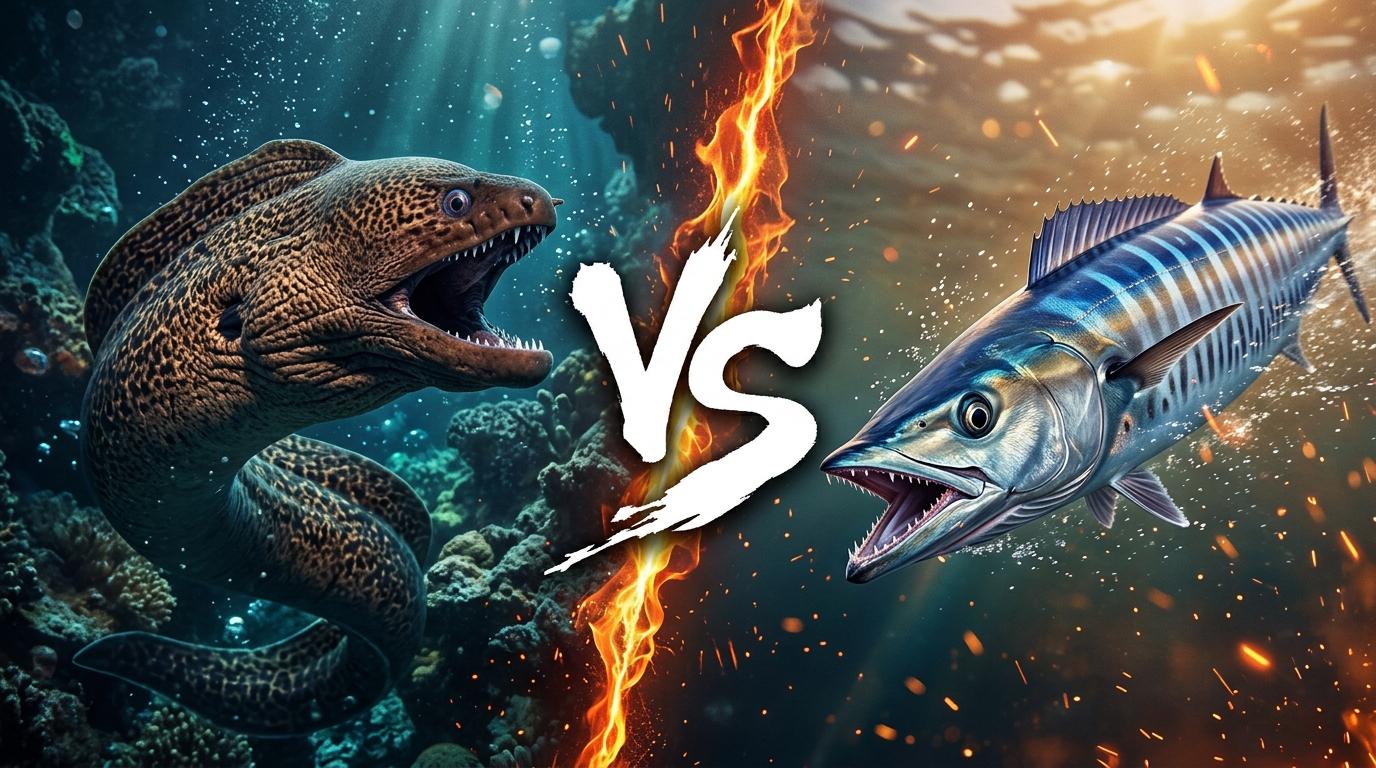
Giant Moray vs Wahoo: Who Actually Wins?
The giant moray wins a real confrontation. At up to roughly 3 m and well over 30 kg, Gymnothorax javanicus carries more mass and a thick, muscular body. It also has a second set of pharyngeal jaws that drag prey inward once its fanged front jaws close. It can also spin its whole body to tear food apart. The wahoo is a 60+ mph-class burst specialist with razor-edged, tightly packed teeth built for slashing schooling fish at speed, not for grappling an armored, snake-bodied opponent. Any engagement close enough to count happens on the moray's terms: near structure, at short range, where one bite and a twist decides things. The wahoo's real advantage is that it never has to show up.
Read comparison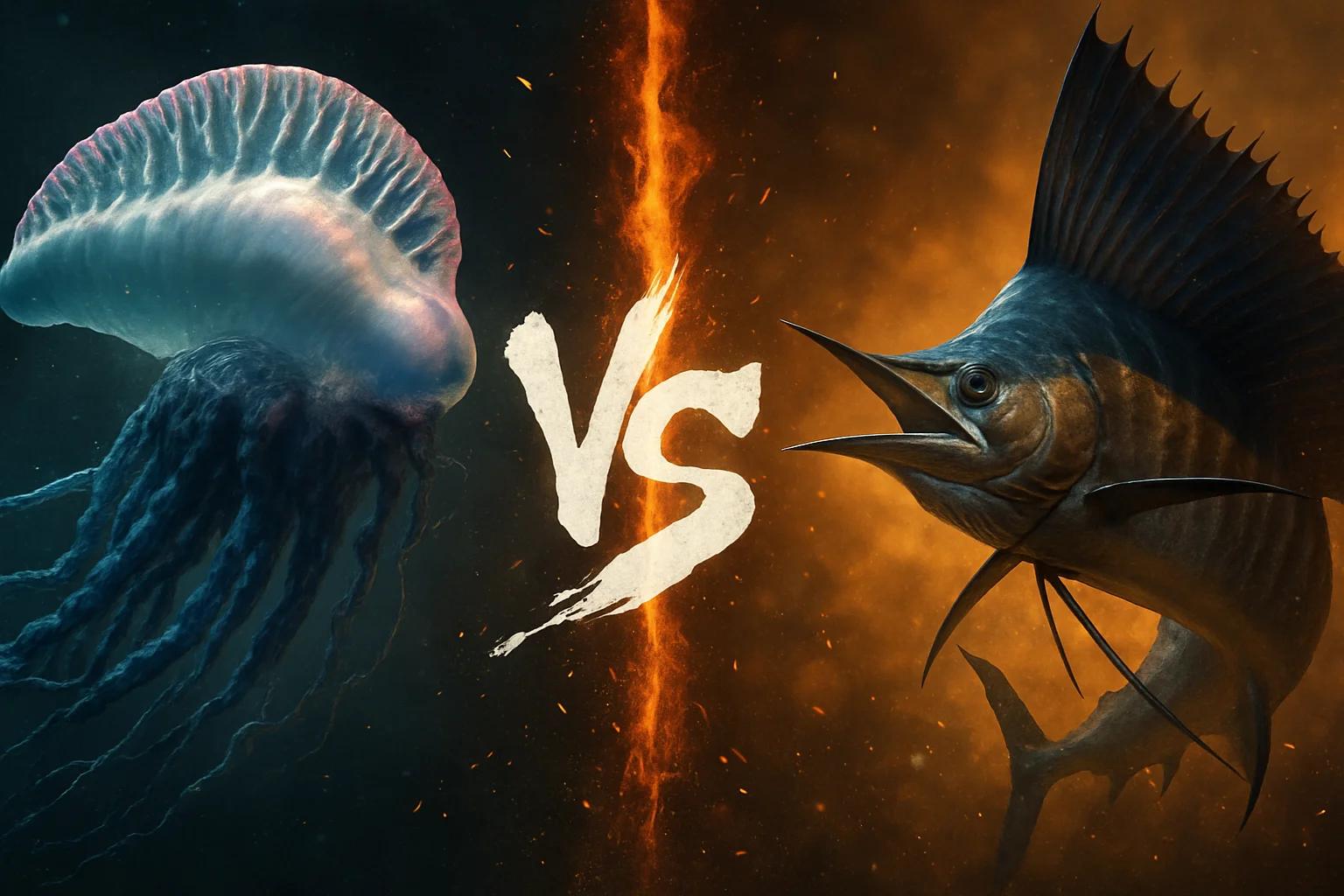
Portuguese Man o' War vs Sailfish: Who Actually Wins?
The sailfish wins, and it isn't close. A Portuguese man o' war is a siphonophore, a floating colony of specialized zooids that cannot steer itself. It drifts on a gas-filled float, pushed by wind, and catches only what blunders into its trailing tentacles. Those tentacles can reach 10 meters or more and carry nematocysts, stinging cells that fire venom on contact and paralyze small fish. A sailfish is a 2–3 meter predator built for burst speed, maneuvering and choosing where it goes. It also has the eyes and judgment to stay away from things that sting. The man o' war can't chase, can't aim and can't force an engagement. The sailfish decides whether contact happens at all. The real danger is accidental: a juvenile sailfish or a careless lunge through a tentacle curtain can end badly. An adult sailfish that keeps its distance takes no damage and can leave whenever it likes.
Read comparison
Oceanic Whitetip Shark vs Sailfish: Who Actually Wins?
The oceanic whitetip shark wins a committed fight. It is typically far heavier than a sailfish, often around 70–170 kg against roughly 25–60 kg. It carries a serrated, prey-processing bite, a cartilage-and-dermal-denticle body built to absorb contact, and the dogged, opportunistic temperament that makes it one of the open ocean's most persistent hunters. The sailfish is the better sprinter and the more agile turner. Its bill is a real tool, but evolution shaped it to slash and stun small schooling fish, not to win sustained combat against a large predator. If the sailfish keeps its distance, it escapes. If the encounter becomes physical, the whitetip's mass and jaws decide it.
Read comparison
Discussion
What do you think?
Share your reasoning with other readers. Be civil and stick to the animals.
Sign in to join the discussion.
Sign inNo comments yet. Start the conversation.