

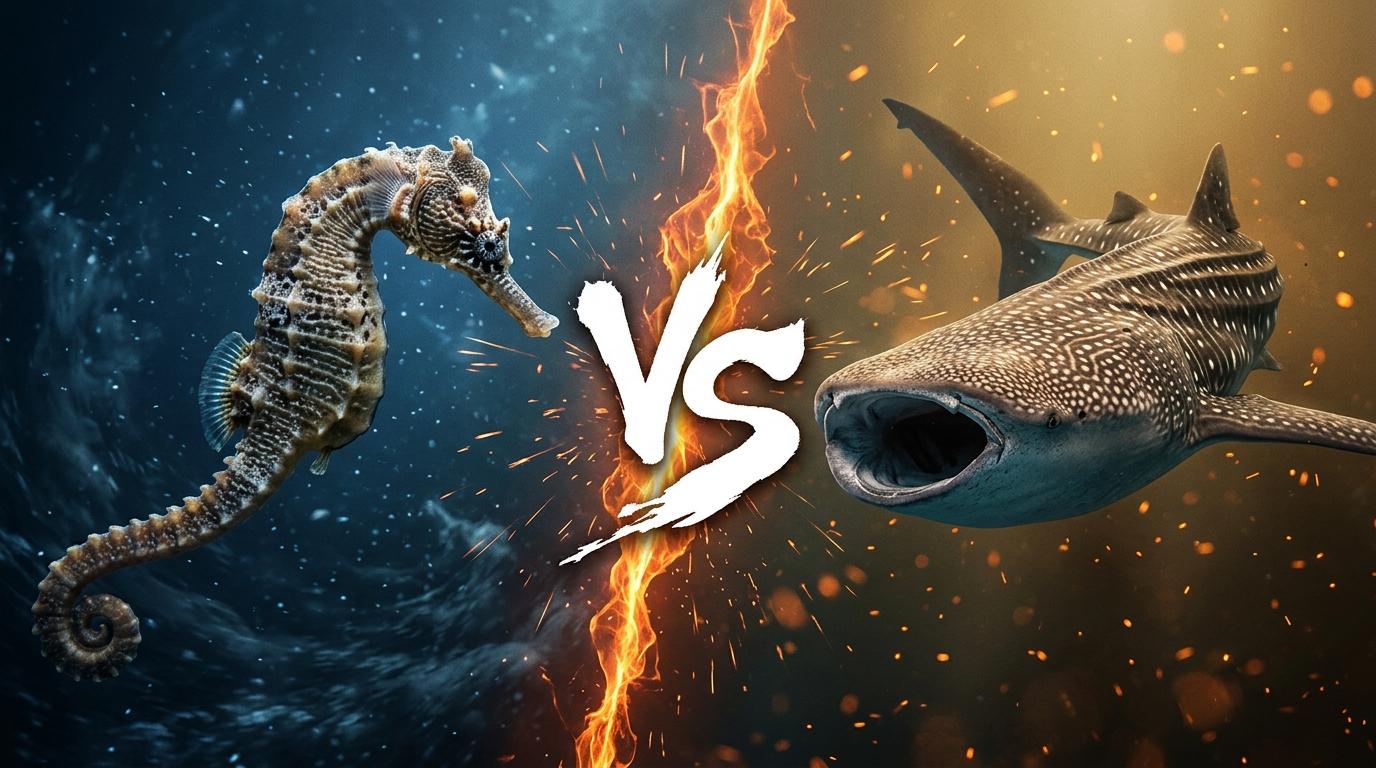
Seahorse vs Whale Shark: Who Actually Wins?
Seahorse vs whale shark: who would win? A biology-first look at size, armor, camouflage, and why the world's largest fish takes this mismatch.
Seahorse vs Whale Shark
Matchup winner
Whale Shark
Quick verdict
Start with the direct answer, then use the structured comparison below to see what changes the outcome.
The whale shark wins clearly. At up to roughly 12–18 meters and many tonnes, the world's largest fish outweighs a typical seahorse by a factor of millions, so any real contest is decided by mass, momentum, and reach rather than tactics. Neither animal is a fighter. The whale shark is a slow, gentle filter feeder, and the seahorse is a tiny ambush sipper of plankton. The seahorse's genuine strengths are bony plate armor, superb camouflage, and a tail that anchors it to seagrass. Those traits help it avoid an encounter, but they cannot win one. If the two meet in open water, the whale shark controls the space simply by existing in it. The seahorse's only 'victory' is staying hidden.
Read the full explanation
Whale shark wins: its size advantage is almost incomprehensible.
Neither animal is aggressive, so a 'fight' is really a question of displacement and survival.
The seahorse's best move is camouflage in cover, not confrontation.
In open water, the whale shark's bulk and filter-feeding gape decide everything.
Reader vote
Who do you think wins?
Pick a side — no account needed. Results update live.
No votes yet — be the first to call it.
Editorial note
Why people disagree
Some readers score a 'win' as surviving, and a seahorse hidden in seagrass does survive, which feels like a technical win.
Sheer mass
Mass is the decisive variable. The whale shark can displace, push, or engulf without trying.
Armor plating
Seahorse armor is excellent for its size, but whale shark skin is several centimeters thick and shrugs off most threats.
Ambush control
The seahorse is one of the fastest striking feeders in the sea, but only at plankton scale.
Read the full explanation +
Whale sharks are famously gentle, so people question whether a harmless giant can 'win' anything at all.
The seahorse's armor and lightning-fast head strike sound formidable until you remember they work against copepods, not titans.
Comparison FAQ
Short, direct answers to the next questions readers usually ask after the headline verdict.
Would a seahorse beat a whale shark?+
No. The whale shark outweighs a seahorse by millions of times. The seahorse cannot injure it and cannot outswim it in open water.
Which is stronger, a seahorse or a whale shark?+
The whale shark, by an enormous margin. A seahorse is strong for its size, mainly in its gripping tail, but it cannot compare in absolute strength.
Would a whale shark attack a seahorse?+
Not deliberately. Whale sharks filter-feed on plankton, fish eggs, and small fish. A seahorse would only be at risk of being swept in incidentally.
Why does the seahorse still matter in this matchup?+
Its camouflage and tail-anchoring let it avoid encounters entirely. Its pivot-feeding strike also makes it a deadly hunter of tiny crustaceans. It is a formidable predator at its own scale and very hard to find.
Is either animal dangerous to humans?+
No. Both are harmless to people. Whale sharks are popular with swimmers and divers precisely because they are docile.
Head-to-head species stats
These are the same core AnimalDex stat dimensions used on the dedicated animal pages, pulled side by side so the matchup is faster to scan.
Seahorse
Tier CWhale Shark
Tier CTrait-by-trait comparison
Only the categories that matter to this matchup are included. The goal is not filler stats, but the real design differences that change the result.
A few grams to tens of grams
Sheer mass
Whale Shark
Multi-tonne, largest living fish
Sheer mass
Whale Shark
Bony plates under the skin
Armor plating
Whale Shark
Very thick skin, among the thickest of any animal
Armor plating
Whale Shark
Pivot-feeding strike in milliseconds
Ambush control
Seahorse
Slow, continuous filter feeding
Ambush control
Seahorse
Color change, skin filaments, tail-anchoring
Concealment
Seahorse
Impossible to hide; relies on size
Concealment
Seahorse
Among the slowest swimming fish
Open-water cruising
Whale Shark
Steady long-distance migrant
Open-water cruising
Whale Shark
Tubular snout for tiny prey
Engulfing reach
Whale Shark
Mouth over a meter wide
Engulfing reach
Whale Shark
How the verdict forms
Verdict timeline
01 · Sheer mass
Whale Shark
02 · Armor plating
Whale Shark
03 · Ambush control
Seahorse
04 · Concealment
Seahorse
05 · Open-water cruising
Whale Shark
06 · Engulfing reach
Whale Shark
Change the conditions
Scenario breakdown
This is where shallow battle content usually fails. Terrain, spacing, timing, and engagement style can change the answer.
Scenario lean
Seahorse
Verdict confidence
82%
The seahorse survives by vanishing.
In dense seagrass or coral, the seahorse anchors its prehensile tail, matches its surroundings, and becomes practically invisible. A whale shark rarely feeds in such tight, shallow structure. Here, avoidance counts as a win, and concealment beats mass because mass never gets to engage.
AnimalDex field profiles
Explore these animals
Seahorse
Hippocampus spp.
Seagrass beds, mangroves, estuaries, and sheltered coral or sponge habitats.
Whale Shark
Rhincodon typus
Warm coastal waters, offshore fronts, reefs, and seasonal plankton aggregation sites.
Systems Intelligence & Hidden Purpose
See the animals behind this comparison as engineered biological systems: what each one is built to do, where it gains leverage, and why the matchup changes by scenario.
Specialized Hardware
Prehensile tail, independently moving eyes, and suction feeding snout make seahorses precision hardware for structured shallow waters.
Systems Script
Seahorses patrol seagrass and reef-edge habitats by anchoring themselves in moving water and striking tiny prey with minimal motion. Their design is strange only if you expect speed to solve everything.
Strategic Insight
Stability can be the enabling technology that makes precision possible.
Specialized Hardware
An enormous mouth, fine filtering structures, and low-cost cruising mechanics allow the whale shark to process huge volumes of plankton-rich water without high-speed pursuit.
Systems Script
Whale sharks connect surface productivity to larger marine food webs by converting diffuse plankton pulses into mobile biomass. Their movement patterns also mark productive ocean zones where energy concentrates seasonally.
Strategic Insight
Scale does not always come from chasing more targets. Sometimes it comes from building a system that can process volume efficiently once the flow arrives.
Final take
The whale shark wins this matchup decisively. It is not ferocious. It is the largest fish on Earth, and the seahorse is among the smallest and slowest. Size is the ruling principle in any physical contest, and here the gap is beyond extreme.
Read the full explanation
The seahorse still deserves respect. Its armor, camouflage, and record-fast feeding strike make it a master of survival at its own scale. In a seagrass bed, it 'wins' by never being found. In any setting where the two actually meet, though, the gentle giant takes it.
Collect both animals in AnimalDex
Track the species behind this matchup, compare their real traits, and build the rivalry into your AnimalDex collection.
Related comparisons
Continue with nearby matchups to compare more real-world animal traits without dropping into junky who-wins filler.
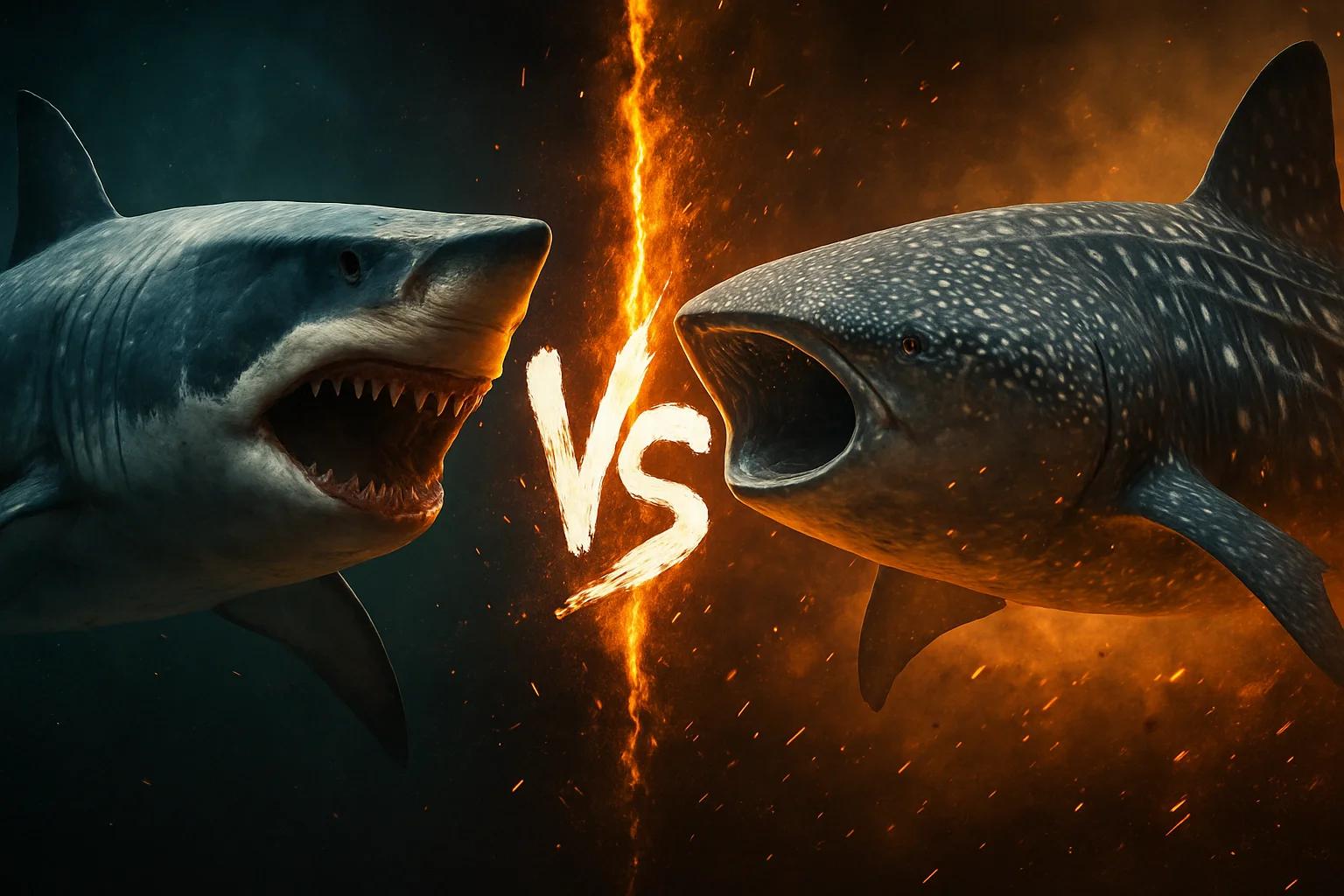
Great White Shark vs Whale Shark: Who Actually Wins?
The great white shark wins this matchup in any frame that counts as a contest, though it would almost never finish one. A whale shark can reach 12–18 m and well over 15 tonnes, which makes it many times heavier than a 4–6 m great white. But the whale shark is a filter feeder. It has thousands of tiny vestigial teeth, no bite worth the name, a cruising speed of about 5 km/h, and no behavioral program for fighting back. The great white brings serrated cutting teeth, burst speed over 35 km/h, a warm-bodied engine and an ambush instinct tuned for big prey. In a forced clash only one animal can inflict wounds. The whale shark's real defenses are sheer bulk and skin up to about 10 cm thick, among the thickest of any animal, and those make it very hard to kill. The great white decides whether damage happens, so it controls the encounter. The whale shark's best result is walking away by simply out-enduring the attack.
Read comparison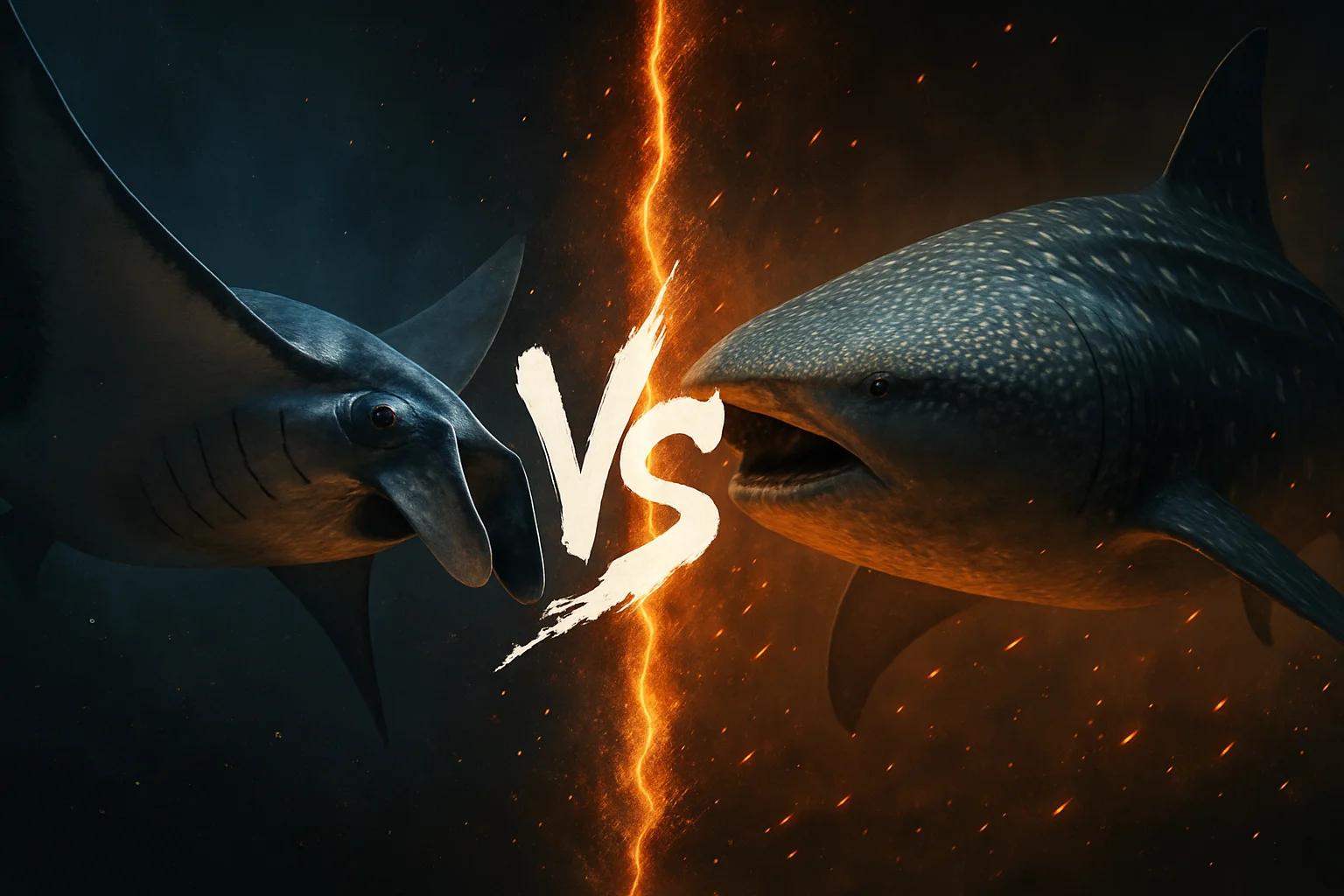
Manta Ray vs Whale Shark: Who Actually Wins?
The whale shark wins, and it is not especially close on raw physics. Neither animal is built to fight. Both are plankton-straining filter feeders with no meaningful bite and no weaponry; the giant manta does not even carry the venomous tail barb its stingray relatives are known for. That turns any confrontation into a contest of mass, momentum and armor, and the whale shark dominates all three. The largest fish alive commonly reaches about 12 meters and can weigh well over 15 tonnes. It is wrapped in skin reported up to roughly 10 centimeters thick, among the thickest of any animal. A large manta can span about 7 meters wingtip to wingtip but weighs roughly 2 tonnes, and it has nothing that can get through that hide. The manta is smarter, faster on the turn and far more agile, so it decides whether contact happens at all. Once contact does happen, the whale shark simply outweighs and out-armors it.
Read comparison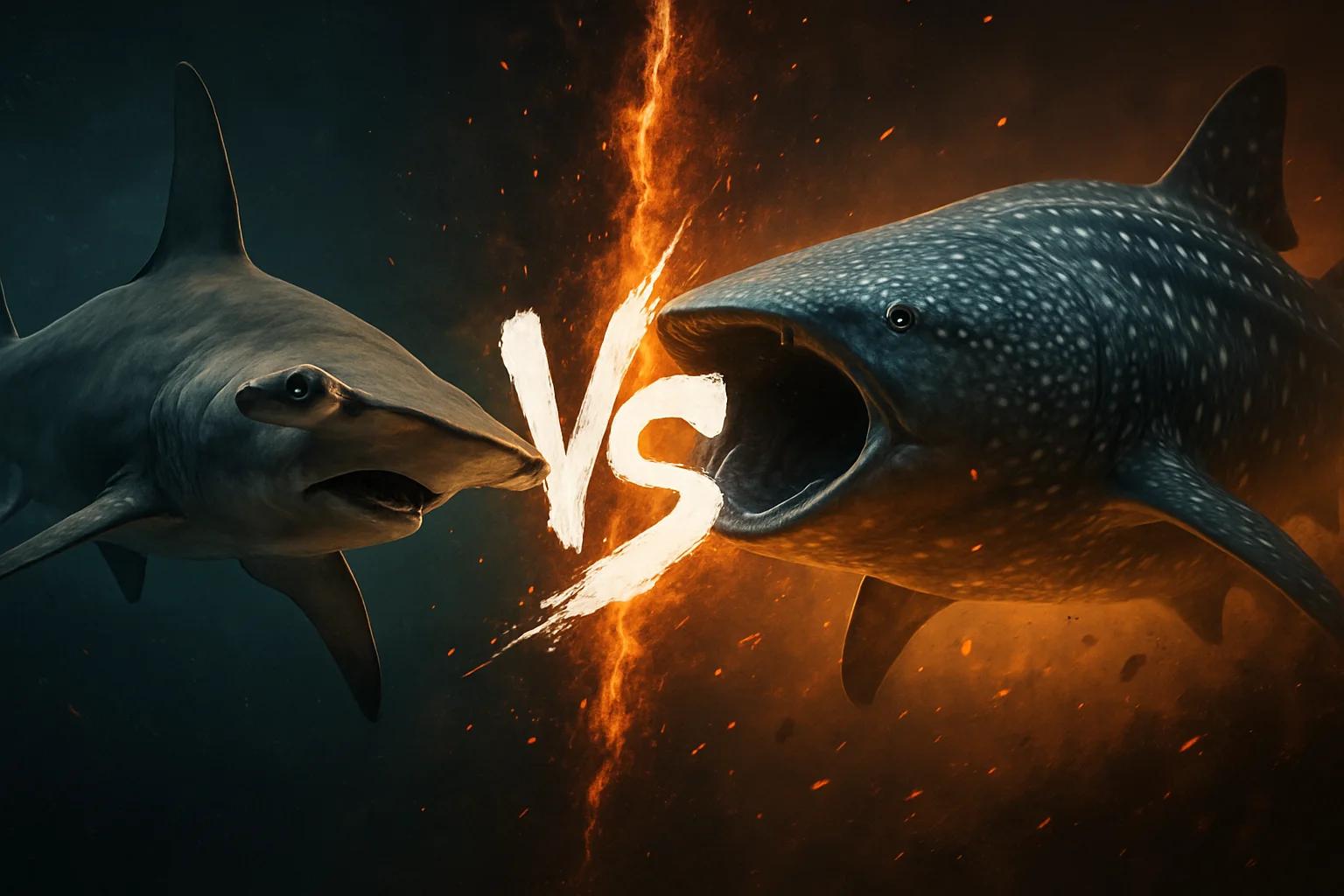
Scalloped Hammerhead vs Whale Shark: Who Actually Wins?
The whale shark wins, and not narrowly. A scalloped hammerhead is a capable predator, usually 2–3 m long, with a sensor-packed head, good acceleration, and a mouth built for squid and reef fish. A whale shark is the largest fish on Earth, commonly 5.5–10 m and sometimes more, with skin roughly 10 cm thick and a body mass more than 50 times greater. The hammerhead has no tool that can reach anything vital. Its bite is sized for prey it can swallow, and against a whale shark it would barely mark the hide. The whale shark is a harmless filter feeder with tiny, useless teeth, so it won't 'win' by killing anything. It wins by being impossible to beat. The hammerhead runs out of options long before the whale shark runs out of body. The only real exception is a newborn or very small juvenile whale shark, which is vulnerable to predatory sharks.
Read comparison
Discussion
What do you think?
Share your reasoning with other readers. Be civil and stick to the animals.
Sign in to join the discussion.
Sign inNo comments yet. Start the conversation.