
Animal field guide
Black-winged Stilt
Himantopus himantopus
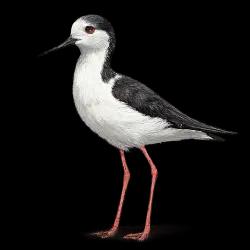
Relative to body size, few birds have longer legs. Thin and bright pink, they let this black-and-white wader walk into water deeper than most shorebirds can use.
Black-winged Stilt at a glance
Animal · Europe · Shallow fresh · Relatively common
Known for: Straight, Black wings contrasting with white body, White wedge up the back, Red eyes in adults
Its Power
Precision Foraging
Focus on the task at hand and execute with precision.
The Black-winged Stilt uses its long legs and slender bill to forage with remarkable accuracy in shallow waters, demonstrating the power of precision in achieving goals.
“Precision in Action.”
Capture a Black-winged Stilt, and it's yours when you finish one step it gives you.
Biological basis
Black-winged Stilts are known for their ability to forage in shallow waters with precision, using their long legs and slender bills to catch small aquatic prey.
Put it into practice
A tailor ignores the shop chatter and places each stitch exactly where the chalk line runs.
What does the black-winged stilt symbolize?
The black-winged stilt symbolizes precision foraging: focus on the task at hand and execute with precision. It represents precision, focus and efficiency. Its AnimalDex motto: "Precision in Action."
The black-winged stilt as a spirit animal
If the black-winged stilt is your spirit animal, the AnimalDex reading is Precision Foraging: the Black-winged Stilt uses its long legs and slender bill to forage with remarkable accuracy in shallow waters, demonstrating the power of precision in achieving goals. It suggests a strength in precision and focus, and a reminder to use it on purpose.
What can the black-winged stilt help you with in life?
The black-winged stilt is a guide for precision, focus and efficiency. Its lesson applies wherever precision matters: the Black-winged Stilt uses its long legs and slender bill to forage with remarkable accuracy in shallow waters, demonstrating the power of precision in achieving goals.
- Precision
- Focus
- Efficiency
In practice: A tailor ignores the shop chatter and places each stitch exactly where the chalk line runs.
What can we learn from the Black-winged Stilt?What does it mean to dream about or encounter a wild black-winged stilt?
A wild black-winged stilt, whether in a dream or in front of you, tends to show up when precision or focus is on your mind. In AnimalDex, the black-winged stilt's principle is Precision Foraging: focus on the task at hand and execute with precision. Read the moment through its core lesson: The Black-winged Stilt uses its long legs and slender bill to forage with remarkable accuracy in shallow waters, demonstrating the power of precision in achieving goals.
Neither good nor bad on its own. How the black-winged stilt acts matters: at ease, it reflects precision; hostile, it flags precision out of balance.
Spotting a black-winged stilt in the wild
If a black-winged stilt crosses your path, take it as a cue to look at where precision fits your day. Its AnimalDex motto: "Precision in Action."
A black-winged stilt that keeps appearing
Seeing the black-winged stilt again and again, in dreams or outside, suggests precision is a theme you have not settled yet.
Dreaming of being chased by a black-winged stilt
Being chased suggests you are avoiding the Precision Foraging the black-winged stilt stands for: the Black-winged Stilt uses its long legs and slender bill to forage with remarkable accuracy in shallow waters, demonstrating the power of precision in achieving goals. Ask what you keep postponing that needs precision.
Dreaming that a black-winged stilt attacks you
When the black-winged stilt attacks, the dream may be about pressure: focus or efficiency applied too hard, by you or by someone close to you.
A calm or friendly black-winged stilt
Meeting a peaceful black-winged stilt is usually encouraging: focus and efficiency are within reach.
A dead or injured black-winged stilt
Seeing the black-winged stilt hurt may point to focus that has been neglected. Ask what it would take to restore it.
These readings are reflective prompts drawn from how the black-winged stilt really lives, not predictions. If you meet one in the wild, watch from a distance and leave it undisturbed.
Capture your own Black-winged Stilt
Photograph or film one in the wild, at a zoo or at home with the app. It becomes yours: it remembers you, gives you steps, and can debate your problems with your other animals.
Animal field guide
Black-winged Stilt
Sign in to hear this read by a natural AI voice instead of your browser's.
Relative to body size, few birds have longer legs. Thin and bright pink, they let this black-and-white wader walk into water deeper than most shorebirds can use.
Native range
Natural range, not this capture location
Shallow fresh, brackish and salt water with open margins: saltpans, lagoons, marshes, flooded fields, rice paddies and sewage ponds, mostly in lowlands from southern Europe through sub-Saharan Africa to southern and South-East Asia.
Search near meAnimalDex stats
Size scale
Understand the animal
Understand the Black-winged Stilt
Factual biology first: what this animal is like, where it lives, how it survives, and why those traits exist.
01
Introduction to Black-winged Stilt
Relative to body size, few birds have longer legs. Thin and bright pink, they let this black-and-white wader walk into water deeper than most shorebirds can use.
How to identify a Black-winged Stilt
- Straight, needle-thin black bill
- Black wings contrasting with white body
- White wedge up the back, visible in flight
- Red eyes in adults
Why Black-winged Stilt are interesting
- Northern populations migrate south for winter, while many tropical birds stay put or move with the rains.
- In recent decades it has bred occasionally in southern England, well north of its usual nesting range.
- Birds quickly move in to newly flooded or temporary wetlands, following short-lived pulses of aquatic insects.
- The name Himantopus comes from Greek words meaning strap foot, after the long, thin legs.
02
Adaptations and biological abilities
03
Why does Black-winged Stilt behave this way?
- Straight, needle-thin black bill
- Black wings contrasting with white body
- White wedge up the back, visible in flight
- Red eyes in adults
Feeds mostly by day but also on moonlit nights. Rests in flocks standing in shallow water or on mud, often on one leg with the bill tucked into the back feathers.
04
Why Shallow fresh?
Habitat: Shallow fresh, brackish and salt water with open margins: saltpans, lagoons, marshes, flooded fields, rice paddies and sewage ponds, mostly in lowlands from southern Europe through sub-Saharan Africa to southern and South-East Asia.
Native range: Europe, Sub-Saharan Africa, South Asia, Southeast Asia
Native range
Natural range, not this specific capture location.
Shallow fresh, brackish and salt water with open margins: saltpans, lagoons, marshes, flooded fields, rice paddies and sewage ponds, mostly in lowlands from southern Europe through sub-Saharan Africa to southern and South-East Asia.
05
Why this diet?
Mainly aquatic insects and their larvae, with small crustaceans, snails, worms, tadpoles and tiny fish. Besides single pecks it sometimes snatches insects from the air or from floating plants, and occasionally sweeps the bill sideways.
06
Activity, rest, and lifespan
Feeds mostly by day but also on moonlit nights. Rests in flocks standing in shallow water or on mud, often on one leg with the bill tucked into the back feathers.
Typically several years in the wild; ringing records suggest some individuals pass ten years.
07
Black-winged Stilt reproduction
Usually four eggs are laid in a shallow scrape or a heaped nest of plant material near water, often in loose colonies. Both parents incubate for about three and a half weeks, and the downy chicks leave the nest within a day and fly at about four weeks.
Males have a glossy, greenish-black back; females have a duller, brownish back. Head markings vary widely in both sexes and are not a reliable guide.
08
Predators, threats, and defense
09
Conservation and rarity
Rarity: Relatively common · 47/100. AnimalDex canonical rarity score: 47/100, maintained by the live indexed species profile.
- Observe from a respectful distance and avoid changing the animal's behavior.
- Do not block feeding, shelter, nesting, or travel routes.
- Use a live camera capture without handling or staging wildlife.
Talk to it
Talk to the Black-winged Stilt
It answers as itself: ask about how it lives, or bring it something of yours and hear what it would do, from its own Power.
Anonymous: 6/day. Signed-in: 10/day. Pro: 100/day.
Side by side
The Black-winged Stilt, side by side
Nothing written side by side for the Black-winged Stilt yet. Pick any animal to compare it with. Compare with any animal →
Where to find them
Where to find Black-winged Stilt
To find Black-winged Stilt in the wild, focus on the exact habitat patches that match its body design and daily behavior, not just the broad country where it exists. You usually do better by working one good piece of habitat inside europe, Sub-Saharan Africa, South Asia, Southeast Asia than by covering too much ground.
- Quiet marsh edges, reedbeds, river bends, or shallow wetland margins
- Protected habitat blocks within europe, Sub-Saharan Africa, South Asia, Southeast Asia
In the Ark
1 Black-winged Stilt is aboard right now.
None have come aboard or left since November 17.
The Ark is a live, shared animal world. Animals come aboard when people capture them, and live there by rules based on their field guides.
Scientific name
Himantopus himantopus
Category
Animal
Habitat
Shallow fresh, brackish and salt water with open margins: saltpans, lagoons, marshes, flooded fields, rice paddies and sewage ponds, mostly in lowlands from southern Europe through sub-Saharan Africa to southern and South-East Asia.
Rarity
Relatively common · 47/100
Native range
Europe, Sub-Saharan Africa, South Asia, Southeast Asia
Take the encyclopedia outside
AnimalDex helps you scan real animals, identify species, collect cards, and learn from nature wherever you are.