
Animal field guide
Fruit Bat
Pteropodidae
The Fruit Bat teaches Night Seed Courier through night flight that spreads seeds, pollen, and future forest. Its fruit diet, wide travel, hanging roosts, and pollination or seed-dispersal work show that influence can happen after the animal has already moved on. Its lesson is that what you spread may matter more than what you keep.
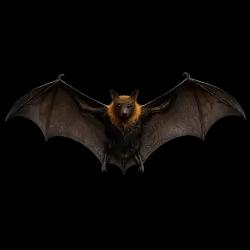
Fruit Bat at a glance
Mammal · Africa · Tropical and subtropical forest of · Uncommon
Known for: Dog-like face with large eyes and no nose-leaf, Clawed second finger as well as a clawed thumb in, Simple ring-like ears without a tragus, Tail short or absent
Its Power
Night Seed Courier
Carry growth farther than yourself.
Influence can be indirect; what you spread may matter more than what you keep.
“Spread the forest.”
Capture a Fruit Bat, and it's yours when you finish one step it gives you.
Biological basis
Many fruit bats disperse seeds and pollinate plants, supporting forest regeneration.
Put it into practice
You want long-term impact, so you plant ideas others can grow later.
What does the fruit bat symbolize?
The fruit bat symbolizes night seed courier: carry growth farther than yourself. It represents contribution, leverage and renewal. Its AnimalDex motto: "Spread the forest."
The fruit bat as a spirit animal
If the fruit bat is your spirit animal, the AnimalDex reading is Night Seed Courier: influence can be indirect; what you spread may matter more than what you keep. It suggests a strength in contribution and leverage, and a reminder to use it on purpose.
What can the fruit bat help you with in life?
The fruit bat is a guide for contribution, leverage and renewal. Its lesson applies wherever contribution matters: influence can be indirect; what you spread may matter more than what you keep.
- Contribution
- Leverage
- Renewal
In practice: You want long-term impact, so you plant ideas others can grow later.
What can we learn from the Fruit Bat?What does it mean to dream about or encounter a wild fruit bat?
A wild fruit bat, whether in a dream or in front of you, tends to show up when contribution or leverage is on your mind. In AnimalDex, the fruit bat's principle is Night Seed Courier: carry growth farther than yourself. Read the moment through its core lesson: Influence can be indirect; what you spread may matter more than what you keep.
Neither good nor bad on its own. How the fruit bat acts matters: at ease, it reflects contribution; hostile, it flags contribution out of balance.
Spotting a fruit bat in the wild
If a fruit bat crosses your path, take it as a cue to look at where contribution fits your day. Its AnimalDex motto: "Spread the forest."
A fruit bat that keeps appearing
Seeing the fruit bat again and again, in dreams or outside, suggests contribution is a theme you have not settled yet.
Dreaming of being chased by a fruit bat
Being chased suggests you are avoiding the Night Seed Courier the fruit bat stands for: influence can be indirect; what you spread may matter more than what you keep. Ask what you keep postponing that needs contribution.
Dreaming that a fruit bat attacks you
When the fruit bat attacks, the dream may be about pressure: leverage or renewal applied too hard, by you or by someone close to you.
A calm or friendly fruit bat
Meeting a peaceful fruit bat is usually encouraging: leverage and renewal are within reach.
A dead or injured fruit bat
Seeing the fruit bat hurt may point to leverage that has been neglected. Ask what it would take to restore it.
These readings are reflective prompts drawn from how the fruit bat really lives, not predictions. If you meet one in the wild, watch from a distance and leave it undisturbed.
Capture your own Fruit Bat
Photograph or film one in the wild, at a zoo or at home with the app. It becomes yours: it remembers you, gives you steps, and can debate your problems with your other animals.
Animal field guide
Fruit Bat
Sign in to hear this read by a natural AI voice instead of your browser's.
The Fruit Bat teaches Night Seed Courier through night flight that spreads seeds, pollen, and future forest. Its lesson is that what you spread may matter more than what you keep.
Native range
Natural range, not this capture location
Tropical and subtropical forest of many kinds, including rainforest, monsoon forest, mangroves and savanna woodland, as well as orchards, plantations and town parks. Most roost in trees; some species roost in caves, rock clefts or under palm fronds.
Search near meAnimalDex stats
Size scale
Understand the animal
Understand the Fruit Bat
Factual biology first: what this animal is like, where it lives, how it survives, and why those traits exist.
01
Introduction to Fruit Bat
The Fruit Bat teaches Night Seed Courier through night flight that spreads seeds, pollen, and future forest. Its fruit diet, wide travel, hanging roosts, and pollination or seed-dispersal work show that influence can happen after the animal has already moved on. Its lesson is that what you spread may matter more than what you keep.
How to identify a Fruit Bat
- Dog-like face with large eyes and no nose-leaf
- Clawed second finger as well as a clawed thumb in most species
- Simple ring-like ears without a tragus
- Tail short or absent
- Rests hanging upside down, wings wrapped around the body
Why Fruit Bat are interesting
- Most species do not echolocate, but rousette bats navigate dark caves using clicks made with the tongue.
- The largest flying foxes have wingspans of about 1.5 metres, while some blossom bats weigh under 20 grams.
- Male hammer-headed bats gather along African rivers and honk loudly at night to attract females, using an enlarged larynx.
- Male Dayak fruit bats have been found producing milk, one of very few mammals in which this is recorded.
02
Adaptations and biological abilities
03
Why does Fruit Bat behave this way?
- Dog-like face with large eyes and no nose-leaf
- Clawed second finger as well as a clawed thumb in most species
- Simple ring-like ears without a tragus
- Tail short or absent
- Rests hanging upside down, wings wrapped around the body
Mostly active from dusk through the night, though a few island species also feed by day. They rest through daylight hanging from branches or in caves, many in colonies; small species often roost alone in foliage.
04
Why Tropical and subtropical forest of many kinds?
Habitat: Tropical and subtropical forest of many kinds, including rainforest, monsoon forest, mangroves and savanna woodland, as well as orchards, plantations and town parks. Most roost in trees; some species roost in caves, rock clefts or under palm fronds.
Native range: Africa, Asia, Australia, and Pacific/Indian Ocean islands, depending on species.
Native range
Natural range, not this specific capture location.
Tropical and subtropical forest of many kinds, including rainforest, monsoon forest, mangroves and savanna woodland, as well as orchards, plantations and town parks. Most roost in trees; some species roost in caves, rock clefts or under palm fronds.
05
Why this diet?
Plant food only: ripe fruit, nectar and pollen, and in some species leaves and flowers. Many crush fruit against the palate, swallow the juice and spit out the fibre; nectar-feeders use long, brush-tipped tongues.
06
Activity, rest, and lifespan
Mostly active from dusk through the night, though a few island species also feed by day. They rest through daylight hanging from branches or in caves, many in colonies; small species often roost alone in foliage.
Varies with size: small species typically live a few years to about ten in the wild, while large flying foxes may reach 15 to 20; captive animals have lived over 30.
07
Fruit Bat reproduction
Most species bear a single young, once or sometimes twice a year, after a pregnancy of roughly four to six months. The young clings to the mother at first, then is left at the roost while she feeds, and flies at about two to three months.
In many species males are larger, with bigger heads and canines. Males of epauletted fruit bats carry white shoulder tufts that they fluff out when displaying; in others the sexes look similar.
08
Predators, threats, and defense
09
Conservation and rarity
Rarity: Uncommon · 61/100. AnimalDex canonical rarity score: 61/100, maintained by the live indexed species profile.
- Observe from a respectful distance and avoid changing the animal's behavior.
- Do not block feeding, shelter, nesting, or travel routes.
- Use a live camera capture without handling or staging wildlife.
Talk to it
Talk to the Fruit Bat
It answers as itself: ask about how it lives, or bring it something of yours and hear what it would do, from its own Power.
Anonymous: 6/day. Signed-in: 10/day. Pro: 100/day.
Side by side
The Fruit Bat, side by side
Nothing written side by side for the Fruit Bat yet. Pick any animal to compare it with. Compare with any animal →
Where to find them
Where to find Fruit Bat
To find Fruit Bat in the wild, focus on the exact habitat patches that match its body design and daily behavior, not just the broad country where it exists. You usually do better by working one good piece of habitat inside africa, Asia, Australia, and Pacific/Indian Ocean islands, depending on species. than by covering too much ground.
- Quiet marsh edges, reedbeds, river bends, or shallow wetland margins
- Forest edge, canopy gaps, fruiting trees, or shaded trails where cover and food meet
- Protected habitat blocks within africa, Asia, Australia, and Pacific/Indian Ocean islands, depending on species.
In the Ark
No Fruit Bat is aboard yet.
None have come aboard or left since November 6.
The Ark is a live, shared animal world. Animals come aboard when people capture them, and live there by rules based on their field guides.
Scientific name
Pteropodidae
Category
Mammal
Habitat
Tropical and subtropical forest of many kinds, including rainforest, monsoon forest, mangroves and savanna woodland, as well as orchards, plantations and town parks. Most roost in trees; some species roost in caves, rock clefts or under palm fronds.
Rarity
Uncommon · 61/100
Native range
Africa, Asia, Australia, and Pacific/Indian Ocean islands, depending on species.
Take the encyclopedia outside
AnimalDex helps you scan real animals, identify species, collect cards, and learn from nature wherever you are.