Animal field guide
Javan Surili
Presbytis comata
Found only on the island of Java, this monkey lives almost entirely on leaves. Its large, chambered stomach holds bacteria that break down tough foliage, so it can live on food that most monkeys cannot digest.
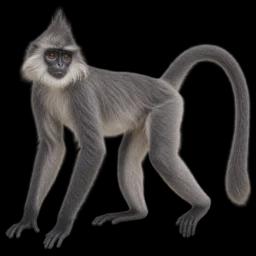
Javan Surili at a glance
Animal · Southeast Asia · Tropical rainforest in western and · Rare
Known for: Grey back, White throat, Bare, Slender body with long legs for leaping
Its Power
Canopy Route
Keep a connected route above the disturbance below.
“Stay on the high branches.”
Capture a Javan Surili, and it's yours when you finish one step it gives you.
Biological basis
Presbytis comata lives in the forest canopy of Java, feeding on young leaves pulled from branches and seldom descending to the ground. Alarmed groups freeze or flee along linked branches while the adult male gives alarm calls.
Put it into practice
When roadworks jam the main street, a courier keeps deliveries moving through the chain of back lanes she mapped months earlier, never joining the stalled traffic.
What does the Javan surili symbolize?
The Javan surili symbolizes canopy route: keep a connected route above the disturbance below. It represents sense of direction, planning and perspective. Its AnimalDex motto: "Stay on the high branches."
The Javan surili as a spirit animal
If the Javan surili is your spirit animal, the AnimalDex reading is Canopy Route: keep a connected route above the disturbance below. It suggests a strength in sense of direction and planning, and a reminder to use it on purpose.
What can the Javan surili help you with in life?
The Javan surili is a guide for sense of direction, planning and perspective. Its lesson applies wherever sense of direction matters: keep a connected route above the disturbance below.
- Sense of Direction
- Planning
- Perspective
In practice: When roadworks jam the main street, a courier keeps deliveries moving through the chain of back lanes she mapped months earlier, never joining the stalled traffic.
What can we learn from the Javan Surili?What does it mean to dream about or encounter a wild Javan surili?
A wild Javan surili, whether in a dream or in front of you, tends to show up when sense of direction or planning is on your mind. In AnimalDex, the Javan surili's principle is Canopy Route: keep a connected route above the disturbance below. Read the moment through its core lesson: Keep a connected route above the disturbance below.
It depends on how the Javan surili behaved. Calm or close by, it reads as planning within reach; aggressive or fleeing, it points to sense of direction you are resisting.
Spotting a Javan surili in the wild
If a Javan surili crosses your path, take it as a cue to look at where sense of direction fits your day. Its AnimalDex motto: "Stay on the high branches."
A Javan surili that keeps appearing
A Javan surili that keeps turning up points to planning you keep circling back to. The repetition is the message.
Dreaming of being chased by a Javan surili
Being chased suggests you are avoiding the Canopy Route the Javan surili stands for: keep a connected route above the disturbance below. Ask what you keep postponing that needs sense of direction.
Dreaming that a Javan surili attacks you
An aggressive Javan surili can mirror a conflict where sense of direction has become a weapon rather than a strength.
A calm or friendly Javan surili
A calm Javan surili suggests you have made peace with sense of direction and can use it without force.
A dead or injured Javan surili
A dead or injured Javan surili, dreamed or found, can mark sense of direction you have let lapse, or a phase built on Canopy Route coming to an end.
These readings are reflective prompts drawn from how the Javan surili really lives, not predictions. If you meet one in the wild, watch from a distance and leave it undisturbed.
Capture your own Javan Surili
Photograph or film one in the wild, at a zoo or at home with the app. It becomes yours: it remembers you, gives you steps, and can debate your problems with your other animals.
Animal field guide
Javan Surili
Sign in to hear this read by a natural AI voice instead of your browser's.
Found only on the island of Java, this monkey lives almost entirely on leaves. Its large, chambered stomach holds bacteria that break down tough foliage, so it can live on food that most monkeys cannot digest.
Native range
Natural range, not this capture location
Tropical rainforest in western and central Java, from remaining lowland patches up into montane forest at around 2,500 m. Most surviving groups live in hill and mountain forest on volcanoes, and it avoids open farmland and plantations.
Search near meAnimalDex stats
Size scale
Understand the animal
Understand the Javan Surili
Factual biology first: what this animal is like, where it lives, how it survives, and why those traits exist.
01
Introduction to Javan Surili
Found only on the island of Java, this monkey lives almost entirely on leaves. Its large, chambered stomach holds bacteria that break down tough foliage, so it can live on food that most monkeys cannot digest.
How to identify a Javan Surili
- Grey back, outer limbs and tail
- White throat, chest and belly
- Bare, dark grey to black face
- Slender body with long legs for leaping
Why Javan Surili are interesting
- It is also known as the grizzled leaf monkey or Javan grizzled langur.
- Groups are reported to be small, usually one adult male with several females and their young.
- The species name comata means long-haired, a reference to the crest on its crown.
- Its long tail cannot grip branches; it serves as a counterweight for balance when leaping.
02
Adaptations and biological abilities
03
Why does Javan Surili behave this way?
- Grey back, outer limbs and tail
- White throat, chest and belly
- Bare, dark grey to black face
- Slender body with long legs for leaping
Diurnal, most active in the early morning and late afternoon, with rest in the canopy around midday. Groups sleep high in tall trees at night; sleeping sites are not well documented. There is no seasonal dormancy.
04
Why Tropical rainforest in western and central Java?
Habitat: Tropical rainforest in western and central Java, from remaining lowland patches up into montane forest at around 2,500 m. Most surviving groups live in hill and mountain forest on volcanoes, and it avoids open farmland and plantations.
Native range: Southeast Asia
Native range
Natural range, not this specific capture location.
Tropical rainforest in western and central Java, from remaining lowland patches up into montane forest at around 2,500 m. Most surviving groups live in hill and mountain forest on volcanoes, and it avoids open farmland and plantations.
05
Why this diet?
Mainly young leaves, with fruit, seeds and flowers eaten when available. It feeds in the canopy, pulling leafy twigs towards the mouth, and seldom comes down to the ground.
06
Activity, rest, and lifespan
Diurnal, most active in the early morning and late afternoon, with rest in the canopy around midday. Groups sleep high in tall trees at night; sleeping sites are not well documented. There is no seasonal dormancy.
Presbytis comata still lacks published wild lifespan figures; its chambered stomach ferments tough leaves high in the Javan canopy.
07
Javan Surili reproduction
A single infant is born at a time. Newborns of surilis and related leaf monkeys of the genus Presbytis have very pale coats that darken with age, and this is thought to hold here too; gestation length and birth spacing are not well documented.
Males and females look alike in colour; males are only slightly larger, and the sexes are hard to tell apart in the field.
08
Predators, threats, and defense
09
Conservation and rarity
Rarity: Rare · 74/100. AnimalDex canonical rarity score: 74/100, maintained by the live indexed species profile.
- Observe from a respectful distance and avoid changing the animal's behavior.
- Do not block feeding, shelter, nesting, or travel routes.
- Use a live camera capture without handling or staging wildlife.
Talk to it
Talk to the Javan Surili
It answers as itself: ask about how it lives, or bring it something of yours and hear what it would do, from its own Power.
Anonymous: 6/day. Signed-in: 10/day. Pro: 100/day.
Side by side
The Javan Surili, side by side
Nothing written side by side for the Javan Surili yet. Pick any animal to compare it with. Compare with any animal →
Where to find them
Where to find Javan Surili
To find Javan Surili in the wild, focus on the exact habitat patches that match its body design and daily behavior, not just the broad country where it exists. You usually do better by working one good piece of habitat inside southeast Asia than by covering too much ground.
- Forest edge, canopy gaps, fruiting trees, or shaded trails where cover and food meet
- Rocky slopes, ridge lines, cliff ledges, or open mountain meadows with a wide view
- Protected habitat blocks within southeast Asia
Where explorers saw it
Javan Surili is threatened, so only countries are shown. Look for it with a licensed local guide.
- IndonesiaSep · 1 sighting
In the Ark
No Javan Surili is aboard yet.
The Ark is a live, shared animal world. Animals come aboard when people capture them, and live there by rules based on their field guides.
See the ArkScientific name
Presbytis comata
Category
Animal
Habitat
Tropical rainforest in western and central Java, from remaining lowland patches up into montane forest at around 2,500 m. Most surviving groups live in hill and mountain forest on volcanoes, and it avoids open farmland and plantations.
Rarity
Rare · 74/100
Native range
Southeast Asia
Take the encyclopedia outside
AnimalDex helps you scan real animals, identify species, collect cards, and learn from nature wherever you are.