

orangutanswildfiresBorneo
Borneo Wildfires 2026 Reach Forests of 52% of Its Orangutans
Fire is burning in forests holding 52% of Bornean orangutans. Why wet peat swamp now burns, how rescuers carry apes out, and why smoke harms them for months.
In this guide
- Where are Borneo's 2026 wildfires burning?
- Why is Indonesia burning so badly in 2026?
- Why does peat swamp forest burn now?
- How do rescuers save an orangutan from a fire?
- Where do rescued orangutans go?
- Is the danger over when the fire goes out?
- Are orangutans going extinct? What the 1997–98 fires warn
- How can you help Borneo's orangutans right now?
The short answer
Quick answer
Fires driven by a 2026 Super El Niño and years of peat drainage and clearing are burning in Kalimantan, Indonesian Borneo, inside habitat holding 52% of Bornean orangutans, the IUCN says. Rescuers have pulled dozens of orangutans from burning land since August, with official tallies of 46, 51 and 53. No overall death toll is known yet.
Ground zero
Where are Borneo's 2026 wildfires burning?
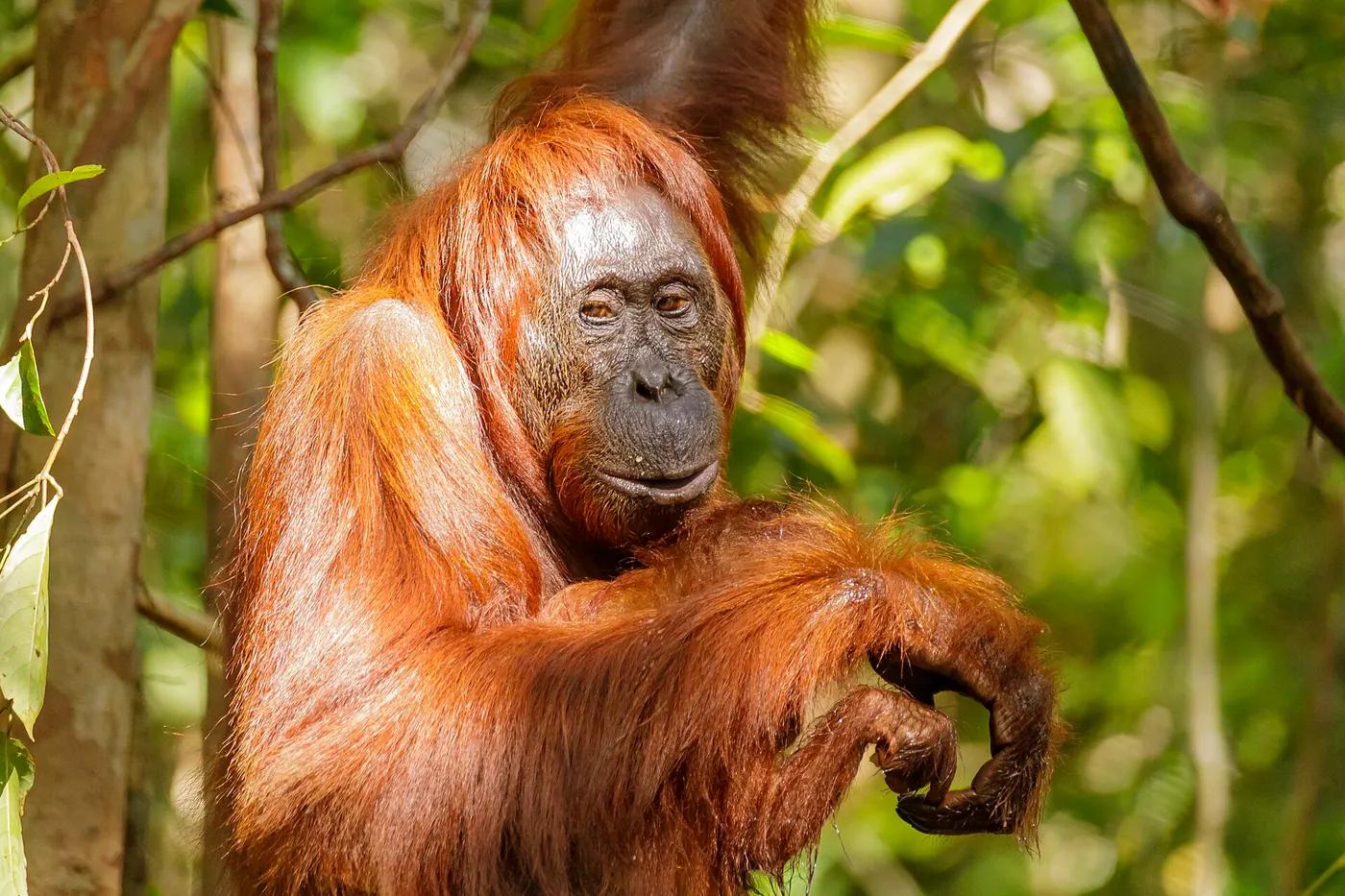
Novita is three or four years old, and to escape the flames she had to cross them. Near Sebangau in late September, she 'had to walk through the fire to get to the tree and climb it, so the soles of her feet and her toes were burned,' said Jamartin Sihite, CEO of the BOS Foundation. Mongabay reported serious burns on all four of her hands and feet.
She is one ape in a fire that has reached the forests of more than half her kind. In September, the IUCN Primate Specialist Group's Section on Great Apes reported fire burning inside habitat units that hold 52% of all Bornean orangutans, including 13 of the 20 largest populations.
For one subspecies the figure is worse. Fire has reached habitat holding 70% of the Central Bornean orangutan, Pongo pygmaeus wurmbii.
Every protected area in the lowlands of Kalimantan, the Indonesian part of Borneo, has reported fire inside its borders. That includes the three national parks with the most orangutans, Sebangau, Gunung Palung and Tanjung Puting, all of them peat-swamp forest. By 13 September, official data showed more than 4,500 ha of Tanjung Puting had burned.
Anton Nurcahyo, CEO of the conservation group BNF, says the Sebangau fires are mostly along the edges. In Gunung Palung and Tanjung Puting, the flames are already inside.
Novita had to walk through fire to reach a tree. The soles of her feet and her toes were burned.
Super El Niño
Why is Indonesia burning so badly in 2026?
Between 1 August and 8 September, Indonesia logged 13,443 fire hotspots. About 600,000 ha burned in a single month, and the first week of September alone released an estimated 19.7 million tonnes of carbon, according to figures compiled by the IUCN. Its experts put the burned area at roughly 800,000 ha by the end of August.
The weather lit the fuse. The IUCN calls this a 'Super El Niño', predicted to become the strongest on record and to last into 2027. Singapore-based atmospheric scientist Wang Jingyu explains that cooler-than-normal sea surface temperatures mean less evaporation, and so less rain: 'We do not have enough rain, the fire cannot be easily put out.'
The smoke doesn't stay in the forest. About 5.5 million people have been directly exposed across Borneo and Sumatra, around 2,400 flights in Indonesia have been disrupted since mid-August, and on 18 October IQAir ranked Singapore and Kuala Lumpur among the world's most polluted major cities.
The clearest sign of how dry it has become: fire has reached kerangas, a rare lowland heath forest, in the Rungan landscape. The IUCN says it is the first wildfire ever reported in that ecosystem. Kutai National Park, which isn't peatland at all, is burning too.
Fire has reached Borneo's kerangas heath forest, the first wildfire ever reported in that rare ecosystem.
Fuel underfoot
Why does peat swamp forest burn now?
Healthy peat-swamp forest is waterlogged and naturally resists fire. Drain it and the peat dries into fuel. Experts quoted by AFP say slash-and-burn land clearing has 'changed the naturally fire-resistant landscape'.
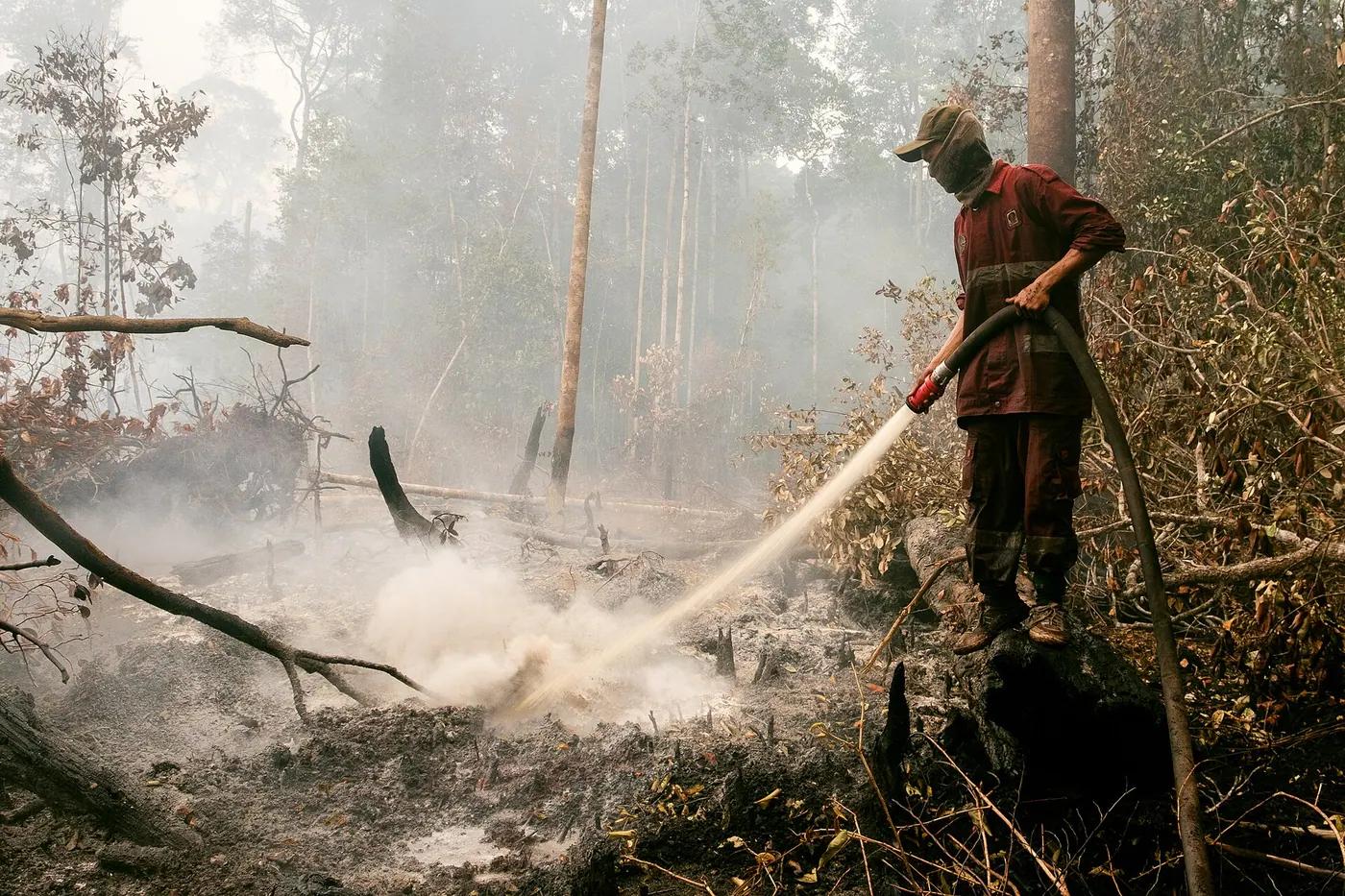
Drained peat doesn't just burn, it smoulders underground for weeks or months. The IUCN warns that these fires cross firebreaks below the surface and flare up again in places that looked safe, which is why crews can't simply drown the flames they can see.
The IUCN names the root causes as drainage, deforestation, expanding plantations, artisanal mining and fire used to clear farmland. Land that has burned once is many times more likely to burn again.
Take forestry firm PT Mohairson Pawan Khatulistiwa, known as Mopakha. In 2017 the government sanctioned it for digging 8.1 km of canals through peat, which lowers the water level. In 2026 at least 1,800 ha of its concession burned, according to Nusantara Atlas, on land the company itself says holds more than 660 orangutans. Its licence was frozen in August.
Fire also swept the oil palm concession of PT Kayung Agro Lestari, home to about 60 orangutans, where TheTreeMap found its peat-swamp orangutan forest almost completely affected. Parent company First Resources says it enforces zero burning, runs a full fire-management programme and helped evacuate orangutans.
This is how habitat loss pushes orangutans out of their homes. Almost half of all wild orangutans live outside protected areas, in forests managed for timber, restoration or conservation value, and some estimates put the share higher. Even repair work is burning: in March, fire swept part of a West Kalimantan site planted with 150,000 trees, and Nurcahyo says restoration must ensure 'the trees planted today won't burn five years from now.'
One company says more than 660 orangutans live on its concession. At least 1,800 ha of it burned this year.
One by one
How do rescuers save an orangutan from a fire?
Rescues start in the treetops, often in smoke. Teams tranquilise the orangutan, bring it down and treat it: Novita was given oxygen and IV fluids. Around 8 October, a male called Bara was brought down from a treetop in thick haze with minor burns.
On Saturday 17 October, three conservation agencies rescued a 20-year-old male in Hampangen village, Katingan Regency, Central Kalimantan. 'After the orangutan was sedated, the medical team immediately conducted a health examination before taking the animal to the... rehabilitation centre,' they said.
Not every orangutan gets that chance. Nurcahyo warns that apes trapped with nowhere to go can 'literally burn alive'. Mothers with young may be at the highest risk, because they stay in their home ranges and can't move fast.
So how many have been saved? Dozens, but the official counts don't match. On 22 September, the Ministry of Forestry said it had rescued 100 animals, including 53 Bornean orangutans. The IUCN's statement counted 23 rescued in West Kalimantan between 6 August and 17 September.
On 11 October, AFP quoted local natural resources agency head Murlan Dameria Pane: authorities and YIARI had rescued 46 orangutans between August and 9 October. On 18 October, the West Kalimantan conservation agency and YIARI gave 51 for the province, for a period AFP printed as ending on 19 October, the day after its story ran, which is probably a typo.
That same week, forestry ministry figures suggested up to 96 had been rescued across Kalimantan in recent months, but AFP could not get officials to clarify. Every named rescue so far has been in Kalimantan.
| Who said it | Reported | Orangutans rescued | Area and period |
|---|---|---|---|
| Ministry of Forestry | 22 Sep 2026 | 53 (among 100 animals) | All rescues to that date |
| IUCN SSC Primate Specialist Group | Sep 2026 | 23 | West Kalimantan, 6 Aug–17 Sep |
| Murlan Dameria Pane, local natural resources agency (via AFP) | 11 Oct 2026 | 46 | Authorities and YIARI, Aug–9 Oct |
| West Kalimantan conservation agency and YIARI (via AFP) | 18 Oct 2026 | 51 | West Kalimantan, 6 Aug to '19 Oct' as published |
| Forestry ministry figures (via AFP) | Week of 18 Oct 2026 | Up to 96 (unconfirmed) | Kalimantan, recent months |
Trapped with nowhere to go, orangutans can 'literally burn alive'.
New home
Where do rescued orangutans go?
On Friday 9 October, eight orangutans rescued from burned land in West Kalimantan were moved into Batu Nyambu Protected Forest: three mothers with babies and two teenage males. The fires that drove them out were mostly in plantations next to their forest homes.
Batu Nyambu covers 23,000 ha (56,800 acres) of primary and secondary forest. YIARI operational director Argitoe Ranting said it was chosen for its food, water and links to other forest: 'We want to ensure that rescued orangutans are not simply moved from one place to another, but actually have a chance to survive in their natural habitat.'
YIARI CEO Karmele Llano Sanchez, a veterinarian, called relocation a 'necessary step' when a habitat is no longer safe, and rescue 'one of the best options' while habitat is still under threat.
The catch is that the safe places are under fire too. In July, flames came within 100 m of YIARI's rehabilitation centre in Ketapang, which holds more than 60 orangutans. Fire got within 200 m of the Rangkong Research Station in Gunung Palung and 150 m of the Tuanan Orangutan Research Station.
At the BOS Foundation's Nyaru Menteng, Indonesia's largest orangutan care facility, 21 orangutans have had coughing, sneezing and runny noses. In East Kalimantan, orangutans in rehabilitation had to be evacuated as the fires closed in.
Fire came within 100 metres of a centre caring for more than 60 rescued orangutans.
After the flames
Is the danger over when the fire goes out?
The most unsettling evidence comes from an earlier fire season, not this one. When haze settled over their forest, wild Bornean orangutans rested more and travelled less, yet their bodies went into ketosis, breaking down stored fat. According to the IUCN's summary of the study, they were eating more at the time, not less.
Erb and colleagues reported this in Scientific Reports in 2018. Their explanation is a likely mechanism rather than a proven one: the smoke probably raises the apes' energy needs by making the immune system work harder. The study covers earlier haze, so it can't tell us what 2026 is doing to individual apes, but it shows what heavy smoke can do.
Other studies point the same way. A 2024 paper by Gwynn and colleagues linked smoke exposure to a 2.5-fold rise in hookworm infection intensity in wild Bornean orangutans, plus more of two other gut parasites. Erb's team found in 2023 that smoke lowers the vocal quality of males' long calls, with effects lasting up to two months.
Smoke can also kill without a single flame. This September an adult male was found struggling to breathe in an oil palm plantation and died despite emergency treatment. The examination pointed to acute oxygen deprivation from smoke.
The forest recovers far more slowly than the apes. The IUCN statement, drawing on research including a 2024 PNAS study led by Harrison, reports that fish in peat forest can crash by up to 85% within a month of a major fire, burned forest loses 58–98% of its tree density and canopy cover, and tree diversity was still low 12 years later. That leaves a broken canopy that is harder for an orangutan to travel through and feed in.
During smoky haze, wild orangutans started burning their own fat, even though they were eating more.
The precedent
Are orangutans going extinct? What the 1997–98 fires warn
Indonesia has been here before. During the 1997–98 El Niño fires, Rijksen and Meijaard estimated that thousands of orangutans died. As the IUCN and Mongabay summarise their 1999 work, that may have been as many as a third of all orangutans alive at the time.
In 2015, about 2.6 million ha burned across Indonesia, and the World Bank put the losses at an estimated US$16.1 billion. The IUCN gives no orangutan death toll for that year. Indonesia created a peatland agency afterwards.
Nobody yet knows how many wild orangutans have died in 2026, and Mongabay notes this year isn't necessarily comparable to 1997–98. The IUCN's warning is blunt: 'Without urgent action, thousands more orangutans could be killed, injured or displaced.'
Their biology makes every loss heavier. A female gives birth roughly once every six to eight years and has only three or four young in her lifetime. Ronna Saab, executive director of FORINA, warns: 'If this metapopulation continues to burn, there could be local extinction.' In small, cut-off groups she fears a 'slow extinction'.
In one location, recent surveys found a single nest and no orangutans. That doesn't prove a local extinction, and the finding is going into an ongoing Population and Habitat Viability Assessment.
How many are left? WWF-UK estimates about 104,700 Bornean orangutans, 13,846 Sumatran orangutans and about 800 Tapanuli orangutans, roughly 119,000 in all. Some news reports, including AFP's citing WWF, give about 104,000 for all orangutans, but that matches WWF-UK's figure for Bornean orangutans alone, so we use the species-by-species count. All three species in the orangutan genus are Critically Endangered.
No fire rescue of a Sumatran or Tapanuli orangutan has been confirmed this year. The Tapanuli orangutan was described in 2017 from Sumatra's Batang Toru forests, the first new great ape species named since the 1920s, after evolving separately for about 670,000 years. If you want to know how Bornean and Sumatran orangutans differ, AnimalDex compares them side by side.
In one location, recent surveys found a single orangutan nest, and no orangutans.
how Bornean and Sumatran orangutans differ
Your move
How can you help Borneo's orangutans right now?
Since August the government has deployed 64 aircraft and more than 54,000 personnel, and President Prabowo Subianto is planning a new agency to restore and manage fire-prone peatland. Even so, Caitlin O'Connell of the Gunung Palung Orangutan Conservation Program says frontline teams 'cannot fight fires of this scale alone.'
The groups in this story are the ones carrying orangutans out of the smoke: the BOS Foundation, which runs Nyaru Menteng; YIARI, whose Ketapang centre came within 100 m of the flames and whose teams moved eight apes to Batu Nyambu; BNF; and the Gunung Palung Orangutan Conservation Program. Donating through their own official websites, and sharing their verified updates rather than viral rumours, puts help where the fire is.
If you back tree-planting, look for projects that pair it with fire prevention. A forest that burns again in five years hasn't been saved.
You can also learn what shares these forests. The AnimalDex guides to Borneo and Sumatra cover the species that live there, and our piece on how orangutans think and survive in the canopy shows why a burned canopy hits them so hard. Before any trip, read what makes a great ethical wildlife guide, and never approach or handle a wild or rescued orangutan.
If you are ever lucky enough to see a wild orangutan in its own forest, you can capture it live with your phone camera in the AnimalDex app and add it to your collection.
Until the rains arrive, expected in late October or early November, rescuers will keep carrying orangutans out of burning forest, one at a time.
Frontline teams 'cannot fight fires of this scale alone.'
BorneoSumatrahow orangutans think and survive in the canopywhat makes a great ethical wildlife guide
Quick questions
Short answers to common questions readers ask on this topic.
- How many orangutans have died in the 2026 Indonesia fires?
- No one knows yet. Individual deaths have been documented, including an adult male who died from smoke-induced oxygen deprivation after being found in an oil palm plantation, but there is no overall toll. The IUCN warns that without urgent action, thousands more orangutans could be killed, injured or displaced.
- Why is Indonesia burning so badly in 2026?
- A Super El Niño has cut rainfall, and the IUCN says it is predicted to become the strongest on record and to last into 2027. The drought has hit land already damaged by peat drainage, deforestation, plantations, mining and fire used to clear farmland. Indonesia logged 13,443 hotspots between 1 August and 8 September.
- Why does peat burn, and why can't firefighters put it out?
- Healthy peat swamp is waterlogged and resists fire, but drained peat dries out and catches easily. It can smoulder underground for weeks or months, cross firebreaks below the surface and flare up again in areas that looked safe. Without enough rain, these fires are very hard to put out.
- How do rescuers save an orangutan from a fire?
- Teams tranquilise the orangutan in the tree, bring it down and examine it. Injured apes such as Novita, who had burned hands and feet, are treated with oxygen and IV fluids before going to a rehabilitation centre. Others are moved to safer forest, like the eight released into Batu Nyambu Protected Forest on 9 October.
- Are orangutans going extinct? How many are left?
- All three orangutan species are Critically Endangered. WWF-UK estimates about 104,700 Bornean, 13,846 Sumatran and about 800 Tapanuli orangutans. Because females have only three or four young in a lifetime, researchers fear local extinctions where small groups keep burning.
- Is palm oil to blame for the fires?
- It is one factor among several. The IUCN lists drainage, deforestation, expanding plantations, artisanal mining and land-clearing fires as root causes. Fire burned inside the PT Kayung Agro Lestari oil palm concession, though parent company First Resources says it enforces zero burning, while forestry firm Mopakha had its licence frozen over repeated burning.
Animals mentioned
Jump from this article into the species pages behind the examples, systems notes, and field-guide references.
Bornean OrangutanOrangutanSumatran OrangutanTapanuli Orangutan
Sources and further reading
- IUCN SSC Primate Specialist Group: Call for Urgent Action to Address the 2026 Forest Fires in Kalimantan, Indonesia
- Mongabay: 'There could be local extinction': the fight to protect Indonesia's orangutans as El Niño fuels fires
- Phys.org/AFP: Indonesia releases eight orangutans rescued from fires to protected forest
- Phys.org/AFP: Walking through flames: Orangutans rescued in Indonesia fires
- Malay Mail/AFP: Dozens of endangered orangutans rescued from Indonesia wildfires as haze chokes region
- Manila Times/AFP: Dozens of orangutans saved from Indonesia fires
- WWF-UK: Orangutan
- IUCN: IUCN calls for a moratorium on projects impacting Critically Endangered Tapanuli orangutan
Answer guides related to this topic
If you want direct comparisons and clear recommendations, continue with these answer-focused pages.
Best Animal Identification Apps
Compare the best animal identification apps by features like photo/video identification, species coverage, collection capabilities, offline use, and more.
What Is Animal Collecting
Learn what animal collecting means in modern apps and how AnimalDex turns real-world sightings into cards, sets, rarity, and species learning.
Pokemon-Like Animal App
Looking for a Pokemon-like animal app with real species? AnimalDex combines creature-collection energy with AI scanning and wildlife learning.