


Bay Duiker vs Potto: Who Actually Wins?
Bay duiker vs potto: a forest antelope against a slow-climbing primate armored with a spiny neck shield. Biology-based breakdown of size, defenses, scenarios and the clear winner.
Bay Duiker vs Potto
Matchup winner
Bay Duiker
Quick verdict
Start with the direct answer, then use the structured comparison below to see what changes the outcome.
The bay duiker wins overall. At roughly 15–24 kg against a potto's 0.8–1.6 kg, the duiker brings about ten to twenty times the body mass, a compact muscular frame built for crashing through dense undergrowth, short sharp horns, and the speed to choose whether any encounter happens at all. The potto is no pushover. It grips with vise-like hands and feet, it has a 'scapular shield' of thickened skin and raised spines over its neck and shoulders that it can thrust toward a threat, and it bites hard for its size. But those defenses evolved to hold off small arboreal predators on a branch, not to overcome a forest ungulate several times its weight. On the ground the potto is slow and badly out of place. In the canopy the duiker can't reach it. Neither animal hunts the other. The only realistic contact is a ground-level stumble or a startled clash, and there the duiker's mass, horns and kicking power decide it.
Read the full explanation
Bay duiker wins: roughly 10–20x heavier, armed with horns, and far faster on the forest floor.
The potto's neck shield and grip are built for defense, not for beating a large opponent.
In the trees the potto is untouchable, so the duiker wins only where the two can actually meet.
Neither animal preys on the other. This is a hypothetical clash, not a natural rivalry.
Reader vote
Who do you think wins?
Pick a side — no account needed. Results update live.
No votes yet — be the first to call it.
Editorial note
Why people disagree
Pottos have a hidden weapon: the spiny scapular shield makes some readers overrate how well the potto would do in a direct fight.
Raw mass advantage
An order-of-magnitude weight gap ends most contests between small animals before technique matters.
Explosive power
The duiker can charge, butt and bolt. The potto has almost no burst to escape or counter.
Close-range armor
The potto's specialized shield is a real anti-bite defense, its best card in any scuffle.
Read the full explanation +
The duiker eats fruit and some animal matter, which leads people to imagine it as a hunter. In reality it would rarely engage a potto at all.
Habitat splits the outcome. The potto lives in the canopy and the duiker on the floor, so 'who wins' depends on where you force them to meet.
Comparison FAQ
Short, direct answers to the next questions readers usually ask after the headline verdict.
Would a bay duiker beat a potto in a fight?+
Yes. A bay duiker is roughly 10–20 times heavier, faster, and has horns and hooves, so it would overpower a potto on the ground.
Which is stronger, a bay duiker or a potto?+
The bay duiker is far stronger in absolute terms. The potto has an exceptionally strong grip for its size, but it can't match the duiker's mass and kicking power.
Why is the potto still dangerous despite losing?+
Pottos have a spiny, thick-skinned scapular shield they push toward attackers, plus a firm grip and a surprisingly hard bite. Any animal that attacks one carelessly risks injury.
Do bay duikers and pottos ever fight in the wild?+
Essentially never. Pottos live in the canopy and duikers on the forest floor, and neither preys on the other.
Where would the potto have the advantage?+
In the trees. A potto gripping a branch out of reach is effectively untouchable by a ground-dwelling antelope.
Head-to-head species stats
These are the same core AnimalDex stat dimensions used on the dedicated animal pages, pulled side by side so the matchup is faster to scan.
Bay Duiker
Tier BPotto
Tier CTrait-by-trait comparison
Only the categories that matter to this matchup are included. The goal is not filler stats, but the real design differences that change the result.
~15–24 kg compact antelope
Raw mass advantage
Bay Duiker
~0.8–1.6 kg arboreal primate
Raw mass advantage
Bay Duiker
Powerful dives, bursts and kicks
Explosive power
Bay Duiker
Deliberate, slow movement
Explosive power
Bay Duiker
Thick hide, low-slung head
Close-range armor
Potto
Spiny scapular shield and tough neck skin
Close-range armor
Potto
Hooves, no grasp
Grip and hold control
Potto
Vise-like hands and feet
Grip and hold control
Potto
Dives through undergrowth with ease
Forest-floor mastery
Bay Duiker
Clumsy and exposed on the ground
Forest-floor mastery
Bay Duiker
None, ground-bound
Canopy refuge
Potto
Lives almost entirely in trees
Canopy refuge
Potto
How the verdict forms
Verdict timeline
01 · Raw mass advantage
Bay Duiker
02 · Explosive power
Bay Duiker
03 · Close-range armor
Potto
04 · Grip and hold control
Potto
05 · Forest-floor mastery
Bay Duiker
06 · Canopy refuge
Potto
Change the conditions
Scenario breakdown
This is where shallow battle content usually fails. Terrain, spacing, timing, and engagement style can change the answer.
Scenario lean
Bay Duiker
Verdict confidence
82%
The duiker dominates on its own turf.
On the ground the potto is slow and has no quick escape. A startled duiker can butt, trample or kick with far greater force. The potto's shield and bite might sting, but mass and mobility decide this one decisively.
AnimalDex field profiles
Explore these animals
Bay Duiker
Cephalophus dorsalis
lowland rainforest, dense thicket, and swamp forest edge
Potto
Perodicticus potto
rainforest canopy and dense tropical woodland
Systems Intelligence & Hidden Purpose
See the animals behind this comparison as engineered biological systems: what each one is built to do, where it gains leverage, and why the matchup changes by scenario.
Specialized Hardware
chestnut forest-floor coat, arched back posture, and secretive understory browsing give the Bay Duiker a body plan tuned for its niche.
Systems Script
Bay Duikers operate through lowland rainforest, dense thicket, and swamp forest edge. Their design links movement, feeding, shelter, and timing into one workable survival system.
Strategic Insight
Dense environments reward precision, patience, and the ability to read layered cover.
Specialized Hardware
slow grasping nocturnal body, dense woolly fur, and branch-hugging stealth give the Potto a body plan tuned for its niche.
Systems Script
Pottos operate through rainforest canopy and dense tropical woodland. Their design links movement, feeding, shelter, and timing into one workable survival system.
Strategic Insight
Dense environments reward precision, patience, and the ability to read layered cover.
Final take
The bay duiker is the clear winner of this hypothetical matchup. It is far heavier, much faster, and armed with horns and hard hooves, and it owns the forest floor where any realistic encounter would happen.
Read the full explanation
The potto earns respect for one of the strangest defensive kits in the primate world: a spiny neck shield, a powerful grip and a stubborn bite. Its real genius is avoidance. It lives high in the canopy, moves slowly and quietly, and almost never needs to fight anything the size of a duiker.
In nature these two share the West and Central African rainforest without conflict. The question is fun, but the honest biological answer is this: the duiker wins if forced to meet, and the potto wins by never coming down.
Collect both animals in AnimalDex
Track the species behind this matchup, compare their real traits, and build the rivalry into your AnimalDex collection.
Related comparisons
Continue with nearby matchups to compare more real-world animal traits without dropping into junky who-wins filler.
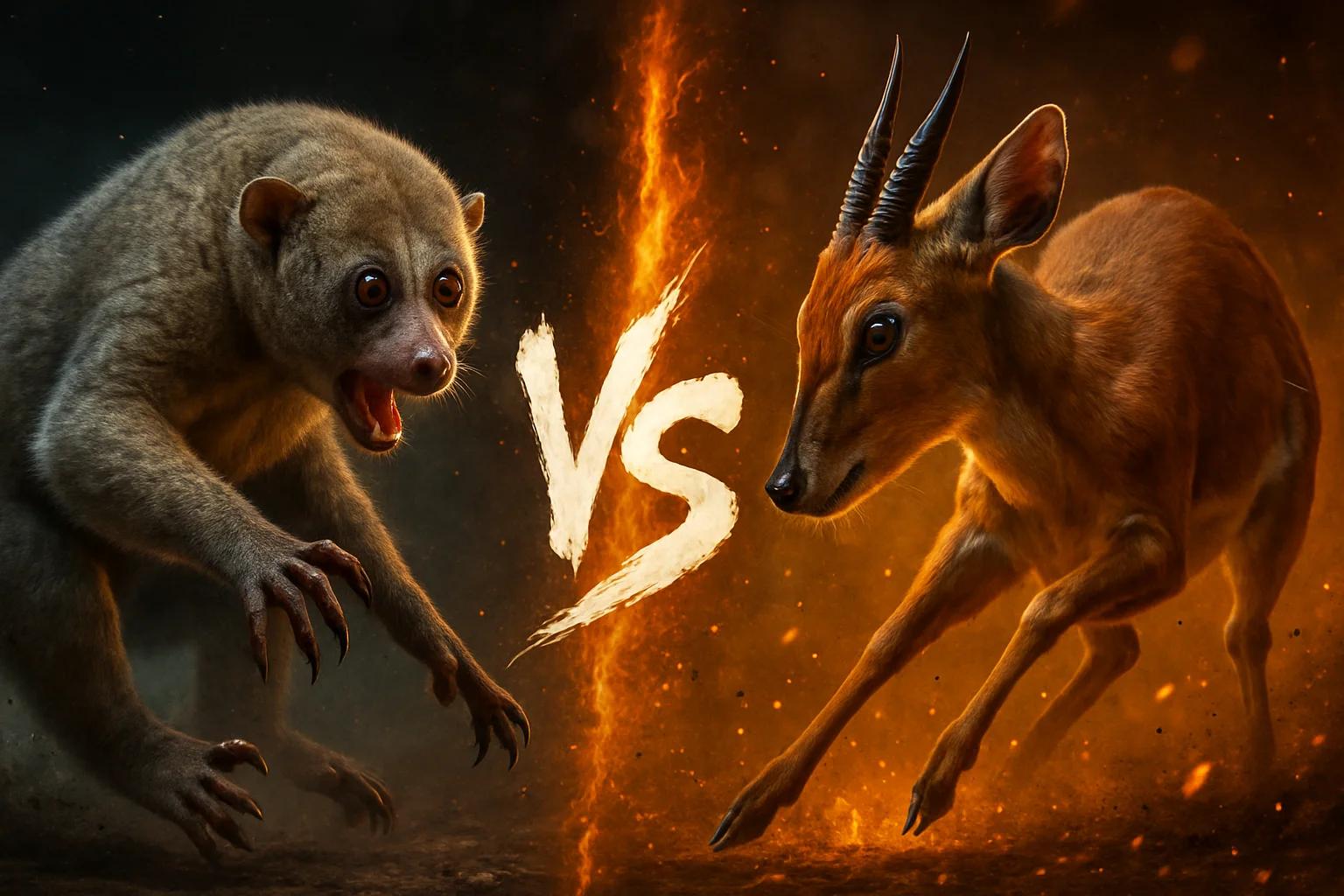
Potto vs Royal Antelope: Who Actually Wins?
The potto wins a true confrontation, but narrowly. The royal antelope is the larger animal at roughly 2–3 kg versus the potto's 1–1.5 kg, and it is vastly faster, with explosive leaps that can clear more than 2 metres. It is built to escape, though, not to fight. Its horns are tiny spikes about 2.5 cm long that only males carry, and its delicate legs are made for bounding rather than brawling. The potto is slow but almost impossible to dislodge once it grips. It has a vise-like hold, a sharp defensive bite, and a bony 'scapular shield' of raised neck vertebrae that it thrusts toward attackers while tucking its head. In any scenario where the two actually make contact, the potto controls the exchange and the antelope's best move is to leave. If the antelope can simply bolt, it never loses, which is why this is a low-confidence win.
Read comparison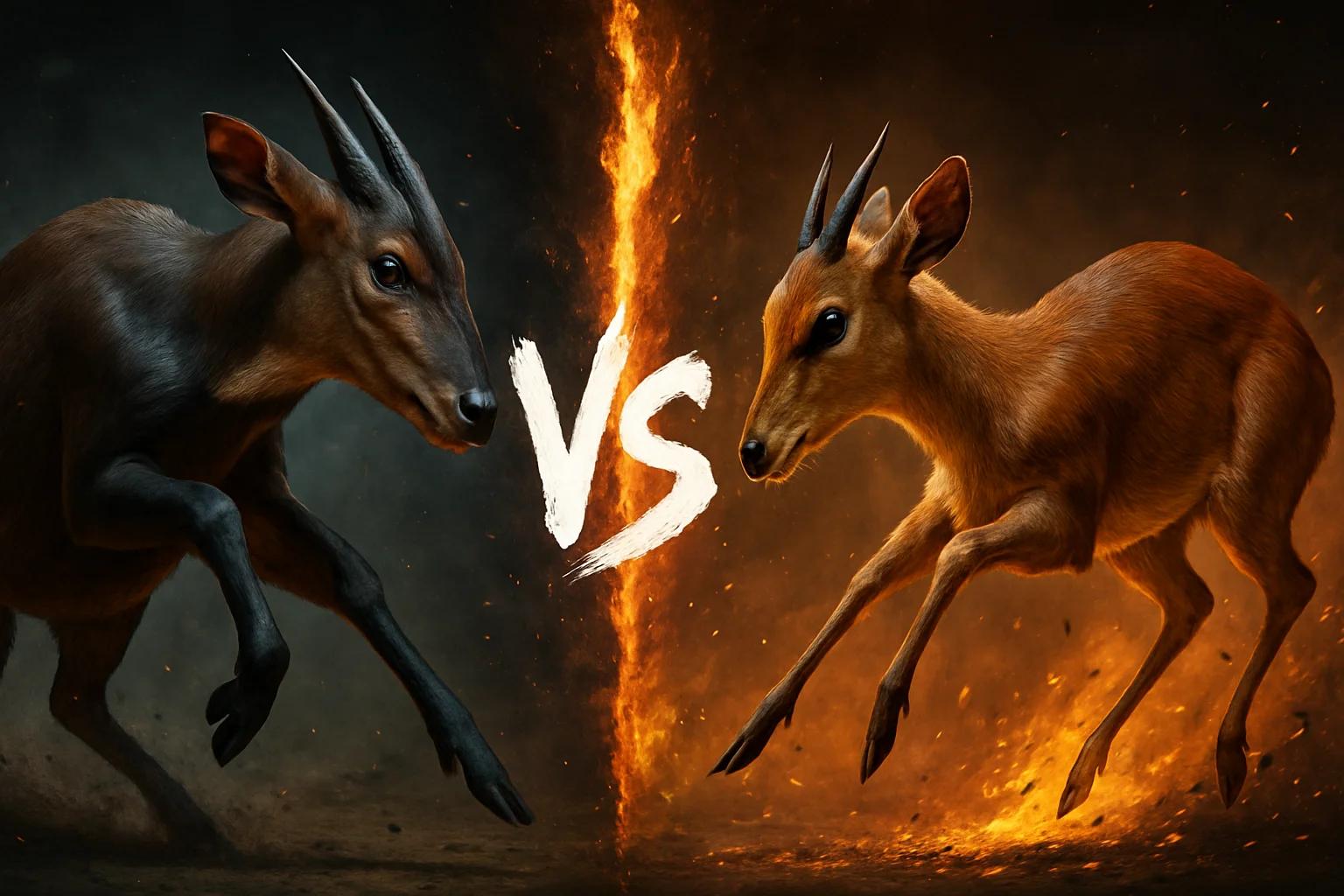
Bay Duiker vs Royal Antelope: Who Actually Wins?
The bay duiker wins, and it isn't close. An adult bay duiker typically weighs about 15–24 kg, roughly six to eight times the 2–3 kg royal antelope, the smallest antelope on Earth. The duiker carries sturdy spike horns on a thick-necked, wedge-shaped body built for driving through dense undergrowth, and it has the bulk to shove a rival off a fruit patch. The royal antelope's best weapon is leaving: explosive standing leaps of over 2.5 m and a hare-like dash into tangles where a larger animal can't follow. In any contest about holding ground or forcing contact, the duiker controls the outcome. The royal antelope wins only the contests that are really about vanishing.
Read comparison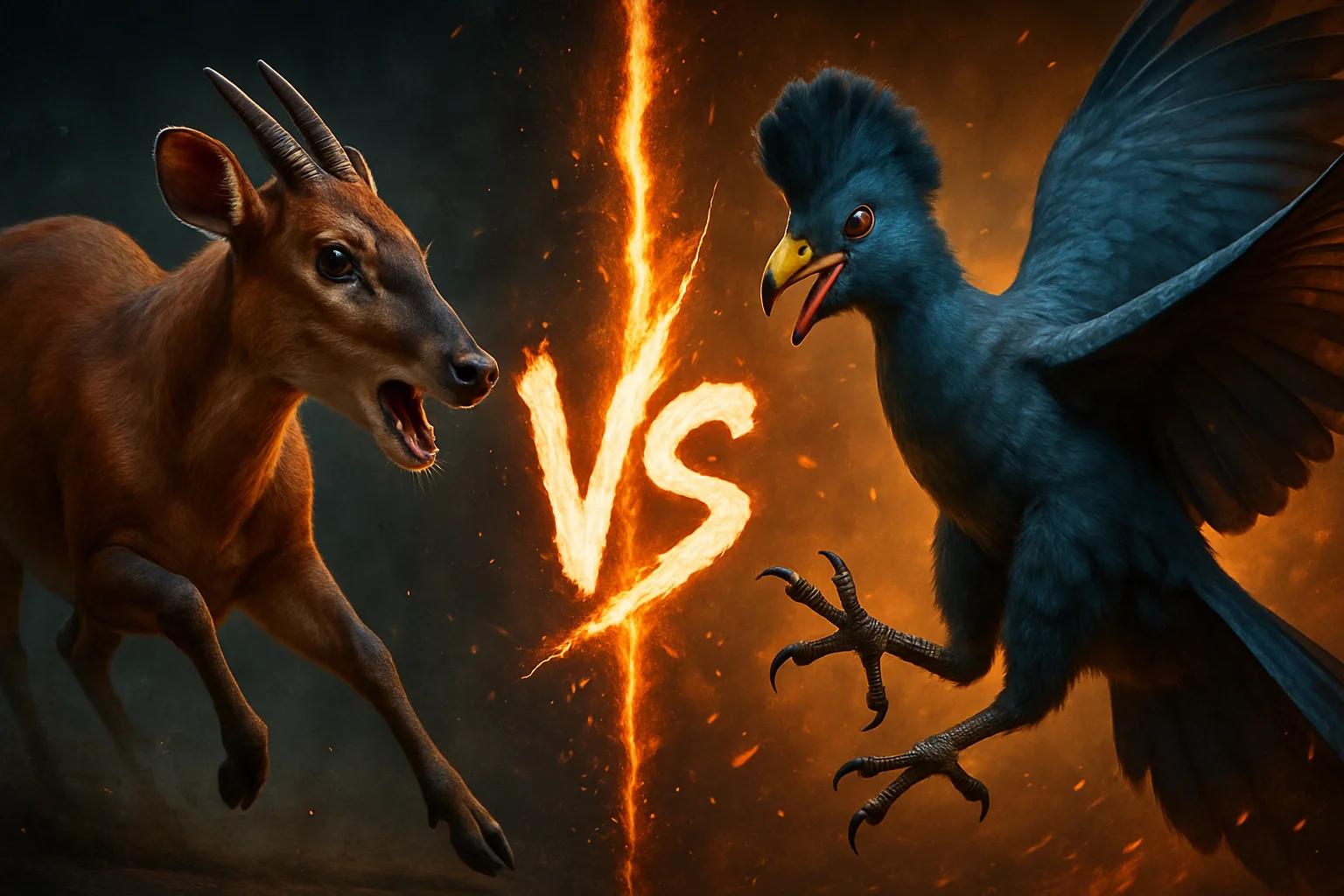
Bay Duiker vs Great Blue Turaco: Who Actually Wins?
The bay duiker wins. A bay duiker weighs roughly 15–25 kg, against about 1 kg for a great blue turaco, so it brings around twenty times the mass. It also has short, spike-like horns, a dense forehead built for butting, and hard hooves on a compact sprinter's frame. The turaco is a striking canopy specialist: about 70–75 cm long, with a heavy bill, strong feet, and a habit of bounding along branches. But it has no weapon that can seriously threaten a mammal of that size. Its real advantage is altitude, not force. If the meeting happens where the duiker can reach it, on the ground or at a fallen-fruit patch, the antelope's mass and horns settle things fast. The turaco's only reliable 'win' is to leave, usually by hopping upward and gliding away in its famously clumsy style. That counts as survival, not victory.
Read comparison
Discussion
What do you think?
Share your reasoning with other readers. Be civil and stick to the animals.
Sign in to join the discussion.
Sign inNo comments yet. Start the conversation.