

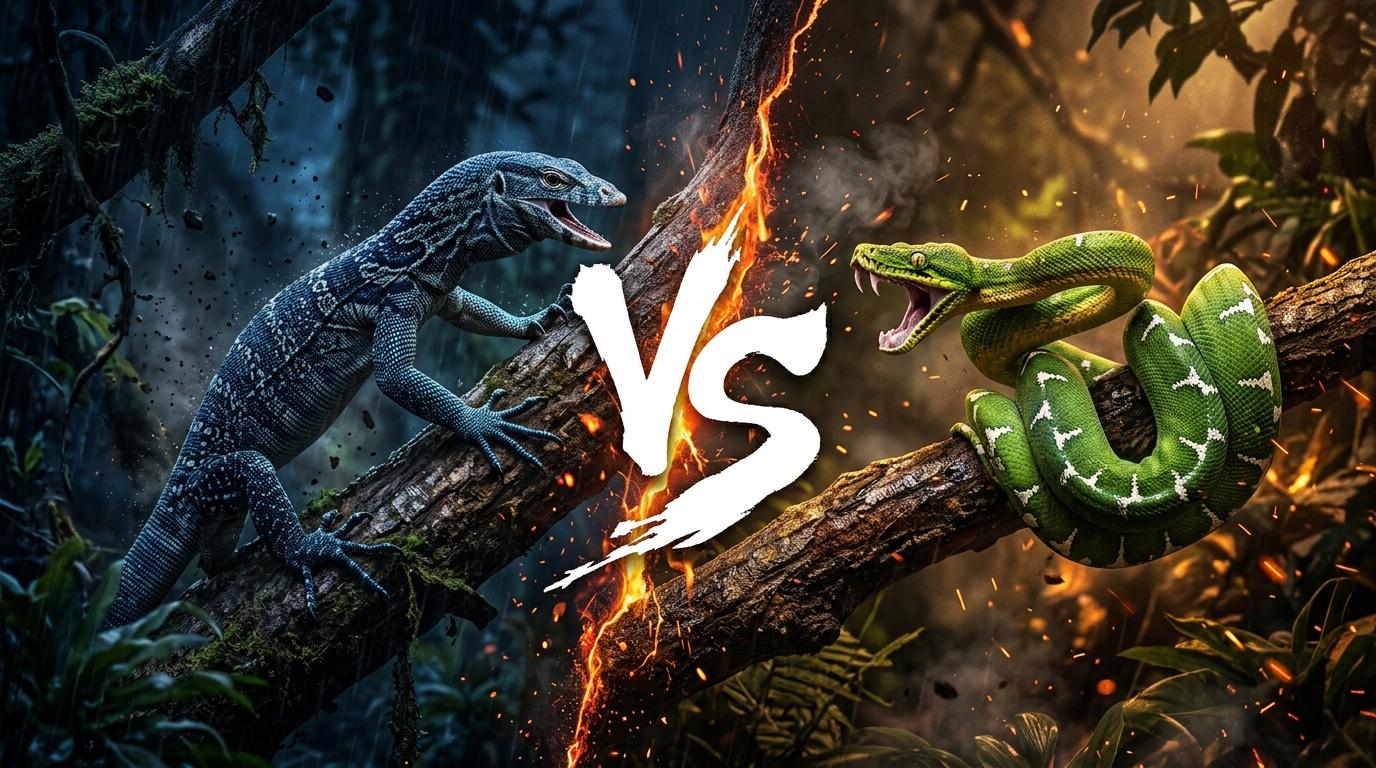
Blue Tree Monitor vs Emerald Tree Boa: Who Actually Wins?
Blue tree monitor vs emerald tree boa: an arboreal lizard built for speed and grip against a canopy constrictor built for ambush and leverage. Here's who wins and why.
Blue Tree Monitor vs Emerald Tree Boa
Matchup winner
Emerald Tree Boa
Quick verdict
Start with the direct answer, then use the structured comparison below to see what changes the outcome.
The emerald tree boa wins this canopy matchup. Both are slender, branch-dwelling specialists of similar overall length class, but the boa carries more body mass along its frame and fights with a system the monitor has no answer for once contact is made. It anchors with a prehensile tail, strikes with long, recurved front teeth built to hold on, and then applies coils that turn every movement the lizard makes into lost breath. The blue tree monitor is quicker, more alert, more active and armed with hooked climbing claws and a sharp bite, so it is far from helpless. If it sees the snake first, the smartest outcome is that it simply leaves. In a committed fight on branches, though, the boa's grip-and-squeeze toolkit beats the monitor's scratch-and-bite toolkit more often than not.
Read the full explanation
Winner: Emerald Tree Boa, roughly 2 out of 3 committed encounters.
The boa's edge is mass, ambush positioning and constriction. Once it coils, the lizard's speed stops mattering.
The monitor's edge is daytime alertness, agility and escape. It wins by not getting caught, not by overpowering.
Real-world note: they never meet. The blue tree monitor is endemic to Batanta Island, Indonesia, and the emerald tree boa lives in South American rainforest.
Reader vote
Who do you think wins?
Pick a side — no account needed. Results update live.
No votes yet — be the first to call it.
Editorial note
Why people disagree
Monitor fans see 'lizard with claws and teeth' and assume it outfights a snake. But small arboreal monitors are built for foraging and climbing, not wrestling a constrictor heavier than they are.
Usable body mass
In a grappling contest on a branch, the heavier animal controls leverage and decides who falls.
Ambush control
The boa chooses when the fight starts, and the first clean bite is often the whole contest.
Canopy agility
Speed lets the monitor dodge, reposition, or simply leave, which is its best weapon.
Read the full explanation +
Snake fans overrate the ambush. A diurnal, active lizard is hard to catch off guard, and a missed strike gives the monitor every chance to escape.
Length comparisons mislead. Much of the monitor's length is a slim prehensile tail, while the boa's length is mostly working muscle.
Comparison FAQ
Short, direct answers to the next questions readers usually ask after the headline verdict.
Would a blue tree monitor beat an emerald tree boa in a fight?+
Usually not. In a committed fight the emerald tree boa wins most encounters thanks to greater body mass, a gripping bite, and constriction.
Which is stronger, the blue tree monitor or the emerald tree boa?+
The emerald tree boa. Its body is mostly muscle used for constriction and anchoring, while much of the monitor's length is a slender tail.
Why is the blue tree monitor still dangerous to the boa?+
Its hooked claws and sharp bite can wound the snake, and its speed and daytime alertness mean it can dodge strikes and escape. A boa that misses or tangles badly can come away hurt.
Do blue tree monitors and emerald tree boas ever meet in the wild?+
No. The blue tree monitor lives only on Batanta Island in Indonesia, and the emerald tree boa is native to South American rainforests.
Is the emerald tree boa venomous?+
No. It is a nonvenomous constrictor with notably long front teeth for gripping prey.
Head-to-head species stats
These are the same core AnimalDex stat dimensions used on the dedicated animal pages, pulled side by side so the matchup is faster to scan.
Blue Tree Monitor
Tier BEmerald Tree Boa
Tier CTrait-by-trait comparison
Only the categories that matter to this matchup are included. The goal is not filler stats, but the real design differences that change the result.
Light, much of the length is tail
Usable body mass
Emerald Tree Boa
Heavier, muscular through the body
Usable body mass
Emerald Tree Boa
Active forager, not a sit-and-wait hunter
Ambush control
Emerald Tree Boa
Coiled perch-and-strike specialist with heat-sensing lip pits
Ambush control
Emerald Tree Boa
Quick, nimble climber with hooked claws
Canopy agility
Blue Tree Monitor
Slow, deliberate mover
Canopy agility
Blue Tree Monitor
Sharp bite, raking claws
Grip-and-hold weaponry
Emerald Tree Boa
Long recurved front teeth plus constriction
Grip-and-hold weaponry
Emerald Tree Boa
Diurnal, sharp-eyed, constantly scanning
Threat awareness
Blue Tree Monitor
Mostly nocturnal, relies on stillness
Threat awareness
Blue Tree Monitor
Tough skin, but small frame
Close-range durability
Emerald Tree Boa
Can absorb scratches while squeezing
Close-range durability
Emerald Tree Boa
How the verdict forms
Verdict timeline
01 · Usable body mass
Emerald Tree Boa
02 · Ambush control
Emerald Tree Boa
03 · Canopy agility
Blue Tree Monitor
04 · Grip-and-hold weaponry
Emerald Tree Boa
05 · Threat awareness
Blue Tree Monitor
06 · Close-range durability
Emerald Tree Boa
Change the conditions
Scenario breakdown
This is where shallow battle content usually fails. Terrain, spacing, timing, and engagement style can change the answer.
Scenario lean
Emerald Tree Boa
Verdict confidence
82%
Boa wins decisively.
At night the boa is in its element. It waits motionless and reads body heat through its lip pits, while the diurnal monitor is resting and less alert. A strike from a tail-anchored coil lands the recurved teeth, and the constriction follows almost immediately. The monitor gets few chances to use its speed.
AnimalDex field profiles
Explore these animals
Blue Tree Monitor
Varanus macraei
island rainforest canopy and humid woodland
Emerald Tree Boa
Corallus caninus
Humid tropical rainforest canopy and understory branch systems.
Systems Intelligence & Hidden Purpose
See the animals behind this comparison as engineered biological systems: what each one is built to do, where it gains leverage, and why the matchup changes by scenario.
Specialized Hardware
electric blue body pattern, long prehensile tail, and canopy climbing agility give the Blue Tree Monitor a body plan tuned for its niche.
Systems Script
Blue Tree Monitors operate through island rainforest canopy and humid woodland. Their design links movement, feeding, shelter, and timing into one workable survival system.
Strategic Insight
Dense environments reward precision, patience, and the ability to read layered cover.
Specialized Hardware
Bright green body with white markings, heavy body coiled on branches, and large head with facial pits give the Emerald Tree Boa a body plan tuned for its niche.
Systems Script
Emerald Tree Boas operate in humid tropical rainforest canopy and understory branch systems. Their design helps them match food access, shelter, and timing inside that environment.
Strategic Insight
A system gains efficiency when rest position and attack position are almost the same thing.
Final take
The emerald tree boa is the pick. It brings more working muscle, a strike designed to hold on, and a constriction finish that nullifies the monitor's best traits. When the fight happens on the boa's terms, which is most of the time in a committed clash, the snake wins.
Read the full explanation
The blue tree monitor is not a pushover. It is a fast, alert, well-clawed daytime climber whose real advantage is not being there when the strike comes. Its strategy is mobility, and in daylight that strategy works. It just isn't a fighting strategy, and this question is about a fight.
Collect both animals in AnimalDex
Track the species behind this matchup, compare their real traits, and build the rivalry into your AnimalDex collection.
Related comparisons
Continue with nearby matchups to compare more real-world animal traits without dropping into junky who-wins filler.

Blue Tree Monitor vs Eyelash Viper: Who Actually Wins?
The Blue Tree Monitor wins this one, narrowly. At roughly a meter long, most of it a gripping prehensile tail, and several times the eyelash viper's body mass, Varanus macraei is an active, intelligent canopy forager with strong jaws, sharp climbing claws, and the stamina to keep moving through branches all day. The eyelash viper is a stationary sit-and-wait specialist. It is usually under 75 cm and built to deliver one fast hemotoxic strike to frogs, lizards, small birds, and rodents, then track the prey as the venom works. That system is excellent against small animals but less reliable against a lizard this large and mobile. A monitor that sees the viper first can pin it or reach the head before a decisive strike lands, and venom dosed for a 30-gram frog has to work much harder on a lizard several times heavier. The viper's path to victory is real. If the monitor blunders into strike range on a leafy branch, one well-placed bite can cause painful, serious tissue damage, so this is a fight the lizard wins more often than not, never safely.
Read comparison
Emerald Tree Boa vs Red-footed Tortoise: Who Actually Wins?
The red-footed tortoise wins this matchup. It is not because the tortoise is the better hunter. It isn't a hunter at all. It wins because the emerald tree boa has no realistic way to beat it. An adult emerald tree boa is a slender canopy specialist, usually around 1.5–1.8 m long and roughly a kilogram or two. Its long front teeth and constricting coils are built to pin and suffocate birds, bats and small mammals. An adult red-footed tortoise can weigh several times more and carries a domed shell of fused bone capped with keratin scutes. When threatened, it can pull its head and limbs in and shield the openings with its scaled forelegs. Boa teeth glance off keratin, coils find no ribcage to squeeze, and the tortoise is far too large to swallow. Meanwhile the tortoise can simply hold its ground or plod forward. The boa's best move is to disengage, and in an encounter framed as who controls the ground, disengaging is losing. The boa only claims the edge up in the branches, where the tortoise never goes.
Read comparison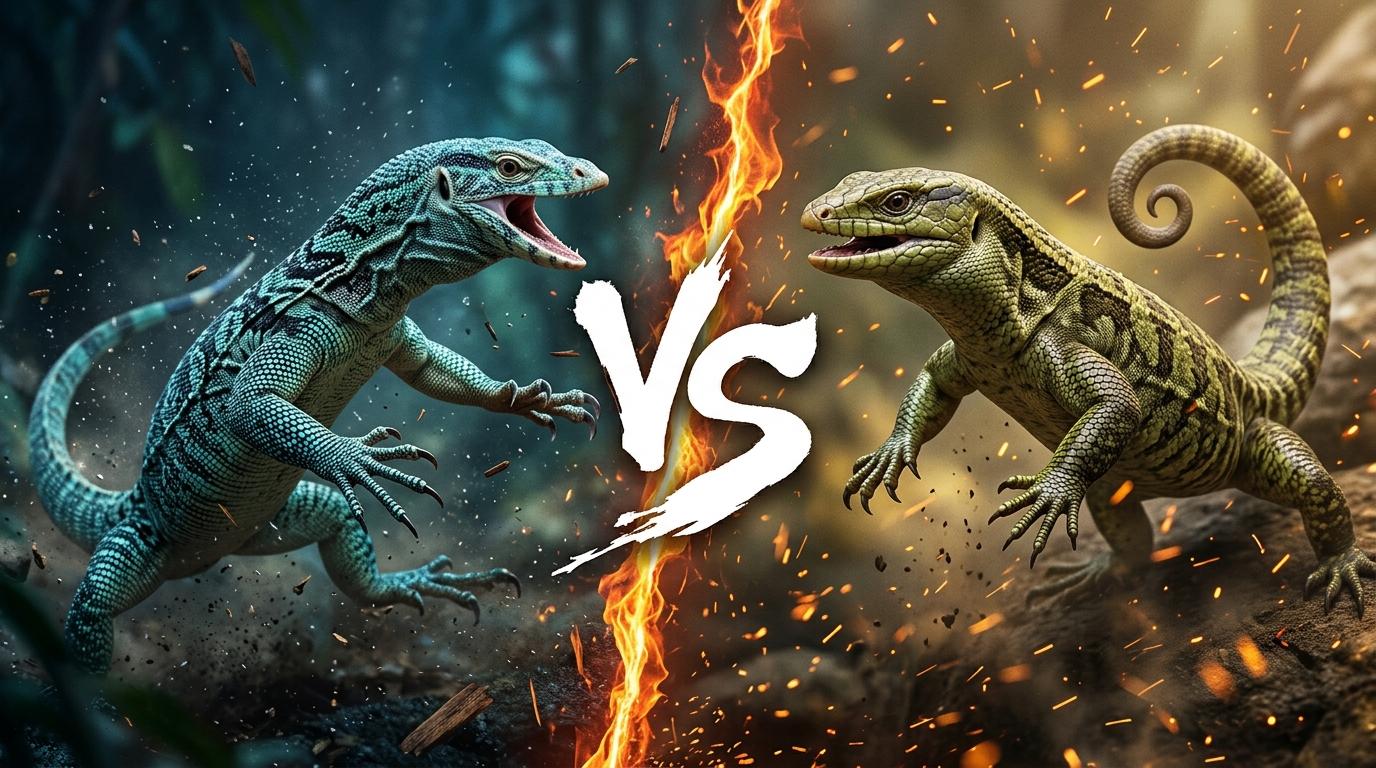
Blue Tree Monitor vs Monkey-tailed Skink: Who Actually Wins?
The Blue Tree Monitor wins this matchup. Varanus macraei is a slender, fast, actively foraging predator from Batanta Island. It has recurved serrated teeth, needle-sharp climbing claws, a prehensile tail and the high-energy metabolism typical of monitors. The Monkey-tailed Skink (Corucia zebrata) of the Solomon Islands is bulkier and can be similar in overall length. But it is a slow, almost entirely herbivorous leaf-eater, built for patience and grip rather than offense. The skink's real weapons are a hard, crushing bite, tough scales and an ability to clamp onto a branch and refuse to move. Those weapons make it costly to fight, but not hard to outmaneuver. In most realistic contexts, the monitor's speed, reach, tooth design and predatory decision-making give it control of the encounter, while the skink's best outcome is a stubborn stalemate that ends with the monitor walking away.
Read comparison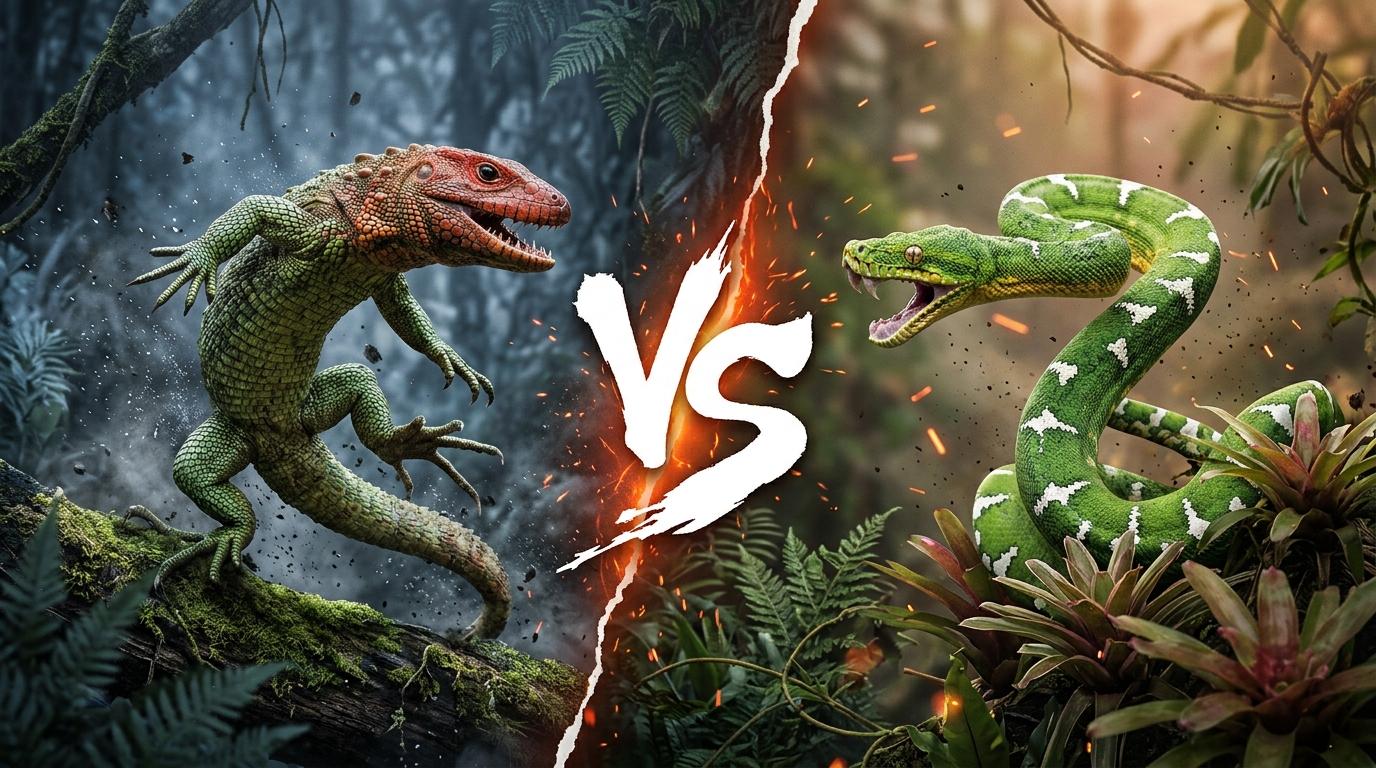
Caiman Lizard vs Emerald Tree Boa: Who Actually Wins?
The caiman lizard wins most realistic encounters. The emerald tree boa looks like the bigger threat because it is longer, has fearsome front teeth, and is a precise ambush constrictor. But it is a slender, light-bodied snake, usually around 1.5–1.8 m and under about 1.5 kg, built to snatch birds and small mammals from branches. The caiman lizard is a heavy-bodied tegu relative, roughly 0.9–1.2 m long and often 2 kg or more. It is covered in thick, keeled, armor-like scales and armed with broad molar-like teeth and jaw muscles made for crushing snail shells. That combination is the wrong size and the wrong build for a tree boa to subdue. On the ground, in flooded forest, or in the water, the lizard's mass, durability, and crushing bite decide things. The boa's real edge exists only high in the canopy, where its grip, camouflage, and strike geometry control the fight.
Read comparison
Discussion
What do you think?
Share your reasoning with other readers. Be civil and stick to the animals.
Sign in to join the discussion.
Sign inNo comments yet. Start the conversation.