

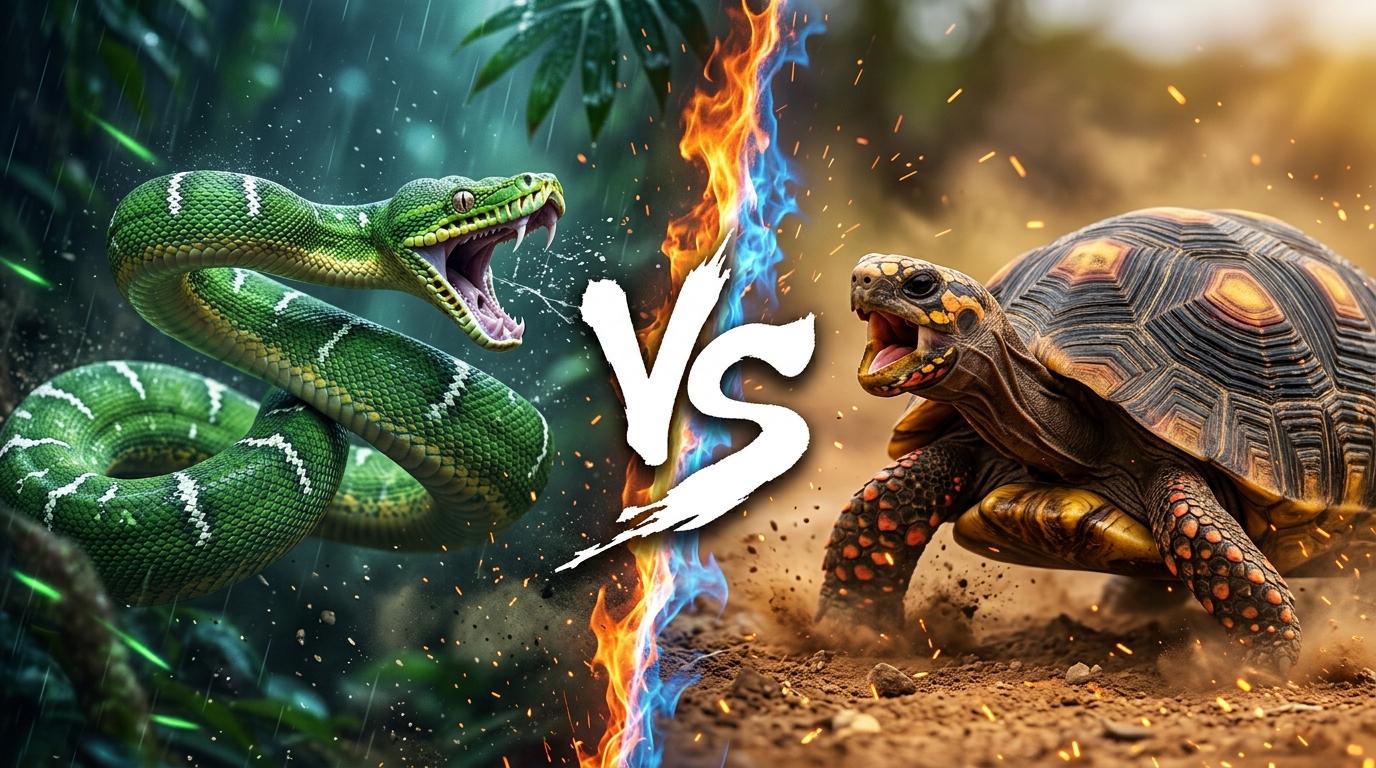
Emerald Tree Boa vs Red-footed Tortoise: Who Actually Wins?
Emerald tree boa vs red-footed tortoise: a canopy ambush predator meets a walking fortress. See who wins the fight, trait by trait and scenario by scenario.
Emerald Tree Boa vs Red-footed Tortoise
Matchup winner
Red-footed Tortoise
Quick verdict
Start with the direct answer, then use the structured comparison below to see what changes the outcome.
The red-footed tortoise wins this matchup. It is not because the tortoise is the better hunter. It isn't a hunter at all. It wins because the emerald tree boa has no realistic way to beat it. An adult emerald tree boa is a slender canopy specialist, usually around 1.5–1.8 m long and roughly a kilogram or two. Its long front teeth and constricting coils are built to pin and suffocate birds, bats and small mammals. An adult red-footed tortoise can weigh several times more and carries a domed shell of fused bone capped with keratin scutes. When threatened, it can pull its head and limbs in and shield the openings with its scaled forelegs. Boa teeth glance off keratin, coils find no ribcage to squeeze, and the tortoise is far too large to swallow. Meanwhile the tortoise can simply hold its ground or plod forward. The boa's best move is to disengage, and in an encounter framed as who controls the ground, disengaging is losing. The boa only claims the edge up in the branches, where the tortoise never goes.
Read the full explanation
Red-footed tortoise wins overall. Its shell neutralizes every weapon the boa has.
An emerald tree boa's teeth and constriction are tuned for small, soft-bodied prey, not armored reptiles.
An adult tortoise outweighs the boa several times over and is far too bulky to swallow.
The boa 'wins' only in the canopy, where the two animals barely interact.
Reader vote
Who do you think wins?
Pick a side — no account needed. Results update live.
No votes yet — be the first to call it.
Editorial note
Why people disagree
Many people assume a snake automatically beats a slow animal. But the boa's hardware assumes a soft target, and the tortoise isn't one.
Close-range durability
The whole fight hinges on whether the boa can damage its target. Against a closed shell, it can't.
Explosive strike
The boa lands first every time. But speed only matters if the strike lands on something vulnerable.
Lethal toolkit
The boa carries real killing gear. It is simply aimed at prey that breathes through soft, squeezable ribs.
Read the full explanation +
Some argue a stalemate isn't a win. In practice, the animal that walks away unhurt and keeps the ground is the clear winner.
Hatchling tortoises really are vulnerable to snakes. People mix up the juvenile risk with the adult matchup.
Comparison FAQ
Short, direct answers to the next questions readers usually ask after the headline verdict.
Would an emerald tree boa beat a red-footed tortoise?+
No. An adult red-footed tortoise is too heavily armored and too large for the boa to injure, constrict or swallow. The likely result is the boa giving up and leaving.
Which is stronger, the emerald tree boa or the red-footed tortoise?+
The boa has more muscular coil strength for its size and a far faster strike. The tortoise has more total mass and much tougher armor, and that is what decides this encounter.
Can an emerald tree boa eat a tortoise?+
Not an adult. A hatchling or very young tortoise could be at risk from snakes in general, but grown red-footed tortoises are well outside the size and shape this boa hunts.
Why is the emerald tree boa still dangerous even though it loses?+
Its long front teeth deliver a painful, deep bite, and its ambush strike is extremely fast. Birds, bats, rodents and small lizards have every reason to fear it. Its loss here only reflects the tortoise's armor.
Do they live in the same habitat?+
Their ranges overlap in parts of northern South America, including Amazonian and Guiana forests. But the boa lives in the canopy and the tortoise on the forest floor, so direct conflict is rare.
Head-to-head species stats
These are the same core AnimalDex stat dimensions used on the dedicated animal pages, pulled side by side so the matchup is faster to scan.
Emerald Tree Boa
Tier CRed-footed Tortoise
Tier DTrait-by-trait comparison
Only the categories that matter to this matchup are included. The goal is not filler stats, but the real design differences that change the result.
Smooth scales over a slender body
Close-range durability
Red-footed Tortoise
Domed bony shell with keratin scutes
Close-range durability
Red-footed Tortoise
Fast ambush strike from an S-coil
Explosive strike
Emerald Tree Boa
Slow, deliberate bite
Explosive strike
Emerald Tree Boa
Long recurved teeth plus constricting coils
Lethal toolkit
Emerald Tree Boa
Sharp-edged, toothless keratin beak
Lethal toolkit
Emerald Tree Boa
Light, arboreal build
Body mass leverage
Red-footed Tortoise
Several times heavier, low and stable
Body mass leverage
Red-footed Tortoise
Elite canopy sit-and-wait hunter
Ambush control
Emerald Tree Boa
Forest-floor forager
Ambush control
Emerald Tree Boa
Clumsy and exposed on the forest floor
Ground-holding persistence
Red-footed Tortoise
Steady, unbothered and able to wait out threats
Ground-holding persistence
Red-footed Tortoise
How the verdict forms
Verdict timeline
01 · Close-range durability
Red-footed Tortoise
02 · Explosive strike
Emerald Tree Boa
03 · Lethal toolkit
Emerald Tree Boa
04 · Body mass leverage
Red-footed Tortoise
05 · Ambush control
Emerald Tree Boa
06 · Ground-holding persistence
Red-footed Tortoise
Change the conditions
Scenario breakdown
This is where shallow battle content usually fails. Terrain, spacing, timing, and engagement style can change the answer.
Scenario lean
Red-footed Tortoise
Verdict confidence
82%
Tortoise holds the ground; boa retreats.
On the leaf litter the boa loses its anchor branches and its ambush geometry. If it strikes, its teeth meet scutes. If it tries to coil, it wraps a rigid dome it can neither squeeze nor swallow. The tortoise withdraws, waits, then resumes foraging. The boa gains nothing and burns energy, so it leaves.
AnimalDex field profiles
Explore these animals
Emerald Tree Boa
Corallus caninus
Humid tropical rainforest canopy and understory branch systems.
Red-footed Tortoise
Chelonoidis carbonarius
Forest edge, savannah, scrub, and humid to seasonally dry tropical habitats.
Systems Intelligence & Hidden Purpose
See the animals behind this comparison as engineered biological systems: what each one is built to do, where it gains leverage, and why the matchup changes by scenario.
Specialized Hardware
Bright green body with white markings, heavy body coiled on branches, and large head with facial pits give the Emerald Tree Boa a body plan tuned for its niche.
Systems Script
Emerald Tree Boas operate in humid tropical rainforest canopy and understory branch systems. Their design helps them match food access, shelter, and timing inside that environment.
Strategic Insight
A system gains efficiency when rest position and attack position are almost the same thing.
Specialized Hardware
Dark domed shell, red or orange leg scales, and heavy slow walking gait give the Red-footed Tortoise a body plan tuned for its niche.
Systems Script
Red-footed Tortoises operate in forest edge, savannah, scrub, and humid to seasonally dry tropical habitats. Their design helps them match food access, shelter, and timing inside that environment.
Strategic Insight
Consistency can take a system farther than urgency.
Final take
This matchup is a lesson in mismatched hardware. The emerald tree boa is a beautifully specialized killer, but its specialization is narrow: small, warm-blooded, soft-bodied prey seized from the canopy. The red-footed tortoise isn't on that menu, and its shell makes sure it never will be once it grows past hatchling size.
Read the full explanation
The red-footed tortoise wins because defense beats offense when the offense can't scale. It never needs to hurt the boa. It only needs to stay intact, and its shell is built for exactly that.
Collect both animals in AnimalDex
Track the species behind this matchup, compare their real traits, and build the rivalry into your AnimalDex collection.
Related comparisons
Continue with nearby matchups to compare more real-world animal traits without dropping into junky who-wins filler.

Caiman Lizard vs Red-footed Tortoise: Who Actually Wins?
The caiman lizard wins this matchup on initiative and weaponry. Dracaena guianensis is a heavy-bodied, semi-aquatic South American teiid that reaches about 1.2 m. It carries broad, molar-like crushing teeth built to crack snail shells, and it is quicker, more agile and more willing to press an encounter than the slow, herbivorous red-footed tortoise. But the tortoise's shell is the great equalizer. An adult Chelonoidis carbonarius can tuck its head and legs inside and become a problem the lizard cannot realistically solve. So 'winning' here means controlling the encounter, pushing the tortoise into a defensive shutdown, and walking away unharmed. It does not mean killing it. The lizard dictates every exchange. The tortoise only survives them.
Read comparison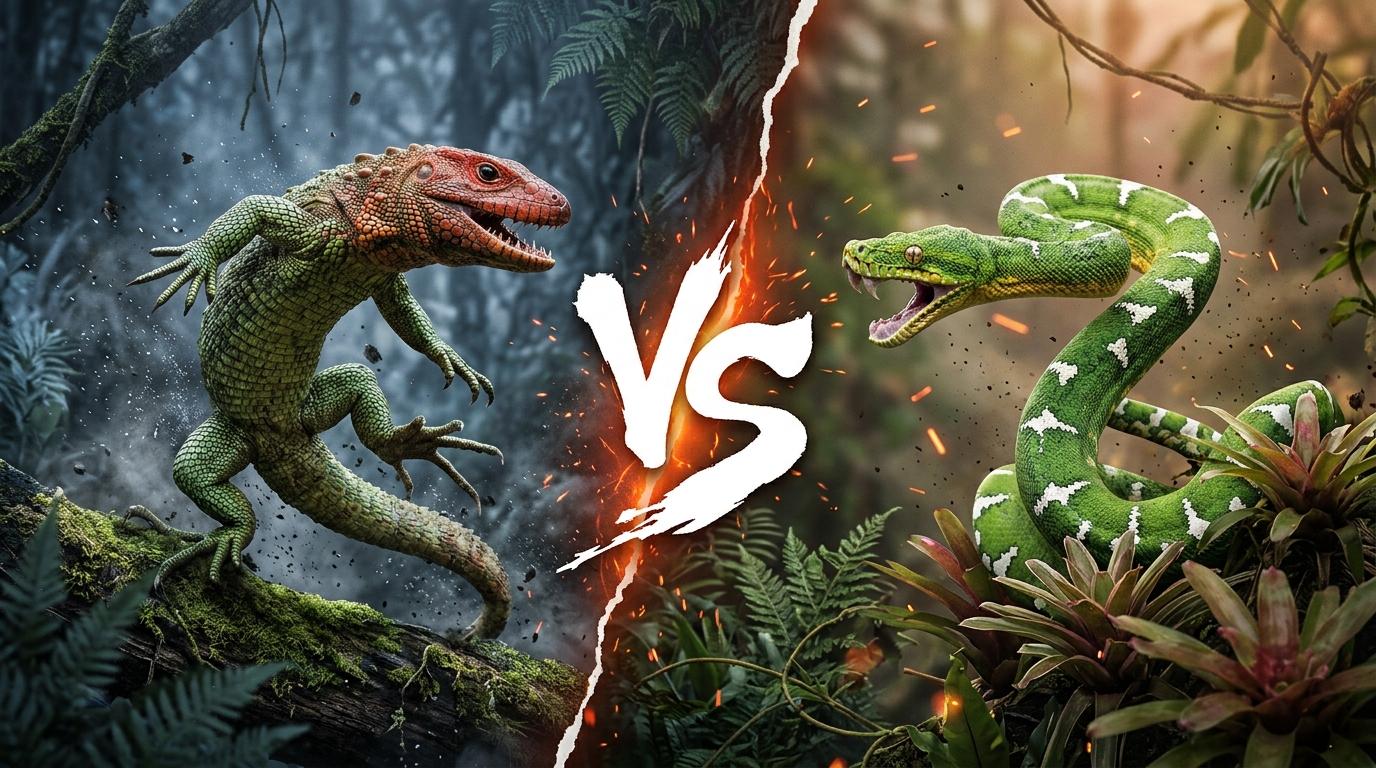
Caiman Lizard vs Emerald Tree Boa: Who Actually Wins?
The caiman lizard wins most realistic encounters. The emerald tree boa looks like the bigger threat because it is longer, has fearsome front teeth, and is a precise ambush constrictor. But it is a slender, light-bodied snake, usually around 1.5–1.8 m and under about 1.5 kg, built to snatch birds and small mammals from branches. The caiman lizard is a heavy-bodied tegu relative, roughly 0.9–1.2 m long and often 2 kg or more. It is covered in thick, keeled, armor-like scales and armed with broad molar-like teeth and jaw muscles made for crushing snail shells. That combination is the wrong size and the wrong build for a tree boa to subdue. On the ground, in flooded forest, or in the water, the lizard's mass, durability, and crushing bite decide things. The boa's real edge exists only high in the canopy, where its grip, camouflage, and strike geometry control the fight.
Read comparison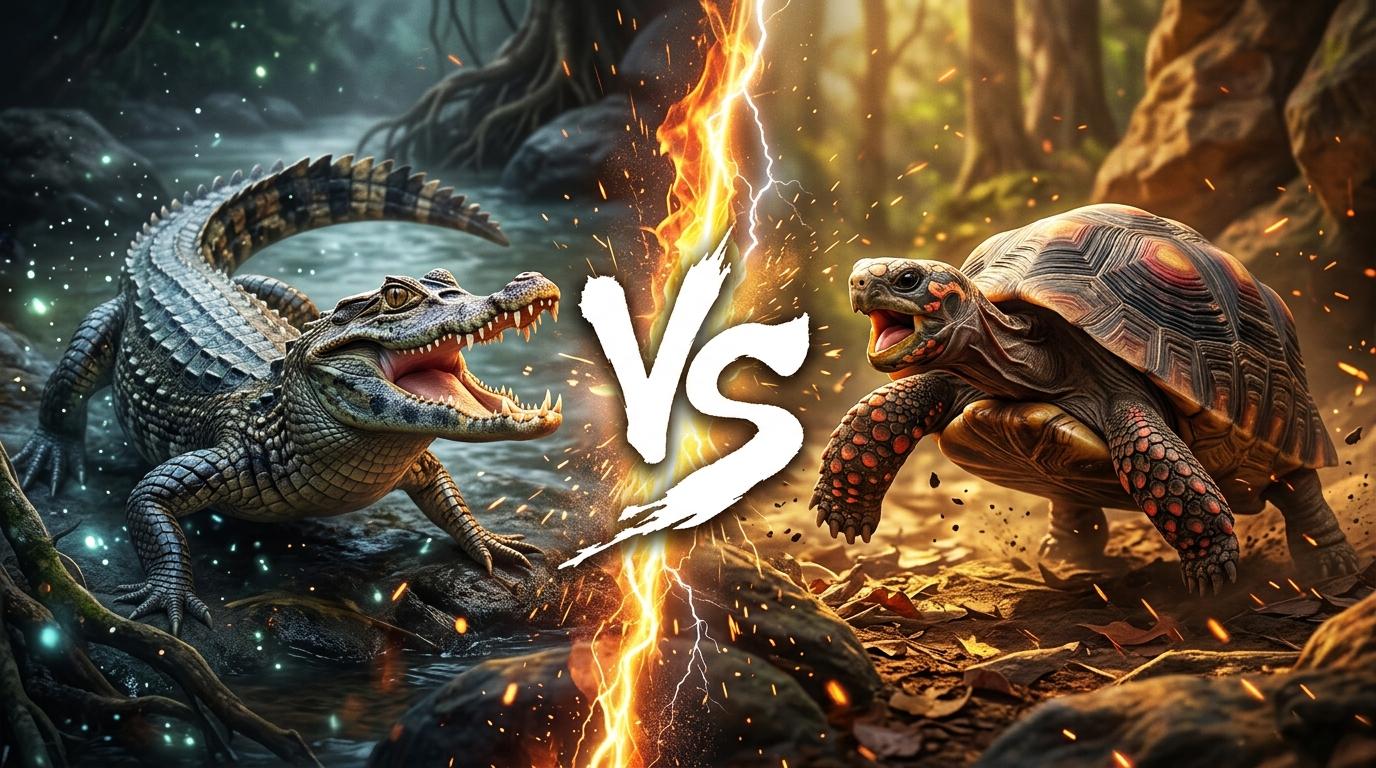
Dwarf Caiman vs Red-footed Tortoise: Who Actually Wins?
The Dwarf Caiman wins this matchup clearly. Cuvier's dwarf caiman is a fast-striking, heavily armored crocodilian with a bite built for gripping and crushing. It has far more speed, more aggression, and the only real offensive weapon in the pairing. The red-footed tortoise is a slow, plant-heavy forest grazer whose whole strategy is to retract and outlast. That shell is a serious obstacle: a full-grown adult tortoise can be too wide and too hard for a dwarf caiman to crack or swallow, so many encounters would end with no kill at all. But 'winning' here means controlling the encounter. The caiman sets the terms, can injure exposed limbs and heads, and easily overwhelms juveniles. The tortoise survives by refusing to fight, not by beating anything.
Read comparison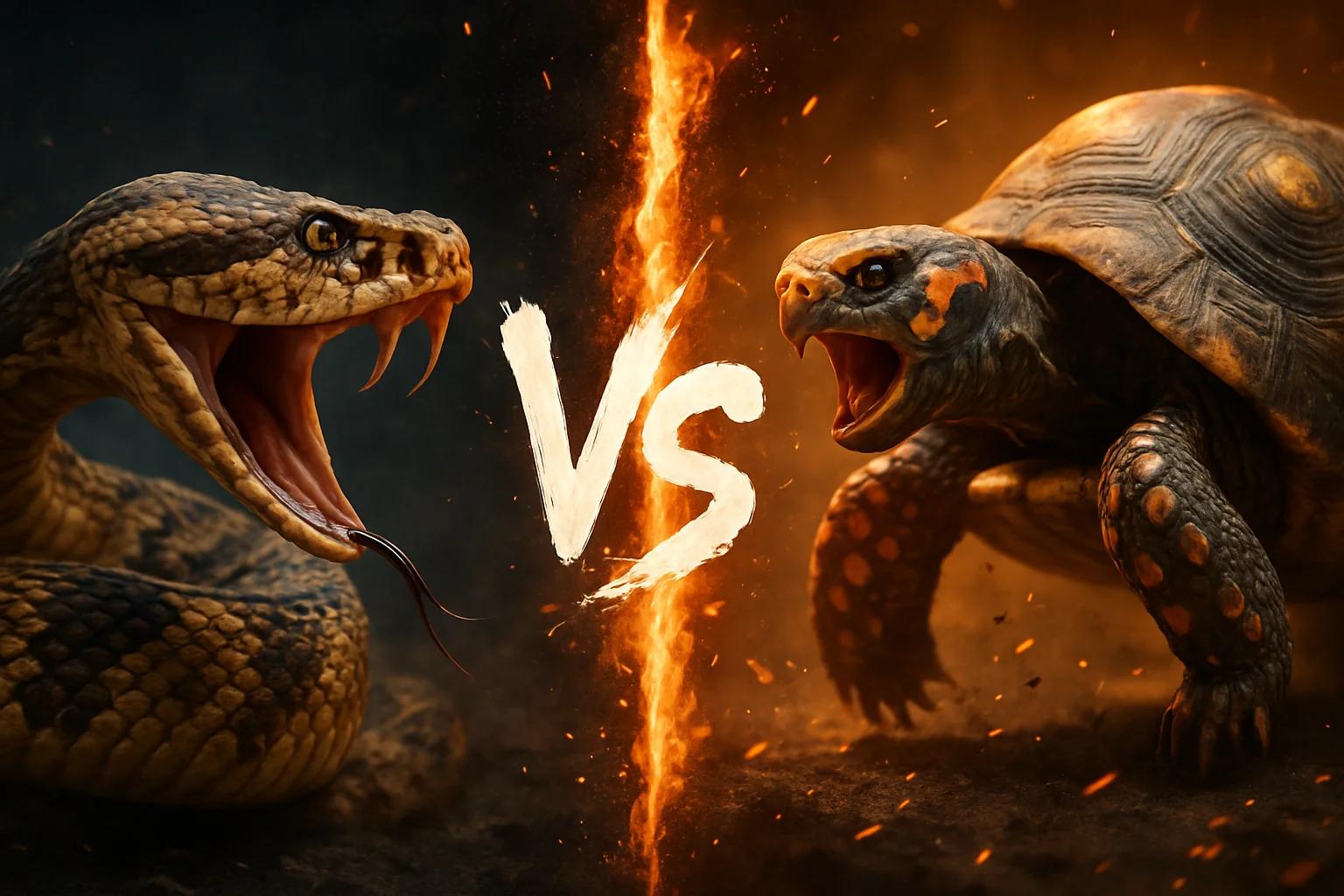
Bushmaster vs Red-footed Tortoise: Who Actually Wins?
The bushmaster wins, though it is a narrower win than the size gap suggests. Lachesis muta is the Americas' longest viper, with adults commonly 2–3 m. It has long fangs, a high-yield venom built to destroy tissue and blood, and heat-sensing pits that read a warm body in the dark. The red-footed tortoise is a slow, fruit-heavy forager whose real weapon is defense: a domed carapace and plastron that most forest predators cannot open. The bushmaster cannot crack that shell or swallow an adult tortoise. What it can do is strike the exposed head, neck, or legs before they retract, and in a forced engagement that reach and venom decide the outcome. The tortoise's best result is survival, not victory. It can wait inside its shell, but it has no way to hurt a snake that strikes and pulls back out of range.
Read comparison
Discussion
What do you think?
Share your reasoning with other readers. Be civil and stick to the animals.
Sign in to join the discussion.
Sign inNo comments yet. Start the conversation.