

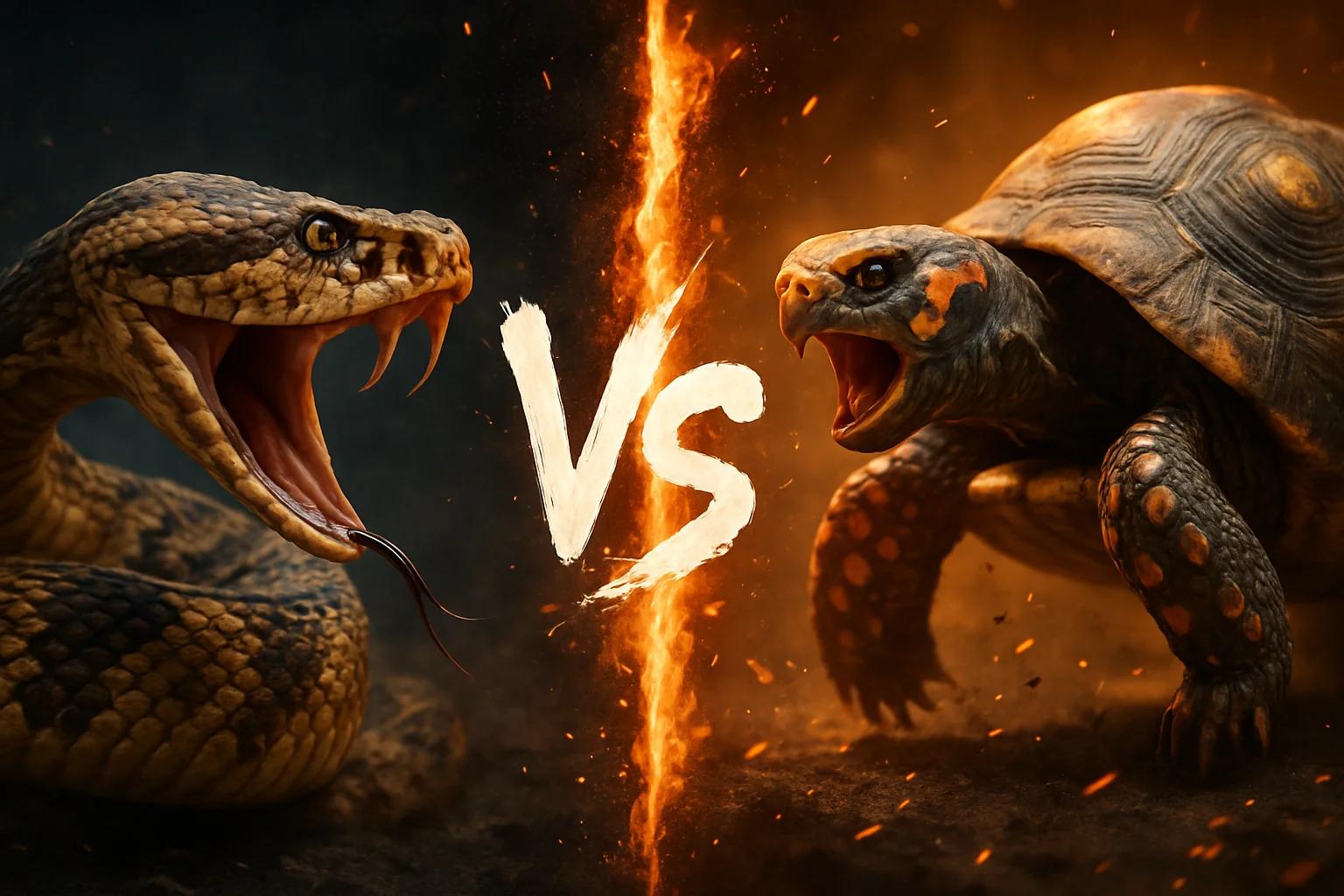
Bushmaster vs Red-footed Tortoise: Who Actually Wins?
Bushmaster vs red-footed tortoise: venom and ambush hardware meet a living fortress. See who wins, why the shell matters, and how each fits the Neotropical forest system.
Bushmaster vs Red-footed Tortoise
Matchup winner
Bushmaster
Quick verdict
Start with the direct answer, then use the structured comparison below to see what changes the outcome.
The bushmaster wins, though it is a narrower win than the size gap suggests. Lachesis muta is the Americas' longest viper, with adults commonly 2–3 m. It has long fangs, a high-yield venom built to destroy tissue and blood, and heat-sensing pits that read a warm body in the dark. The red-footed tortoise is a slow, fruit-heavy forager whose real weapon is defense: a domed carapace and plastron that most forest predators cannot open. The bushmaster cannot crack that shell or swallow an adult tortoise. What it can do is strike the exposed head, neck, or legs before they retract, and in a forced engagement that reach and venom decide the outcome. The tortoise's best result is survival, not victory. It can wait inside its shell, but it has no way to hurt a snake that strikes and pulls back out of range.
Read the full explanation
Bushmaster wins: long fangs, potent venom, and heat-guided strikes give it the only real offense in this matchup.
The tortoise cannot meaningfully injure an adult bushmaster. Its whole game is armor and endurance.
The shell turns many encounters into stalemates, so the bushmaster's win depends on landing a strike on exposed limbs or head.
In real forests the two mostly ignore each other. Tortoises are not typical bushmaster prey.
Reader vote
Who do you think wins?
Pick a side — no account needed. Results update live.
No votes yet — be the first to call it.
Editorial note
Why people disagree
Armor fans argue that a shell-retracted tortoise is effectively unkillable, so the snake 'can't win.' But being impossible to kill is not the same as winning.
Offensive lethality
Only one side can inflict serious harm. In a forced fight, that alone decides the winner.
Close-range durability
The shell is why this is not a blowout. It blocks most strike angles and turns the fight into a hunt for gaps.
Ambush control
The bushmaster picks the moment and the range, and the first strike is its best chance at exposed skin.
Read the full explanation +
Venom is often treated as instant death. Reptiles have slow metabolisms, though, and a bitten tortoise may decline slowly rather than collapse on the spot.
Some readers picture a constrictor-style fight. The bushmaster is a strike-and-release ambusher, which is a poor fit against an armored target, and that makes the matchup feel closer than the raw stats suggest.
Comparison FAQ
Short, direct answers to the next questions readers usually ask after the headline verdict.
Would a bushmaster beat a red-footed tortoise?+
Yes, in a forced fight. Its venomous strike to an exposed head or limb is the only decisive weapon on either side.
Which animal is stronger?+
The bushmaster is far stronger offensively, being much longer and capable of a fast strike. The tortoise is stronger only in passive resistance, thanks to its armored shell.
Can a bushmaster eat a red-footed tortoise?+
Not an adult. Bushmasters mainly eat rodents and other small mammals, and an adult tortoise's shell makes it effectively impossible to swallow.
Why does the tortoise stay dangerous to beat?+
Once it retracts, it offers almost no soft target. A snake that misses its first strike gains nothing by waiting, so the tortoise often wins by outlasting it.
Is the bushmaster dangerous to humans?+
Yes. Its bite is a medical emergency, although bites are uncommon because bushmasters are reclusive and avoid people.
Head-to-head species stats
These are the same core AnimalDex stat dimensions used on the dedicated animal pages, pulled side by side so the matchup is faster to scan.
Bushmaster
Tier BRed-footed Tortoise
Tier DTrait-by-trait comparison
Only the categories that matter to this matchup are included. The goal is not filler stats, but the real design differences that change the result.
Long fangs, high-yield hemotoxic venom
Offensive lethality
Bushmaster
Beak bite, mainly for fruit and fungi
Offensive lethality
Bushmaster
Thin-scaled, vulnerable body
Close-range durability
Red-footed Tortoise
Domed bony shell with retractable limbs
Close-range durability
Red-footed Tortoise
Heat pits, patient sit-and-wait coil
Ambush control
Bushmaster
Slow, visible, foraging on the open floor
Ambush control
Bushmaster
Fast lunging strike from a coil
Strike speed
Bushmaster
Retraction reflex, otherwise slow
Strike speed
Bushmaster
Low-energy waiter, but needs a payoff
Endurance and attrition
Red-footed Tortoise
Can seal up and outlast threats
Endurance and attrition
Red-footed Tortoise
2–3 m long, wide strike radius
Size and reach
Bushmaster
Roughly 30–40 cm shell
Size and reach
Bushmaster
How the verdict forms
Verdict timeline
01 · Offensive lethality
Bushmaster
02 · Close-range durability
Red-footed Tortoise
03 · Ambush control
Bushmaster
04 · Strike speed
Bushmaster
05 · Endurance and attrition
Red-footed Tortoise
06 · Size and reach
Bushmaster
Change the conditions
Scenario breakdown
This is where shallow battle content usually fails. Terrain, spacing, timing, and engagement style can change the answer.
Scenario lean
Bushmaster
Verdict confidence
82%
Bushmaster, by first-strike advantage.
In dense leaf litter, the bushmaster's camouflage and heat sensing let it strike a foraging tortoise whose head and forelimbs are extended. Ambush is the snake's specialty, and here its venom has the best chance of reaching exposed tissue before the tortoise retracts.
AnimalDex field profiles
Explore these animals
Bushmaster
Lachesis muta
humid tropical forest and dense rainforest floor
Red-footed Tortoise
Chelonoidis carbonarius
Forest edge, savannah, scrub, and humid to seasonally dry tropical habitats.
Systems Intelligence & Hidden Purpose
See the animals behind this comparison as engineered biological systems: what each one is built to do, where it gains leverage, and why the matchup changes by scenario.
Specialized Hardware
large viper body, leaf-litter camouflage, and forest-floor ambush give the Bushmaster a body plan tuned for its niche.
Systems Script
Bushmasters operate through humid tropical forest and dense rainforest floor Their design links movement, shelter, and feeding into one workable survival system.
Strategic Insight
An unseen system can hold enormous force if position and camouflage are already doing the work.
Specialized Hardware
Dark domed shell, red or orange leg scales, and heavy slow walking gait give the Red-footed Tortoise a body plan tuned for its niche.
Systems Script
Red-footed Tortoises operate in forest edge, savannah, scrub, and humid to seasonally dry tropical habitats. Their design helps them match food access, shelter, and timing inside that environment.
Strategic Insight
Consistency can take a system farther than urgency.
Final take
The bushmaster is the clear winner because it is the only participant with real offense. Its venom, reach, and ambush timing give it a path to seriously injuring the tortoise, while the tortoise has no path to injuring the snake.
Read the full explanation
The red-footed tortoise still earns respect. Its shell turns many encounters into a standoff, and in the wild most meetings probably end with the snake moving on. The fair summary is that the tortoise wins at survival while the bushmaster wins the fight.
Collect both animals in AnimalDex
Track the species behind this matchup, compare their real traits, and build the rivalry into your AnimalDex collection.
Related comparisons
Continue with nearby matchups to compare more real-world animal traits without dropping into junky who-wins filler.
Bushmaster vs Emerald Tree Boa: Who Actually Wins?
The bushmaster wins clearly. As the longest viper in the Americas, Lachesis muta often reaches 2–2.5 m and carries a heavy body, long fangs and a large venom load. That venom causes rapid tissue damage and blood-clotting failure. The emerald tree boa is a medium-sized arboreal constrictor, usually 1.5–1.8 m. It has extremely long front teeth built to grip birds and small mammals in the canopy, but it has no venom and was never built to subdue a large, armed snake. On the forest floor, where the bushmaster lives, the boa would have to close to grappling range. That range is exactly where a single envenomating bite decides the encounter. The boa's best outcome is avoidance, not victory.
Read comparison
Argentine Black and White Tegu vs Red-footed Tortoise: Who Actually Wins?
The Argentine Black and White Tegu wins clearly. It is a fast, muscular, heavy-jawed predator-scavenger that can reach about 1.2–1.4 m and weigh 5–7 kg or more. It also has the curiosity and mobility to control almost any encounter. The Red-footed Tortoise is a slow, mostly plant-eating forager whose real answer is its domed shell, not its beak. In a direct conflict, the tegu sets the pace, wins the food, and drives the tortoise off. It can also seriously injure exposed limbs, heads, or juvenile tortoises, which tegus are known to eat as eggs and hatchlings in the wild. An adult red-foot rarely 'loses' outright, though, because a fully withdrawn tortoise with a hard carapace is a poor return on effort. The tegu wins on control and dominance. The tortoise wins only at not being worth finishing.
Read comparison
Bushmaster vs Rhinoceros Viper: Who Actually Wins?
The bushmaster wins. Lachesis muta is the longest viper in the Americas and regularly exceeds 2 meters, sometimes approaching 3. The rhinoceros viper is a heavy-bodied African ambusher that usually stays around 1 to 1.2 meters. That length gap gives the bushmaster greater strike reach, a larger venom reserve per bite, and a body that is harder to pin or overwhelm. The rhinoceros viper has long fangs and a potent hemotoxic venom, so it can absolutely inflict a serious bite. But neither snake hunts other snakes, and in a forced clash, reach and mass decide who lands first and who absorbs the reply. Those advantages belong to the bushmaster.
Read comparison
Discussion
What do you think?
Share your reasoning with other readers. Be civil and stick to the animals.
Sign in to join the discussion.
Sign inNo comments yet. Start the conversation.