

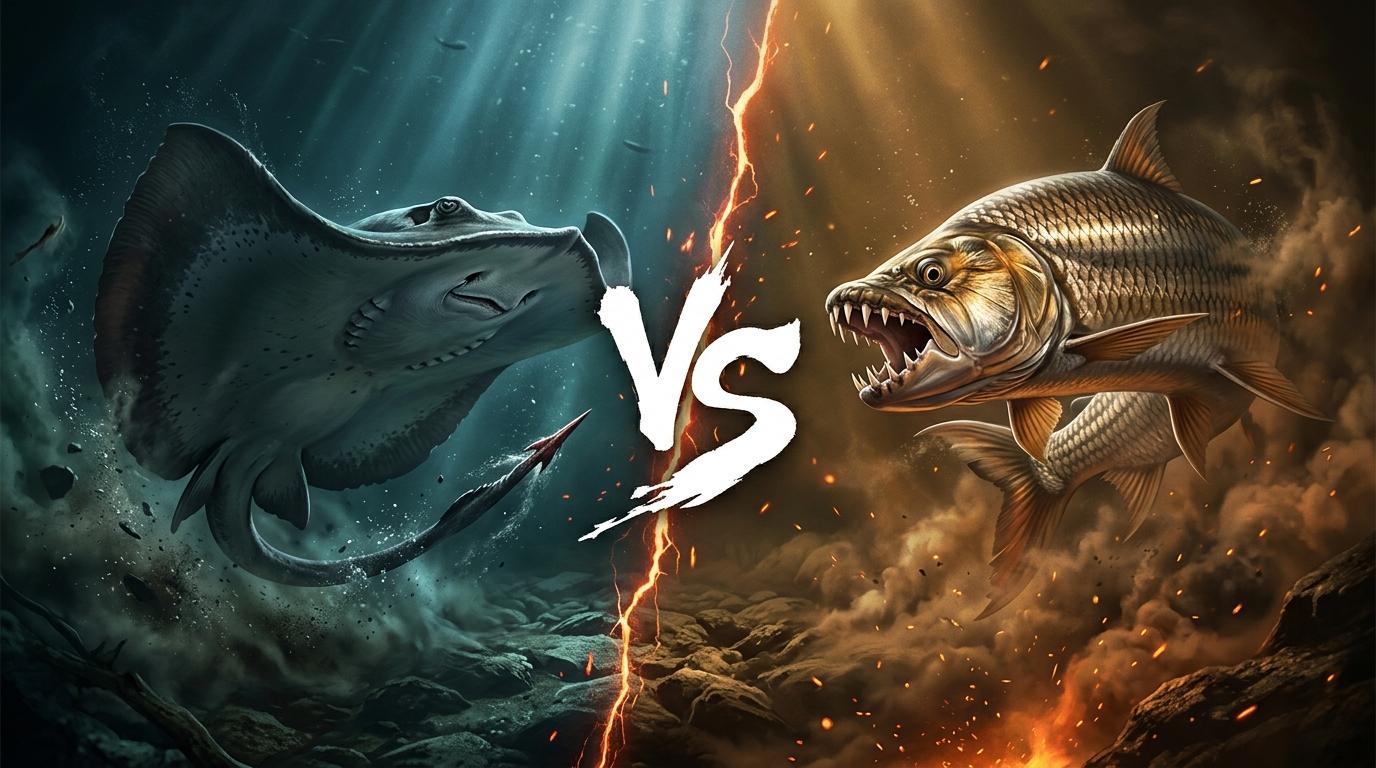
Giant Freshwater Stingray vs Goliath Tigerfish: Who Actually Wins?
Giant freshwater stingray vs goliath tigerfish: a biology-first breakdown of size, venom, bite power and speed to decide which river giant wins.
Giant Freshwater Stingray vs Goliath Tigerfish
Matchup winner
Giant Freshwater Stingray
Quick verdict
Start with the direct answer, then use the structured comparison below to see what changes the outcome.
The giant freshwater stingray wins. One of the largest freshwater fish on Earth, it can pass 2 meters across the disc and is often estimated at around 300 kg. It carries a serrated, venom-coated tail barb that can reach about 38 cm. The goliath tigerfish is a fast, toothy predator, but it usually weighs 50 kg or less, and its interlocking fangs are built to slice prey small enough to grab. A stingray's body is a broad, tough disc it can pin to the riverbed, and a fish that size is simply too big to bite into pieces. In any real encounter, the tigerfish's best move is to leave, and the stingray's sheer mass plus its barb make it the clear overall winner.
Read the full explanation
Winner: Giant Freshwater Stingray, with a large size and mass advantage.
The stingray's venomous serrated barb punishes any close attack.
The goliath tigerfish is faster and has a fearsome bite, but its prey is much smaller than an adult stingray.
The tigerfish only has a real edge against juvenile rays or in open, fast current.
Reader vote
Who do you think wins?
Pick a side — no account needed. Results update live.
No votes yet — be the first to call it.
Editorial note
Why people disagree
Goliath tigerfish look like monsters, with exposed dagger teeth and a reputation as Africa's piranha. That image makes people overrate how they would do against a far heavier animal.
Raw mass
In water, mass decides who can be bitten, pushed or pinned. The ray outweighs the tigerfish many times over.
Strike weaponry
The tigerfish has the better offensive mouth, but slicing teeth suit prey fish, not a broad armored disc.
Burst speed
Speed lets the tigerfish choose whether to engage at all, and decide when to escape.
Read the full explanation +
Stingrays seem passive and slow. People forget that the barb is a defensive weapon that works best exactly when something attacks from close range.
The two species never meet. The tigerfish lives in the Congo basin and the stingray in Southeast Asian rivers, so every argument is a thought experiment about body plans rather than recorded fights.
Comparison FAQ
Short, direct answers to the next questions readers usually ask after the headline verdict.
Would a giant freshwater stingray beat a goliath tigerfish?+
Yes. An adult giant freshwater stingray outweighs the tigerfish many times over and has a venomous barb, so it wins most realistic encounters.
Which is stronger, the giant freshwater stingray or the goliath tigerfish?+
The stingray is far stronger in raw mass and pushing power. The tigerfish is stronger in bite sharpness and burst speed.
Why is the goliath tigerfish still dangerous?+
Its interlocking fangs can shear flesh instantly, and its speed lets it strike and escape. Smaller or juvenile rays are genuinely at risk from it.
Is the stingray's barb dangerous to people?+
Yes. The serrated, venom-coated barb can cause deep, painful wounds. These rays are generally not aggressive and use the barb defensively, so careful handling and respect are essential.
Head-to-head species stats
These are the same core AnimalDex stat dimensions used on the dedicated animal pages, pulled side by side so the matchup is faster to scan.
Giant Freshwater Stingray
Tier AGoliath Tigerfish
Tier CTrait-by-trait comparison
Only the categories that matter to this matchup are included. The goal is not filler stats, but the real design differences that change the result.
Disc over 2 m, often estimated around 300 kg
Raw mass
Giant Freshwater Stingray
Typically up to about 50 kg
Raw mass
Giant Freshwater Stingray
Serrated, venom-coated tail barb
Strike weaponry
Goliath Tigerfish
Interlocking dagger teeth built for slicing
Strike weaponry
Goliath Tigerfish
Slow cruiser that glides along the bottom
Burst speed
Goliath Tigerfish
Explosive torpedo bursts
Burst speed
Goliath Tigerfish
Thick, tough skin over a huge disc
Close-range durability
Giant Freshwater Stingray
Muscular but much smaller body
Close-range durability
Giant Freshwater Stingray
Barb aimed by a whipping tail, plus burying in sediment
Defensive deterrence
Giant Freshwater Stingray
Relies on speed and schooling
Defensive deterrence
Giant Freshwater Stingray
Owns the sandy, murky riverbed
Habitat control
Giant Freshwater Stingray
Owns open, fast midwater
Habitat control
Giant Freshwater Stingray
How the verdict forms
Verdict timeline
01 · Raw mass
Giant Freshwater Stingray
02 · Strike weaponry
Goliath Tigerfish
03 · Burst speed
Goliath Tigerfish
04 · Close-range durability
Giant Freshwater Stingray
05 · Defensive deterrence
Giant Freshwater Stingray
06 · Habitat control
Giant Freshwater Stingray
Change the conditions
Scenario breakdown
This is where shallow battle content usually fails. Terrain, spacing, timing, and engagement style can change the answer.
Scenario lean
Giant Freshwater Stingray
Verdict confidence
82%
Stingray, decisively.
Half-buried in silt, the ray offers almost no edge for the tigerfish to bite. Any approach from the rear brings the tail barb into play. The ray can also pin or smother the attacker against the substrate with its body.
AnimalDex field profiles
Explore these animals
Giant Freshwater Stingray
Urogymnus polylepis
large muddy river, estuary, and deep tropical freshwater channel
Goliath Tigerfish
Hydrocynus goliath
large river channel, rocky rapid, and deep freshwater pool
Systems Intelligence & Hidden Purpose
See the animals behind this comparison as engineered biological systems: what each one is built to do, where it gains leverage, and why the matchup changes by scenario.
Specialized Hardware
huge river-floor disc body, long whip-like tail, and bottom-hugging camouflage give the Giant Freshwater Stingray a body plan tuned for its niche.
Systems Script
Giant Freshwater Stingrays operate through large muddy river, estuary, and deep tropical freshwater channel. Their design links movement, feeding, shelter, and timing into one workable survival system.
Strategic Insight
Where water controls movement, position and timing often matter more than speed.
Specialized Hardware
oversized dagger teeth, muscular river body, and violent current-water strikes give the Goliath Tigerfish a body plan tuned for its niche.
Systems Script
Goliath Tigerfishs operate through large river channel, rocky rapid, and deep freshwater pool. Their design links movement, feeding, shelter, and timing into one workable survival system.
Strategic Insight
Where water controls movement, position and timing often matter more than speed.
Final take
The giant freshwater stingray is the overall winner. Its advantage comes from physics more than aggression: a massive, durable disc that is too large to treat as prey, backed by one of the most dangerous defensive weapons in fresh water.
Read the full explanation
The goliath tigerfish is still a superb predator. Its teeth and speed would wreck almost any fish its own size, but against an adult giant stingray the smart choice is retreat, not combat.
Collect both animals in AnimalDex
Track the species behind this matchup, compare their real traits, and build the rivalry into your AnimalDex collection.
Related comparisons
Continue with nearby matchups to compare more real-world animal traits without dropping into junky who-wins filler.

Goliath Tigerfish vs Senegal Bichir: Who Actually Wins?
The Goliath Tigerfish wins this matchup decisively. It is one of Africa's largest freshwater predators. Adults commonly exceed a meter in length and can weigh over 30 kg. It hunts in open current using a battery of interlocking, dagger-like teeth built to seize and shear prey. The Senegal Bichir is an ancient, armored survivor. It is protected by thick ganoid scales, can gulp air through primitive lungs, and is skilled at hiding in weedy, low-oxygen margins. It rarely tops 30–35 cm, though. In most direct encounters it is simply prey-sized for a tigerfish. The bichir's real strength is avoiding the fight, not winning it.
Read comparison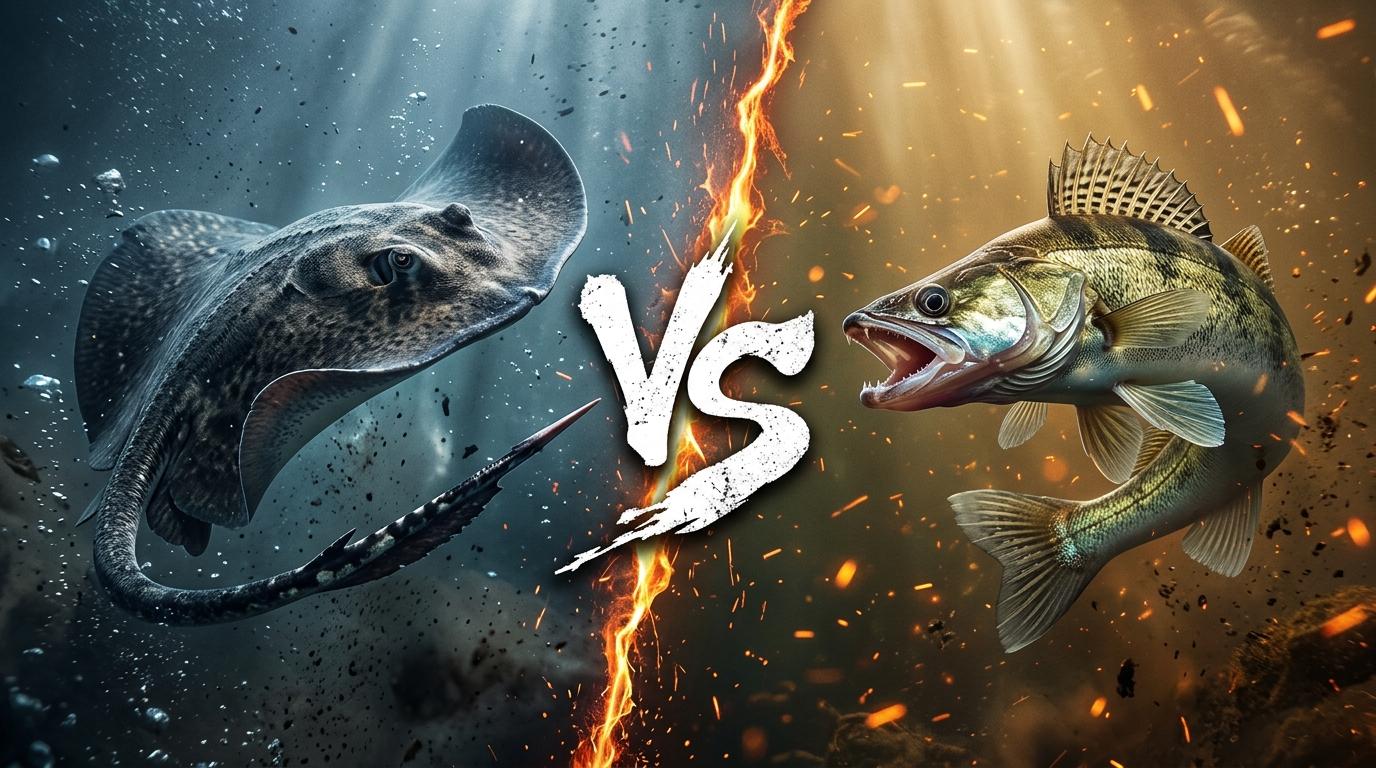
Giant Freshwater Stingray vs Zander: Who Actually Wins?
The giant freshwater stingray wins, and it isn't close. Urogymnus polylepis is one of the largest freshwater fishes on Earth. Adults can span over 2 meters across the disc and weigh several hundred kilograms. A big zander tops out around 10–20 kg. The stingray has a broad, heavy body, a tough denticle-studded back, and a long serrated, venomous tail spine. All of that turns a zander's best weapon, a fast lunge with fang-like teeth meant for slim prey fish, into a bad gamble. The zander is the sharper hunter: it sees better in low light, coordinates better in murky water, and moves faster in short bursts. But it has no way to grip, swallow, or disable an animal many times its mass. The likely outcome is that the zander breaks off or gets pinned and punished, not a drawn-out fight.
Read comparison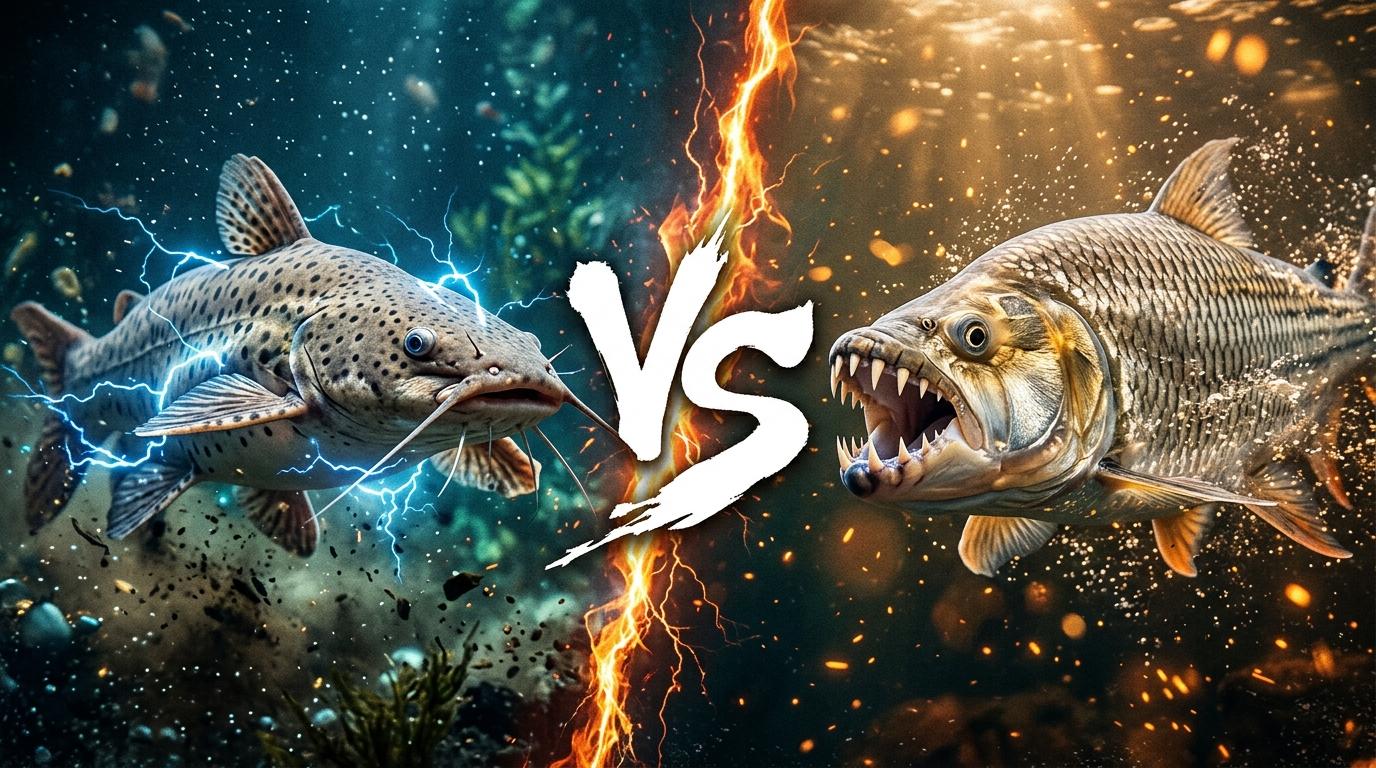
Electric Catfish vs Goliath Tigerfish: Who Actually Wins?
The Goliath Tigerfish wins this matchup, though the margin is narrow. It is longer, heavier at the top end (record fish exceed 1.5 m and 50 kg, while large electric catfish rarely pass about 1 m), much faster, and armed with 32 interlocking dagger teeth built for slash-and-release strikes in powerful current. The Electric Catfish carries one of the most dramatic defenses in freshwater, an electric organ that can deliver discharges of roughly 300–450 volts that stun nearby fish. That weapon works best at contact range, while the tigerfish's whole hunting style is built on fast entry, a deep cut, and immediate disengagement. If the tigerfish controls distance and timing, it controls the fight. If it lets the catfish dictate a slow, close tangle in cover, the result can flip.
Read comparison
Giant Freshwater Stingray vs Yangtze Finless Porpoise: Who Actually Wins?
The Giant Freshwater Stingray wins. This is a mismatch of mass and weaponry. Urogymnus polylepis can reach 2 m across and is often estimated at 300 kg or more, though weights above roughly 300 kg rest on few verified specimens. It also carries a serrated, venom-coated tail spine up to 30–38 cm long that can puncture flesh and bone. The Yangtze finless porpoise is quick, highly intelligent and steers well with echolocation, but it tops out around 1.5–2 m long and only about 40–70 kg. It has no armor, no weapon beyond its jaws, and it must surface to breathe. In any frame where the two actually make contact, the ray's bulk, its habit of pinning itself to the bottom and its spine decide the result. The porpoise's realistic 'win' is refusing to engage at all, and refusing to fight is not the same as winning one.
Read comparison
Discussion
What do you think?
Share your reasoning with other readers. Be civil and stick to the animals.
Sign in to join the discussion.
Sign inNo comments yet. Start the conversation.