

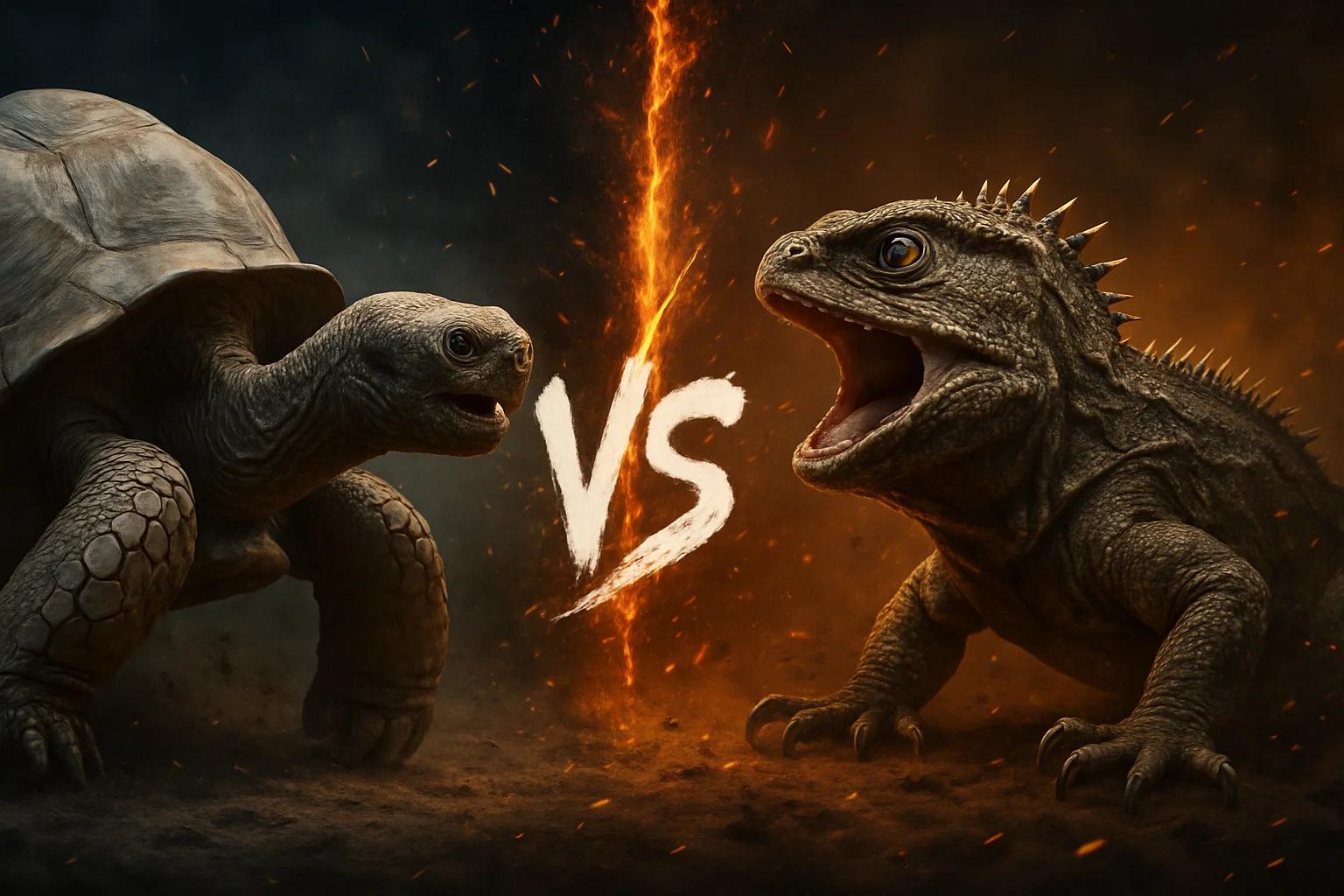
Giant Tortoise vs Tuatara: Who Actually Wins?
Giant tortoise vs tuatara: a biology-first look at armor, bite, size and temperament to settle who would win between these two living-fossil reptiles.
Giant Tortoise vs Tuatara
Matchup winner
Giant Tortoise
Quick verdict
Start with the direct answer, then use the structured comparison below to see what changes the outcome.
The giant tortoise wins clearly. A Galápagos or Aldabra giant can weigh 150–250+ kg against a tuatara's roughly 0.5–1 kg, and it carries a fused bony shell that the tuatara's shearing bite has no realistic way to breach. The tuatara is a capable nocturnal predator with a unique saw-like jaw built for crunching insects, small lizards and seabird chicks. But every tool it owns is scaled for prey far smaller than a tortoise's armored limb. The tortoise doesn't need to attack at all. It can retreat into its shell, shove, or simply walk over the problem. Size, armor and sheer mass decide this matchup long before tactics matter.
Read the full explanation
Giant tortoise wins: it is roughly 200× heavier and fully armored.
The tuatara's bite is sharp for insects and chicks but useless against shell and scaled limbs.
Tortoise 'offense' is mostly mass. A shove or a step outclasses anything the tuatara can absorb.
Neither animal seeks this fight. Both are slow-living reptiles that avoid conflict.
Reader vote
Who do you think wins?
Pick a side — no account needed. Results update live.
No votes yet — be the first to call it.
Editorial note
Why people disagree
The tuatara looks like a fierce mini-dinosaur, so people overrate its fighting power compared with its actual size.
Armored resilience
The tortoise can make itself effectively immune to the tuatara's only weapon.
Mass and leverage
At this size gap, contact alone is a decisive force advantage.
Bite precision
The tuatara owns the more sophisticated bite, but it is tuned for small prey.
Read the full explanation +
Tortoises seem passive, which hides how decisive a quarter-ton of armored mass really is.
Both are 'living fossils', so fans treat it as an ancient-lineage showdown rather than a simple physics problem.
Comparison FAQ
Short, direct answers to the next questions readers usually ask after the headline verdict.
Would a giant tortoise beat a tuatara?+
Yes. The tortoise's armor and enormous size make it effectively untouchable, and it can overpower the tuatara with mass alone.
Which is stronger, a giant tortoise or a tuatara?+
The giant tortoise by a huge margin. It can carry hundreds of kilograms of body and shell. The tuatara weighs about a kilogram.
Can a tuatara bite through a tortoise shell?+
No. Its shearing jaw slices insects and small vertebrates but cannot penetrate bony carapace or thick limb scales.
Why is the tuatara still dangerous?+
Its bite is sharp and tenacious, and it can deliver painful wounds to small animals or careless hands. Its speed and cold-weather alertness also let it escape threats that catch other reptiles.
Do giant tortoises and tuatara live together?+
No. Giant tortoises live on the Galápagos and Aldabra. Tuatara are found only in New Zealand, mostly on predator-free islands.
Head-to-head species stats
These are the same core AnimalDex stat dimensions used on the dedicated animal pages, pulled side by side so the matchup is faster to scan.
Giant Tortoise
Tier ATuatara
Tier BTrait-by-trait comparison
Only the categories that matter to this matchup are included. The goal is not filler stats, but the real design differences that change the result.
Fused bony carapace and plastron, scaled limbs
Armored resilience
Giant Tortoise
Granular skin, spiny crest, no armor
Armored resilience
Giant Tortoise
150–250+ kg
Mass and leverage
Giant Tortoise
About 0.5–1 kg
Mass and leverage
Giant Tortoise
Toothless beak for cropping plants
Bite precision
Tuatara
Shearing, saw-action jaw with fused tooth rows
Bite precision
Tuatara
Ponderous, deliberate gait
Quick-strike agility
Tuatara
Short bursts, quick lunges
Quick-strike agility
Tuatara
Carries its refuge on its back
Refuge control
Giant Tortoise
Uses seabird burrows and crevices
Refuge control
Giant Tortoise
Needs warmth, sluggish when cold
Cool-climate activity
Tuatara
Active near 5–12°C, unusual for a reptile
Cool-climate activity
Tuatara
How the verdict forms
Verdict timeline
01 · Armored resilience
Giant Tortoise
02 · Mass and leverage
Giant Tortoise
03 · Bite precision
Tuatara
04 · Quick-strike agility
Tuatara
05 · Refuge control
Giant Tortoise
06 · Cool-climate activity
Tuatara
Change the conditions
Scenario breakdown
This is where shallow battle content usually fails. Terrain, spacing, timing, and engagement style can change the answer.
Scenario lean
Tuatara
Verdict confidence
82%
The tuatara survives by vanishing.
In burrow-riddled terrain the tuatara simply slips underground where a tortoise cannot follow. Here the tuatara 'wins' by denying contact. Its small size and burrow sharing with seabirds make cover its home advantage, though it inflicts nothing on the tortoise.
AnimalDex field profiles
Explore these animals
Giant Tortoise
Chelonoidis spp. and Aldabrachelys gigantea
island scrub, grassland, dry lowland, and coastal woodland
Tuatara
Sphenodon punctatus
Coastal forest, shrubland, and predator-free island sanctuary habitat.
Systems Intelligence & Hidden Purpose
See the animals behind this comparison as engineered biological systems: what each one is built to do, where it gains leverage, and why the matchup changes by scenario.
Specialized Hardware
Spiny crest along the back, stout lizard-like body, and slow growth and long lifespan give the Tuatara a body plan tuned for its niche.
Systems Script
Tuataras operate in coastal forest, shrubland, and predator-free island sanctuary habitat. Their design helps them match food access, shelter, and timing inside that environment.
Strategic Insight
Some of the rarest systems matter because they preserve an old design almost nowhere else remains.
Final take
The giant tortoise wins this matchup decisively. It isn't a better fighter in any aggressive sense. It simply sits in a different physical league: two hundred times the mass, wrapped in a fused bone fortress.
Read the full explanation
The tuatara deserves respect as one of evolution's great survivors. It is the last of the rhynchocephalians, with a third-eye parietal organ and a slow, cold-adapted life spanning a century. But its toolkit is built for beetles and chicks, not armored giants. Its winning move is retreat, and it is very good at that.
Collect both animals in AnimalDex
Track the species behind this matchup, compare their real traits, and build the rivalry into your AnimalDex collection.
Related comparisons
Continue with nearby matchups to compare more real-world animal traits without dropping into junky who-wins filler.
Galápagos Tortoise vs Giant Tortoise: Who Actually Wins?
The Giant Tortoise wins, but this matchup comes with a twist: the Galápagos tortoise is itself a giant tortoise. 'Giant Tortoise' here covers the whole heavyweight group, including the Chelonoidis species of the Galápagos and the Aldabra giant tortoise (Aldabrachelys gigantea). This page compares a typical Galápagos tortoise with the strongest contender that group can field. In the AnimalDex profile, the giant tortoise group scores higher on dominance (85 vs 54), size (80 vs 58), and speed (40 vs 9). Tortoise contests are not brawls. They are slow rituals of rising tall, gaping, and shoving, decided by height, mass, and footing. A group that can always send its biggest, most assertive male will usually out-reach and out-push a single average Galápagos individual. The upset path is real, though. A large domed Galápagos male is among the heaviest tortoises alive and can match anything in the group.
Read comparison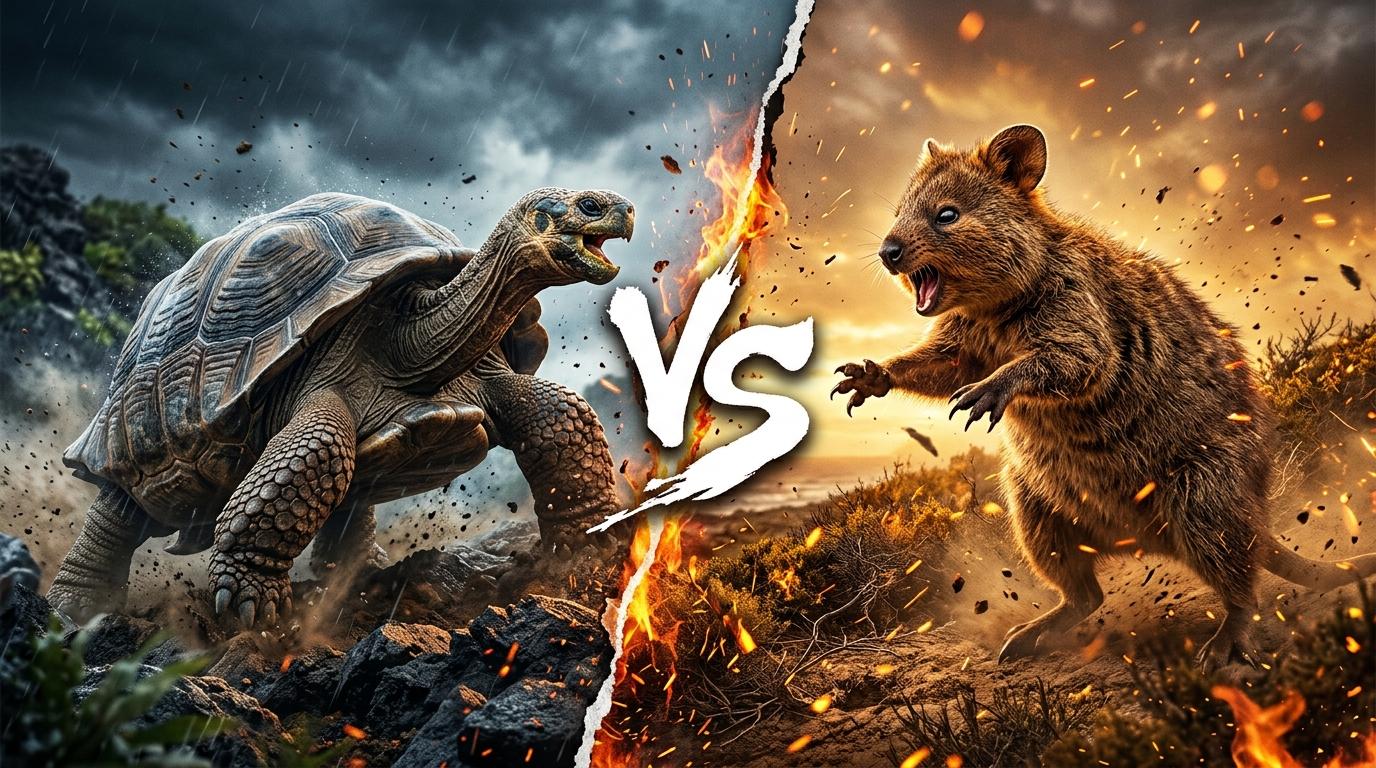
Giant Tortoise vs Quokka: Who Actually Wins?
The giant tortoise wins, and it is not close in any contact scenario. A Galápagos or Aldabra giant tortoise can top 200–300 kg behind a domed bony carapace. A quokka weighs about 2.5–5 kg and has no weapon that can get through that shell. The quokka's only real tools are speed, hopping agility and the instinct to bolt, so it can avoid losing but cannot win. When the two meet over food, a path or shade, the tortoise simply walks forward. Its sheer bulk, its armor and its habit of shoving rivals settle the matter without any need for aggression.
Read comparison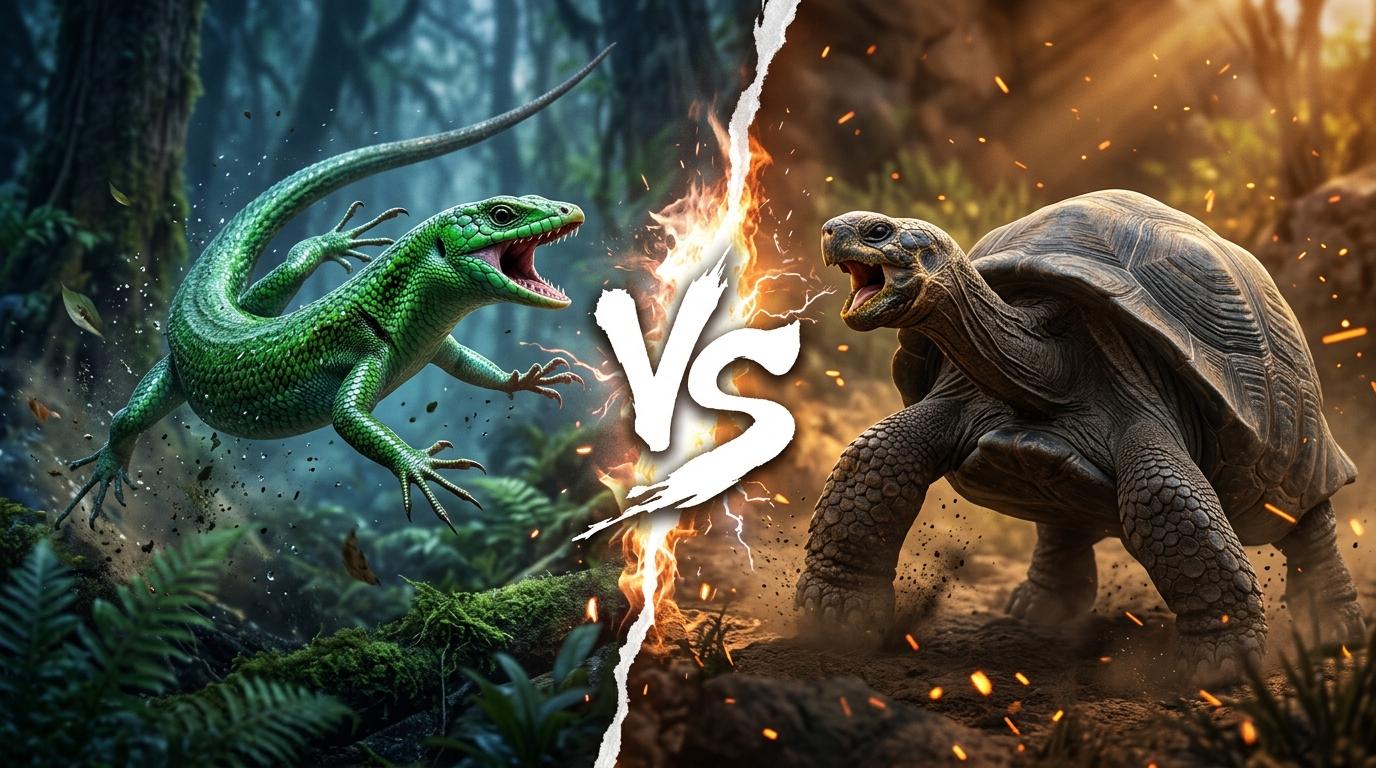
Emerald Tree Skink vs Giant Tortoise: Who Actually Wins?
The giant tortoise wins, and it is not close. A Galápagos or Aldabra giant tortoise can weigh 150–300+ kg and carries a fused bony shell, while the emerald tree skink is a slender arboreal lizard around 20–25 cm long, most of it tail, weighing a few dozen grams. The skink's bite cannot damage tortoise armor, and the tortoise's sheer mass, crushing beak, and pushing power can injure the skink by accident. The skink's real strength is not fighting at all. It is a fast, agile climber that would simply leave. In any frame where the two are forced to contest space, the tortoise holds the ground. In any frame where escape is allowed, the skink survives but does not win.
Read comparison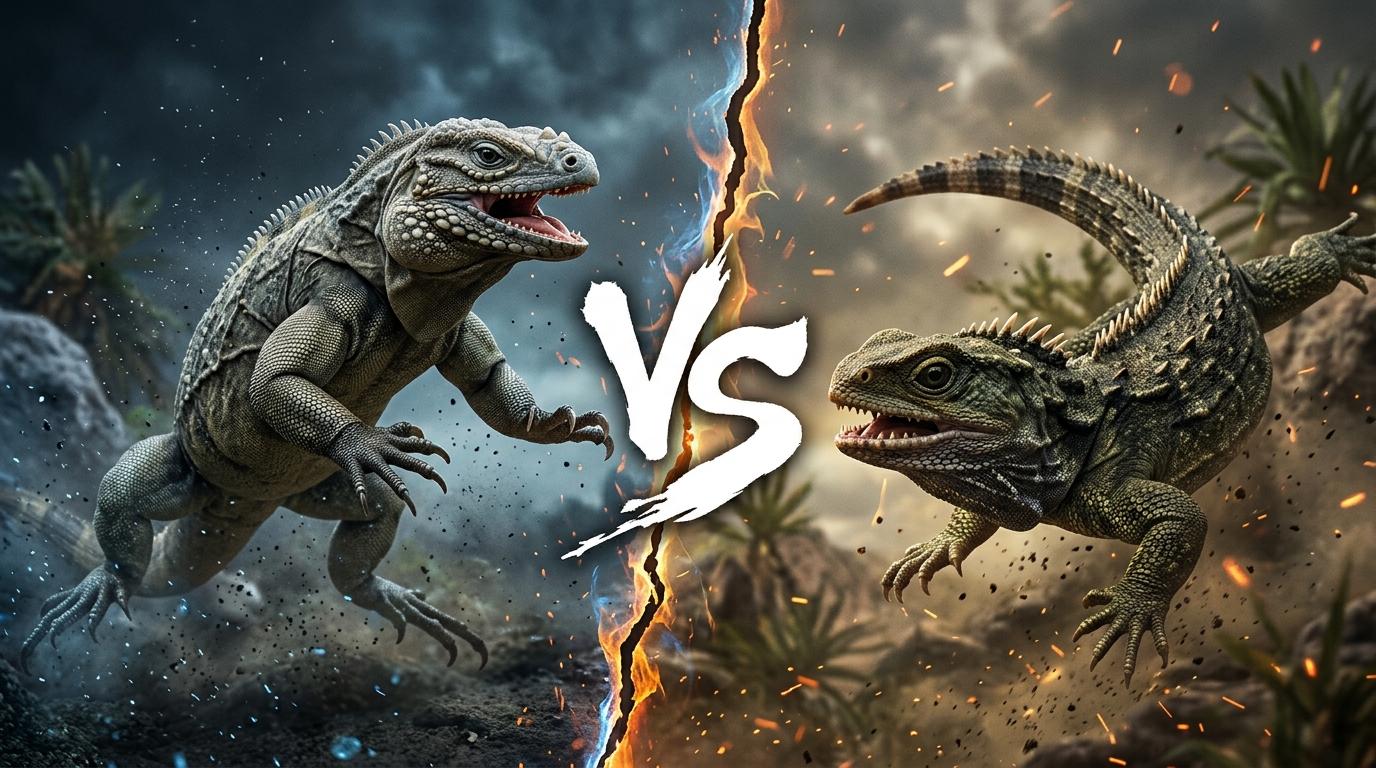
Cuban Rock Iguana vs Tuatara: Who Actually Wins?
The Cuban rock iguana wins this matchup. It is the larger animal by a wide margin. Adults commonly run 1.2–1.5 m long and can weigh several kilograms, while a big male tuatara tops out near 60 cm and about 1 kg. The iguana also brings a muscular whip-tail, strong limbs built for scrambling over limestone, and a territorial streak honed by head-bobbing, shoving disputes with rival males. The tuatara is no pushover. Its shearing bite, with a lower jaw that slides forward between two rows of upper teeth, can lacerate skin, and its cold-tolerant, patient temperament makes it hard to rattle. But it is built as a slow, low-energy nocturnal ambusher of insects and seabird chicks, not as a wrestler of an animal four or five times its mass. In most realistic encounters the iguana's size, reach and warm-weather stamina decide things before the tuatara's bite can matter.
Read comparison
Discussion
What do you think?
Share your reasoning with other readers. Be civil and stick to the animals.
Sign in to join the discussion.
Sign inNo comments yet. Start the conversation.