

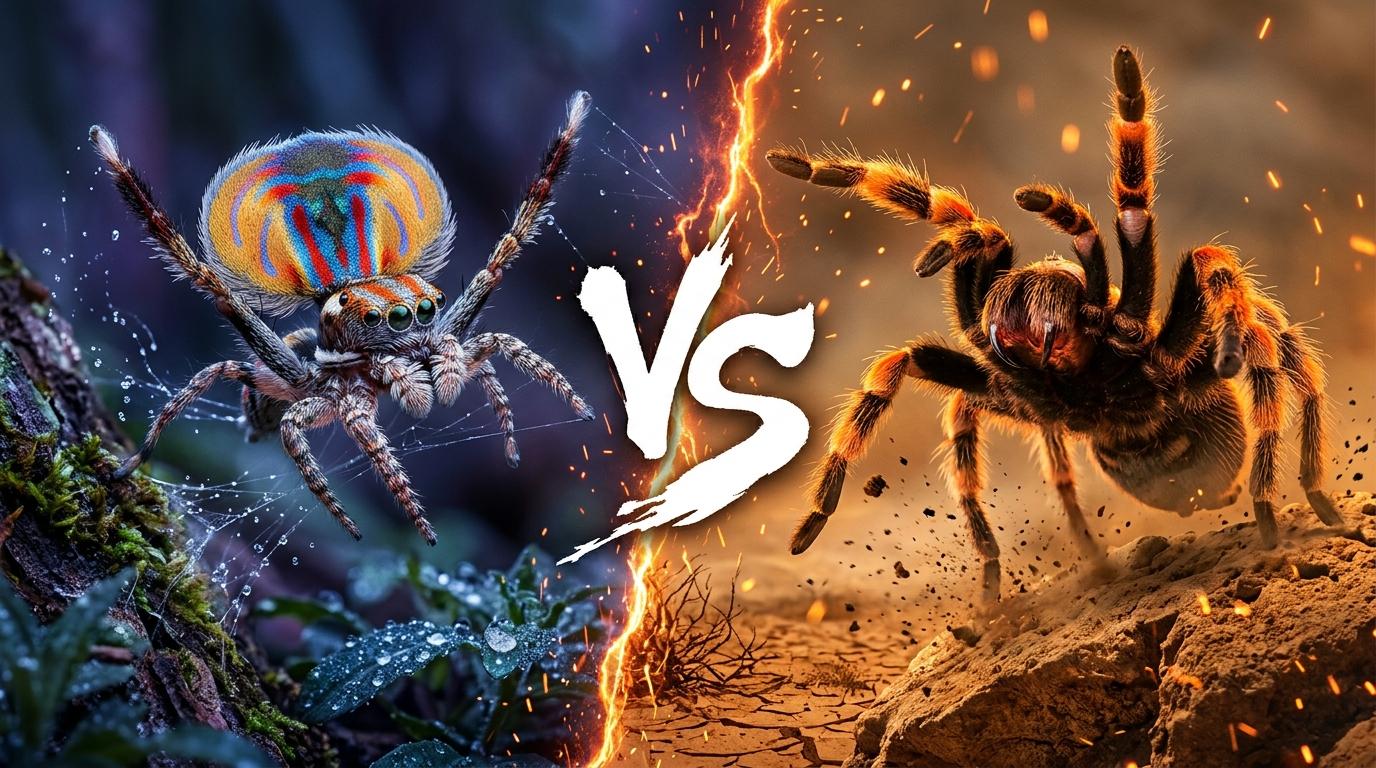
Peacock Spider vs Red-kneed Tarantula: Who Actually Wins?
Peacock spider vs red-kneed tarantula: a 4–5 mm jumping spider against a palm-sized Mexican tarantula. Size, venom, defenses and scenarios explain who wins.
Peacock Spider vs Red-kneed Tarantula
Matchup winner
Red-kneed Tarantula
Quick verdict
Start with the direct answer, then use the structured comparison below to see what changes the outcome.
The red-kneed tarantula wins, and it isn't close. Maratus volans is a jumping spider about 4–5 mm long, famous for its iridescent courtship flap. Brachypelma hamorii carries a legspan of roughly 13–15 cm and a body mass hundreds of times greater. It also has heavy downward-striking fangs and a coat of urticating hairs. The peacock spider's real gifts are superb eyesight, fast reactions and a jump that can carry it several body lengths. Those let it read the tarantula and dodge, but it has no tool that can hurt something so large. Any contact ends with the tarantula pinning and eating a snack-sized spider. The peacock spider's only good outcome is escape.
Read the full explanation
Red-kneed tarantula wins: it is hundreds of times heavier and its fangs can reach a body this small in one strike.
Peacock spider has better eyes and reflexes, so it can spot and dodge, but it cannot do damage at this scale.
The tarantula is a slow ambusher. The peacock spider's best play is to never get within leg reach.
In real life they wouldn't meet: the tarantula lives in Mexico and the peacock spider in Australia.
Reader vote
Who do you think wins?
Pick a side — no account needed. Results update live.
No votes yet — be the first to call it.
Editorial note
Why people disagree
Jumping spiders are famously smart and sharp-eyed, so fans assume brains can beat bulk. At a size ratio this extreme, they can't.
Raw mass and frame
The size gap is so large that the peacock spider is prey-sized for the tarantula, not a rival.
Explosive power
The peacock spider's jump is its getaway engine, not a weapon.
Visual targeting
The peacock spider spots danger first, which is its whole survival case.
Read the full explanation +
Tarantulas look slow and docile, which hides how fast a strike is once prey touches their legs.
Viral peacock spider videos make it seem bigger and bolder than a 5 mm animal really is.
Comparison FAQ
Short, direct answers to the next questions readers usually ask after the headline verdict.
Would a peacock spider beat a red-kneed tarantula?+
No. The tarantula is hundreds of times heavier, and one bite or grip would kill the peacock spider.
Which spider is stronger?+
The red-kneed tarantula, by a huge margin, in raw force, bite and toughness.
Why is the peacock spider still dangerous to tangle with?+
For an animal its size, it is dangerous mainly through speed and eyesight. Its jumps and reflexes make it very hard to catch in the open, and it is a capable hunter of tiny insects. It poses no threat to the tarantula or to people.
Is the red-kneed tarantula dangerous to humans?+
Not seriously. Its bite is usually compared to a bee sting, and its flicked hairs can irritate skin and eyes.
Do they live in the same place?+
No. Peacock spiders are Australian, and red-kneed tarantulas come from the Pacific coast of Mexico.
Head-to-head species stats
These are the same core AnimalDex stat dimensions used on the dedicated animal pages, pulled side by side so the matchup is faster to scan.
Peacock Spider
Tier DRed-kneed Tarantula
Tier DTrait-by-trait comparison
Only the categories that matter to this matchup are included. The goal is not filler stats, but the real design differences that change the result.
~5 mm body, tiny fraction of a gram
Raw mass and frame
Red-kneed Tarantula
~13–15 cm legspan, heavy-bodied
Raw mass and frame
Red-kneed Tarantula
Hydraulic jumps covering several body lengths
Explosive power
Peacock Spider
Short, fast lunge from rest
Explosive power
Peacock Spider
Large principal eyes, sharp depth judgement
Visual targeting
Peacock Spider
Poor eyesight, relies on vibration and touch
Visual targeting
Peacock Spider
Tiny chelicerae made for small insects
Strike lethality
Red-kneed Tarantula
Large fangs and venom that overwhelm small prey
Strike lethality
Red-kneed Tarantula
Fragile, crushed by one grip
Close-range durability
Red-kneed Tarantula
Thick exoskeleton plus urticating hair shield
Close-range durability
Red-kneed Tarantula
Active stalker, wide-ranging hunter
Ambush control
Red-kneed Tarantula
Burrow-mouth sit-and-wait predator
Ambush control
Red-kneed Tarantula
How the verdict forms
Verdict timeline
01 · Raw mass and frame
Red-kneed Tarantula
02 · Explosive power
Peacock Spider
03 · Visual targeting
Peacock Spider
04 · Strike lethality
Red-kneed Tarantula
05 · Close-range durability
Red-kneed Tarantula
06 · Ambush control
Red-kneed Tarantula
Change the conditions
Scenario breakdown
This is where shallow battle content usually fails. Terrain, spacing, timing, and engagement style can change the answer.
Scenario lean
Red-kneed Tarantula
Verdict confidence
82%
Tarantula. The ambush is its home turf.
Under cover, the peacock spider's eyesight is less useful and the tarantula's touch-sensitive legs pick up close movement. One accidental brush is enough to trigger a strike.
AnimalDex field profiles
Explore these animals
Peacock Spider
Maratus volans
Grassland, scrub, leaf litter, and low vegetation in warm open habitat.
Red-kneed Tarantula
Brachypelma hamorii
dry forest, thorn scrub, and semi-arid grassland
Systems Intelligence & Hidden Purpose
See the animals behind this comparison as engineered biological systems: what each one is built to do, where it gains leverage, and why the matchup changes by scenario.
Specialized Hardware
Tiny body with large forward eyes, bright patterned abdominal fan on males, and jerky jumping movement give the Peacock Spider a body plan tuned for its niche.
Systems Script
Peacock Spiders operate in grassland, scrub, leaf litter, and low vegetation in warm open habitat. Their design helps them match food access, shelter, and timing inside that environment.
Strategic Insight
Scale does not limit impact when the signal is memorable enough.
Specialized Hardware
black velvet body, orange-red knee bands, and burrow-front threat display give the Red-kneed Tarantula a body plan tuned for its niche.
Systems Script
Red-kneed Tarantulas operate through dry forest, thorn scrub, and semi-arid grassland. Their design links movement, feeding, shelter, and timing into one workable survival system.
Strategic Insight
Harsh places reward efficiency, timing, and bodies that waste very little.
Final take
The red-kneed tarantula wins overall. This isn't a fair fight scaled down. It's a predator meeting something prey-sized. Mass, fangs and armor all point the same way.
Read the full explanation
The peacock spider still deserves respect. It is a precision animal with excellent vision and timing, and in open light it can survive the encounter by refusing to fight. Survival through avoidance is a real biological win, but it isn't a win over the tarantula.
Collect both animals in AnimalDex
Track the species behind this matchup, compare their real traits, and build the rivalry into your AnimalDex collection.
Related comparisons
Continue with nearby matchups to compare more real-world animal traits without dropping into junky who-wins filler.
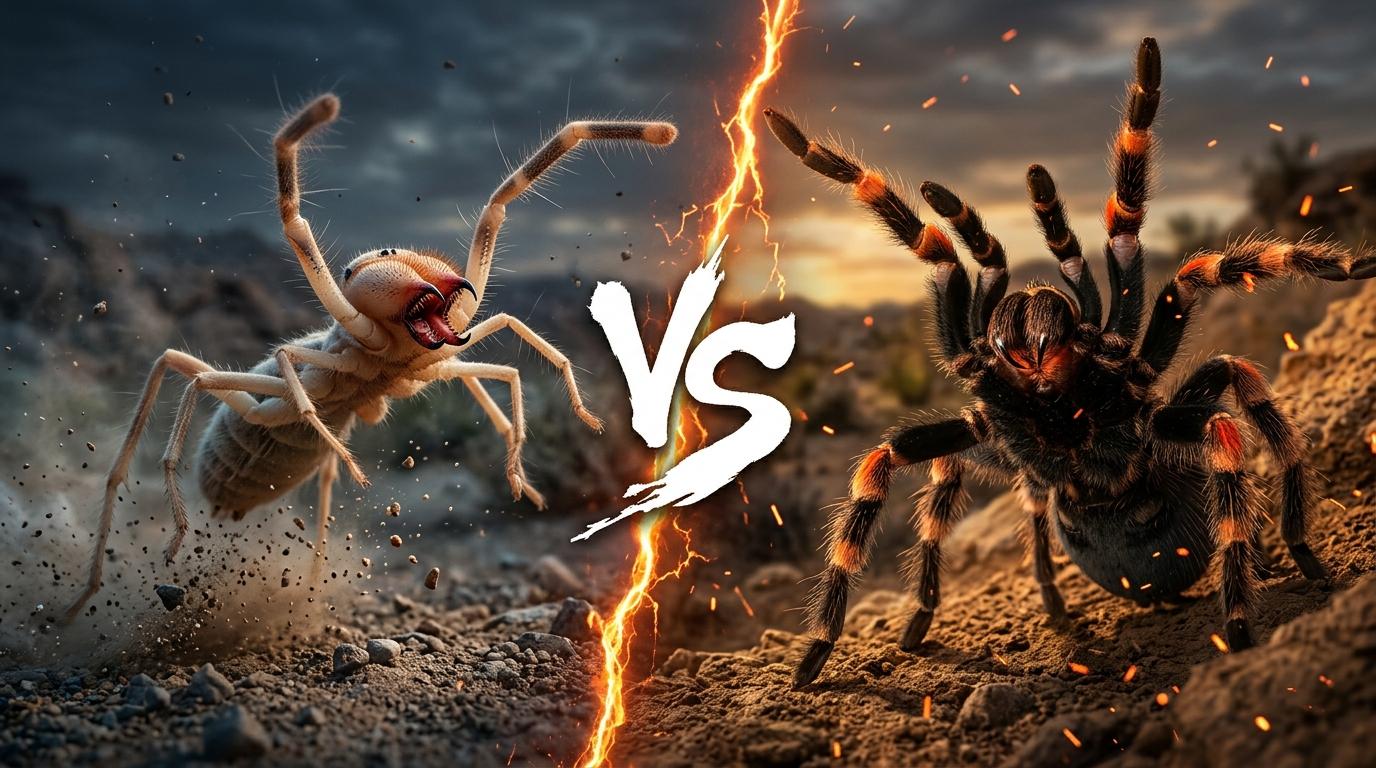
Camel Spider vs Red-kneed Tarantula: Who Actually Wins?
The red-kneed tarantula wins more often than not. A mature Brachypelma hamorii brings a heavier, sturdier body, downward-striking fangs with venom, and a coat of barbed urticating hairs it can kick into an attacker's face. Galeodes arabs, the Arabian camel spider, is the faster and more aggressive animal. Its huge crushing chelicerae can do brutal damage if it lands a clean grip on the tarantula's abdomen. That is the camel spider's whole path to victory, though: strike first and fast, or lose. Once the tarantula braces in a threat posture, its size, fangs, and hair defense turn the fight into a war of attrition. The camel spider has no venom and depends on raw tearing, so it is badly suited to that kind of fight. Against an adult, burrow-anchored tarantula, bet on the tarantula.
Read comparison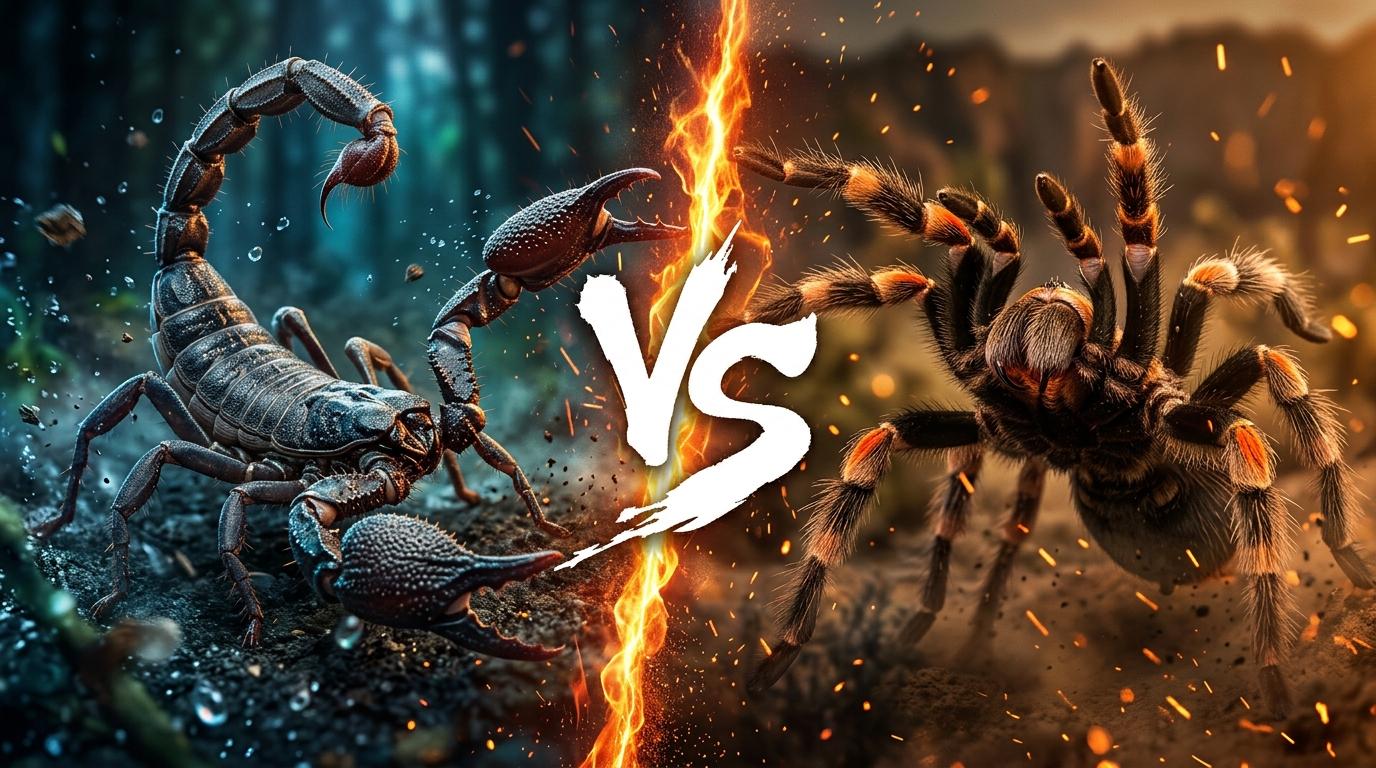
Giant Forest Scorpion vs Red-kneed Tarantula: Who Actually Wins?
The Giant Forest Scorpion (Heterometrus swammerdami) wins most realistic encounters. It is one of the largest scorpions alive, often 16–23 cm long, and its build is made for this kind of fight. Thick, heavily sclerotized armor blunts the tarantula's best weapon, a downward fang strike that needs a soft joint or seam to work. Massive crushing pincers can grip and pin the tarantula's long, comparatively fragile legs before it sets up a bite. The scorpion's venom is mild for its size, so it fights mostly with its claws. Those claws are the right tool for disabling a spider whose whole offense depends on getting close enough to bite. The Red-kneed Tarantula (Brachypelma hamorii) is no pushover. Its fangs are heavy and it has a defensive kit, but its main deterrent is a cloud of urticating hairs. Those hairs evolved to irritate the eyes and soft tissue of mammals and do little against an armored arthropod. If the tarantula lands a clean bite into a joint early, it can win. Over the course of a struggle, though, armor and grip favor the scorpion.
Read comparison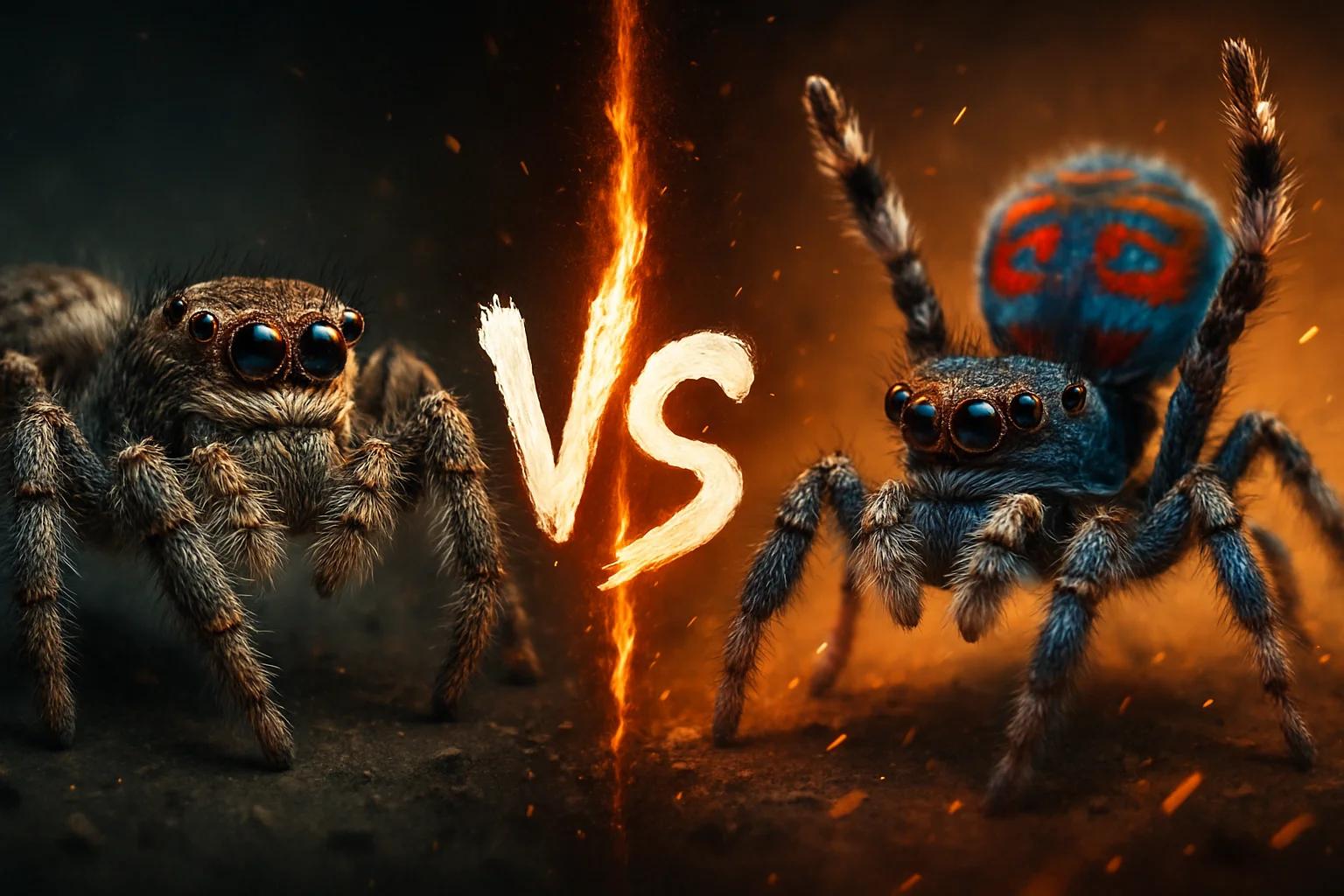
Jumping Spider vs Peacock Spider: Who Actually Wins?
The tan jumping spider (Platycryptus undatus) wins clearly. Both are salticids: daylight hunters with superb forward-facing eyes, silk safety lines and a pounce instead of a web. The gap is size. An adult tan jumper runs roughly 8–13 mm, while a peacock spider is about 4–5 mm. That gives Platycryptus several times the body mass, longer reach, stronger chelicerae and a bigger venom load. Peacock spiders are not wired for this kind of contest either. Their most striking hardware, the male's iridescent fan and his leg-waving dance, evolved to win over females, not to win fights. Small salticids also sit squarely inside the prey range of larger jumping spiders, and salticids readily eat other spiders. In most realistic encounters, the tan jumper treats the peacock spider as a meal.
Read comparison
Discussion
What do you think?
Share your reasoning with other readers. Be civil and stick to the animals.
Sign in to join the discussion.
Sign inNo comments yet. Start the conversation.