

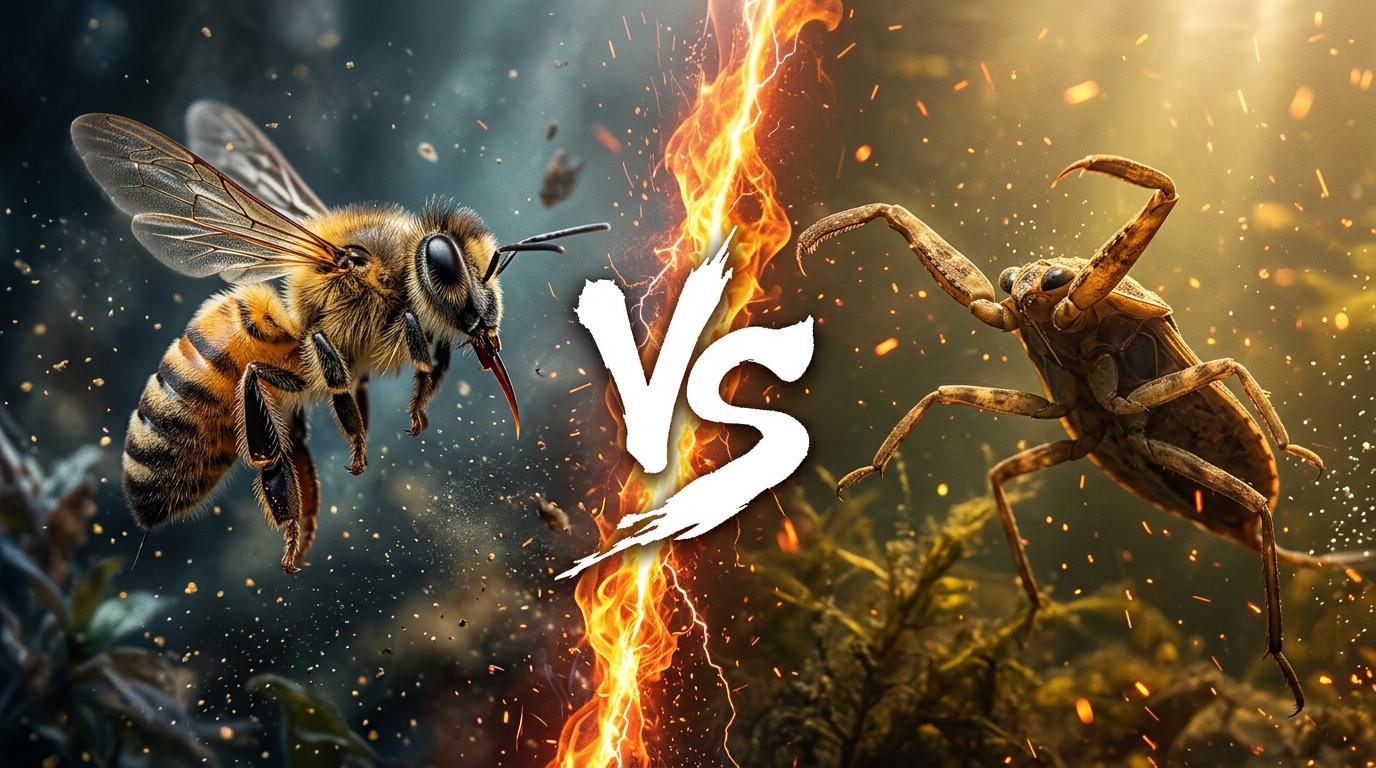
Western Honey Bee vs Water Scorpion: Who Actually Wins?
Honey bee vs water scorpion: a sting-armed flier against a slow, raptorial pond ambusher. The habitat decides almost everything, and here is who wins most matchups.
Western Honey Bee vs Water Scorpion
Matchup winner
Water Scorpion
Quick verdict
Start with the direct answer, then use the structured comparison below to see what changes the outcome.
The Western Honey Bee wins this matchup overall. The reason is control of the encounter, not raw toughness. A honey bee is fast, airborne and armed with a venomous sting, and it almost never has to enter the water scorpion's world. Nepa cinerea is a slow, flattened bottom-dweller. It breathes through a snorkel-like tail siphon and hunts by grabbing prey with folding forelegs, much like a mantis. In its own shallow-water ambush zone it can seize a bee that has fallen in and pierce it with a sucking beak that injects digestive saliva. That one frame is real. On land, in open air, or at a shared resource like a pond edge, the bee picks the terms and can sting first or simply leave. Most realistic encounters favor the bee.
Read the full explanation
Overall winner: Western Honey Bee, because of speed, flight and a venomous sting.
The water scorpion wins only when a bee is already trapped in its shallow-water ambush zone.
Both are about 2 cm long, so the fight is decided by mobility and habitat, not size.
The bee's sting is a defensive weapon. The scorpion's grasping forelegs and piercing beak are built for hunting.
Reader vote
Who do you think wins?
Pick a side — no account needed. Results update live.
No votes yet — be the first to call it.
Editorial note
Why people disagree
The name 'scorpion' makes people expect a stinger. The tail is actually a breathing tube, so the water scorpion has no sting at all.
Explosive mobility
Whoever controls distance controls whether a fight happens at all.
Ambush control
In shallow water among plants and debris, the water scorpion's patience turns into a decisive first strike.
Weapon system
The sting works at the moment of contact and from any angle. The beak only works once prey is already held.
Read the full explanation +
Water-surface encounters are real. Bees do drown in ponds, and an aquatic predator can exploit that, which makes the underdog look stronger than it is.
Honey bees are famous as colony defenders. Alone, a single worker is fragile, and stinging can cost it its life.
Comparison FAQ
Short, direct answers to the next questions readers usually ask after the headline verdict.
Would a honey bee beat a water scorpion?+
In most scenarios, yes. The bee wins on land, in the air and at shared resources. The water scorpion wins mainly when a bee has fallen into its shallow-water ambush zone.
Which is stronger, a honey bee or a water scorpion?+
In close grappling the water scorpion is physically sturdier and has the stronger grip. The bee is stronger overall as a fighter because of its sting and its mobility.
Can a water scorpion sting?+
No. Its 'tail' is a breathing siphon. It attacks with its grasping forelegs and a beak that injects saliva, and that bite can be painful to humans.
Why is the water scorpion still dangerous to a bee?+
Its camouflage, patience and grasping forelegs make it lethal to any bee that ends up struggling in the water. Once it gets a grip, escape is hard.
Does a honey bee die if it stings a water scorpion?+
Usually not. The sting barb mainly lodges in elastic mammal skin. Against an insect's exoskeleton the bee can often pull its sting back out.
Head-to-head species stats
These are the same core AnimalDex stat dimensions used on the dedicated animal pages, pulled side by side so the matchup is faster to scan.
Western Honey Bee
Tier CWater Scorpion
Tier BTrait-by-trait comparison
Only the categories that matter to this matchup are included. The goal is not filler stats, but the real design differences that change the result.
Rapid flight with fast takeoff
Explosive mobility
Western Honey Bee
Slow crawler and weak swimmer
Explosive mobility
Western Honey Bee
No ambush tactics; active forager
Ambush control
Water Scorpion
Camouflaged, motionless raptorial grab
Ambush control
Water Scorpion
Barbed venomous sting with pain-causing venom
Weapon system
Western Honey Bee
Grasping forelegs plus a beak that injects digestive saliva
Weapon system
Western Honey Bee
Light body built for flight
Close-range durability
Water Scorpion
Flat, leathery, tough exoskeleton
Close-range durability
Water Scorpion
Strong vision, learning and alarm signals
Situational awareness
Western Honey Bee
Minimal, tuned to triggers that mean 'grab now'
Situational awareness
Western Honey Bee
Air, land, flowers and water edges
Habitat reach
Western Honey Bee
Shallow still water only
Habitat reach
Western Honey Bee
How the verdict forms
Verdict timeline
01 · Explosive mobility
Western Honey Bee
02 · Ambush control
Water Scorpion
03 · Weapon system
Western Honey Bee
04 · Close-range durability
Water Scorpion
05 · Situational awareness
Western Honey Bee
06 · Habitat reach
Western Honey Bee
Change the conditions
Scenario breakdown
This is where shallow battle content usually fails. Terrain, spacing, timing, and engagement style can change the answer.
Scenario lean
Water Scorpion
Verdict confidence
82%
Water scorpion, if the bee is in the water.
A bee that is waterlogged and struggling cannot fly away. The water scorpion's camouflage and raptorial forelegs are made for exactly this moment. It seizes the bee, keeps the sting angled away where it can, and feeds with its beak. This is the underdog's only clear win.
AnimalDex field profiles
Explore these animals
Western Honey Bee
—
Habitat details are not published on a dedicated AnimalDex species page yet.
Species guide coming soon.
Water Scorpion
Nepa cinerea
pond, ditch, and quiet wetland
Systems Intelligence & Hidden Purpose
See the animals behind this comparison as engineered biological systems: what each one is built to do, where it gains leverage, and why the matchup changes by scenario.
Specialized Hardware
raptorial forelegs, breathing tail siphon, and still-water ambush behavior give the Water Scorpion a body plan tuned for its niche.
Systems Script
Water Scorpions operate through pond, ditch, and quiet wetland. Their design links movement, feeding, shelter, and timing into one workable survival system.
Strategic Insight
Where water controls movement, position and timing often matter more than speed.
Final take
The Western Honey Bee wins this comparison because it decides whether the encounter happens at all. Flight, speed and a venomous sting give it control in almost every setting.
Read the full explanation
The water scorpion is a specialist ambush hunter. It is deadly in its narrow pond habitat and nearly irrelevant outside it. Respect its grab, but bet on the bee.
Collect both animals in AnimalDex
Track the species behind this matchup, compare their real traits, and build the rivalry into your AnimalDex collection.
Related comparisons
Continue with nearby matchups to compare more real-world animal traits without dropping into junky who-wins filler.
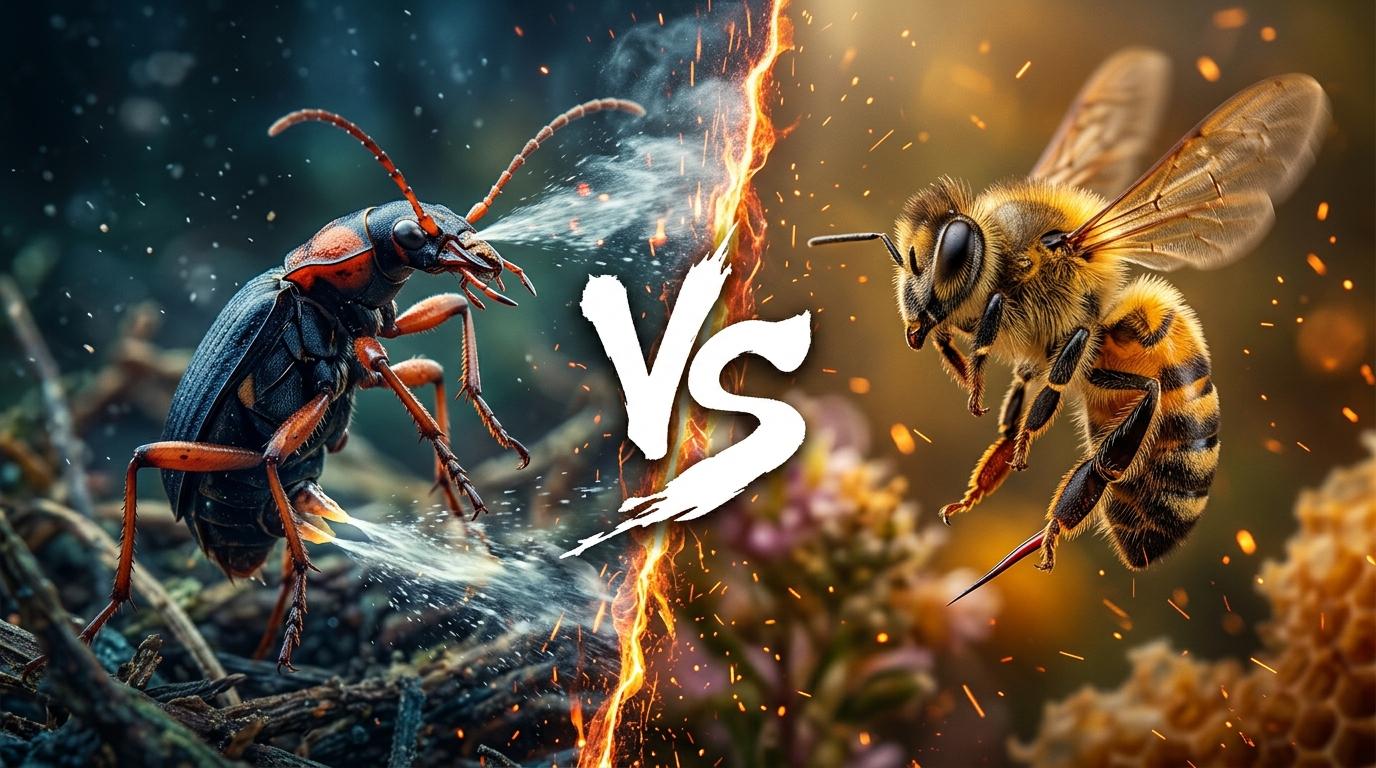
Bombardier Beetle vs Western Honey Bee: Who Actually Wins?
The bombardier beetle wins a one-on-one fight. A single western honey bee worker is a forager built to cooperate, not a solo duelist. Its sting is a defensive tool that only works on the beetle if it finds a soft joint between armor plates. The bombardier beetle (Brachinus crepitans) is a ground-dwelling predator wrapped in hardened elytra, and it carries one of the most famous chemical weapons in the insect world. It mixes stored reactants in a reinforced chamber and fires a pulsed, near-boiling blast of irritating benzoquinones at whatever grabs it. That spray reliably drives off ants, spiders and even toads. A lone bee that grapples the beetle takes a hot chemical hit to the face and antennae, which are the sensors it needs to aim and fly. The honey bee's real power is the colony. Outside the hive, the beetle's armor plus instant chemical defense beats a single bee's speed and sting.
Read comparison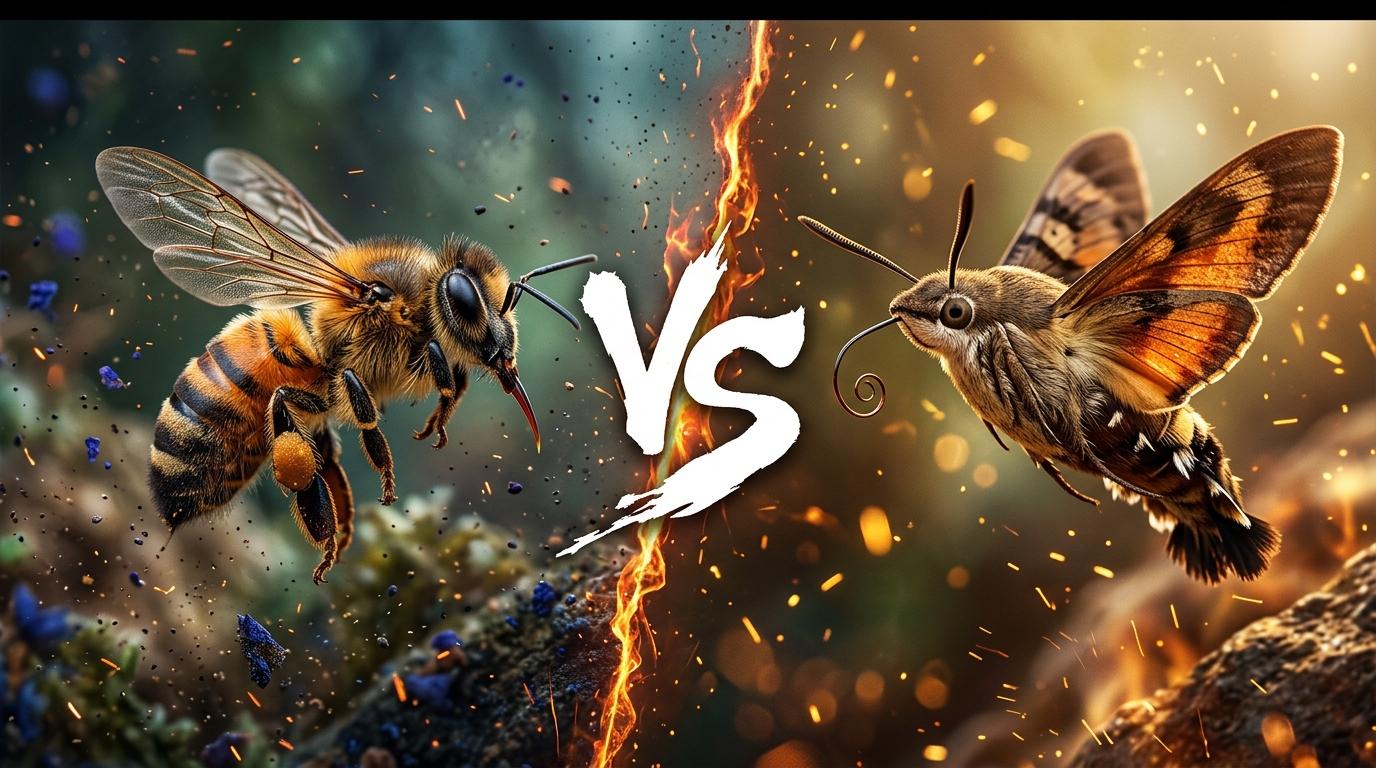
Western Honey Bee vs Hummingbird Hawk-Moth: Who Actually Wins?
The Western Honey Bee wins. The hummingbird hawk-moth is bigger, faster and one of the most gifted hoverers in the insect world, but it has no weapon. It cannot sting or bite. Its long proboscis is a drinking straw, not a blade. A worker honey bee carries a venom-loaded, barbed stinger, strong mandibles, and an alarm-pheromone system that can pull nestmates into a defense. If the two actually make contact, only one of them can do real harm. The moth's real strength is avoidance: it can feed from a distance, accelerate away, and simply refuse the fight. That keeps it safe, but it does not win anything. In any frame where contact happens or a resource is defended, the bee holds the decisive tool.
Read comparison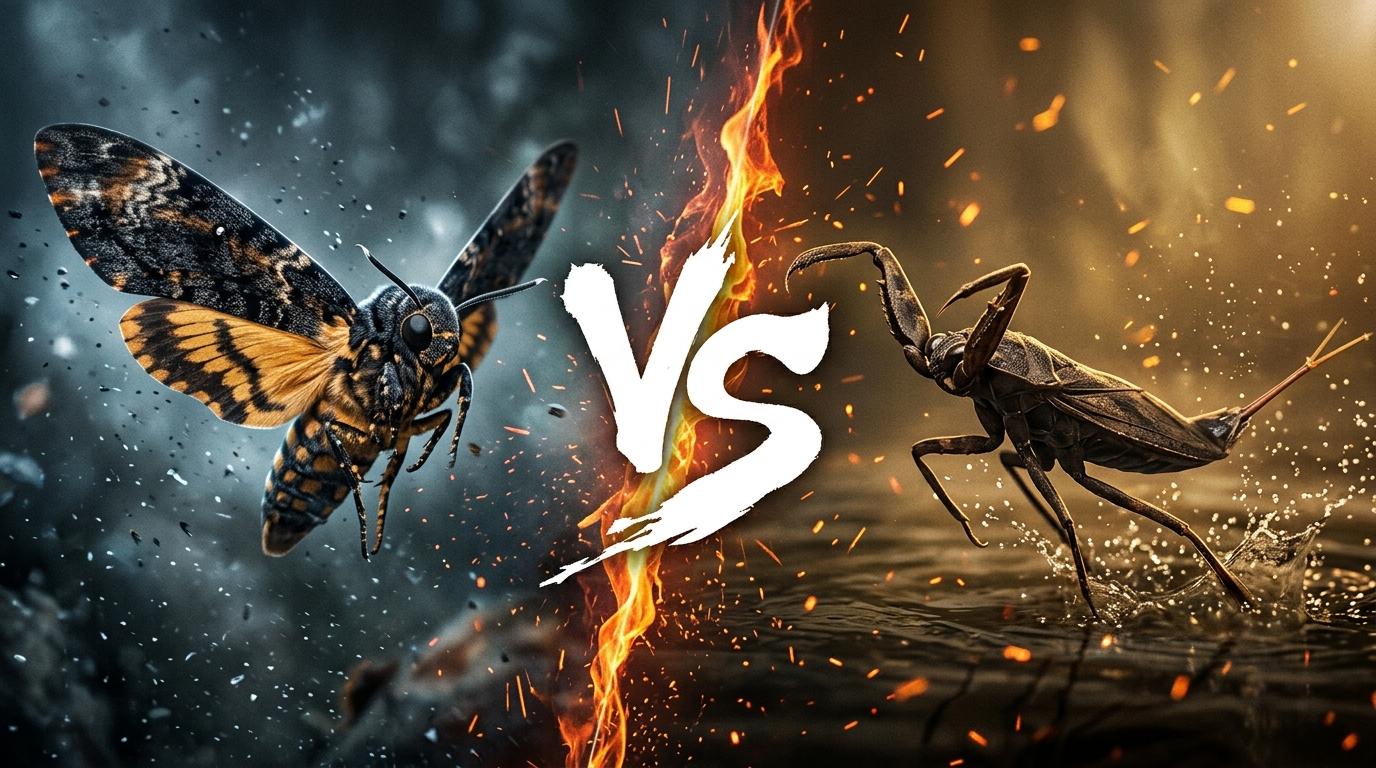
Death's-head Hawkmoth vs Water Scorpion: Who Actually Wins?
The Death's-head Hawkmoth wins overall. With a wingspan of roughly 9–13 cm and a heavy, armored body several times the mass of a 2 cm Water Scorpion, the moth simply outclasses Nepa cinerea in size, speed and escape options. It is not a predator, so it would never "beat" the bug in a hunting sense. But the Water Scorpion's raptorial forelegs and piercing beak are built for tadpoles, small fish and aquatic insects, not for subduing a thick-bodied, scale-covered, flight-capable moth that can squeak, thrash and leave. On land or in the air, the moth controls the encounter. Only in a submerged ambush does the little bug get a real chance.
Read comparison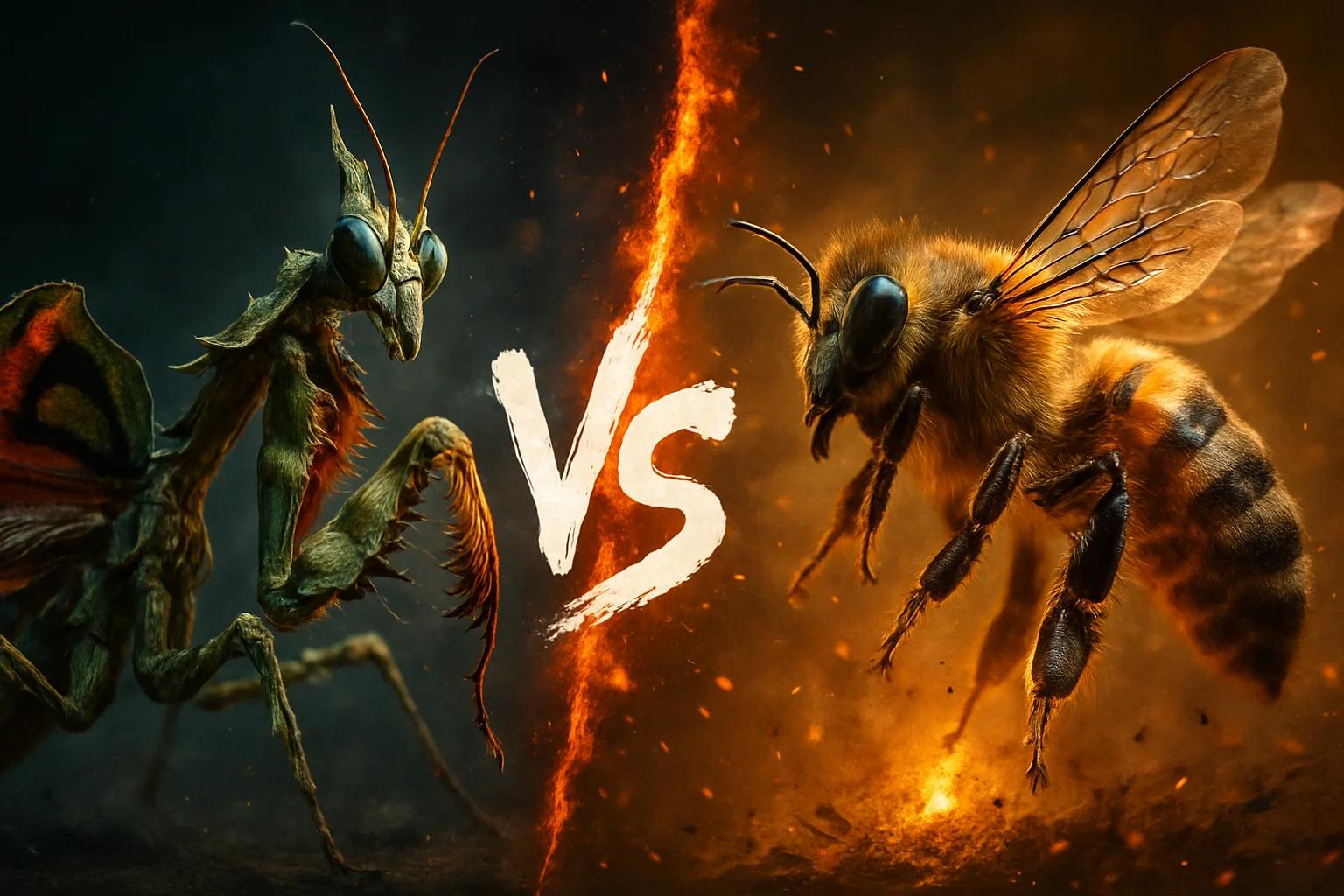
Devil's Flower Mantis vs Western Honey Bee: Who Actually Wins?
The Devil's flower mantis wins a one-on-one encounter. At roughly 10–13 cm, it is many times longer and heavier than a 12–15 mm worker honey bee. Its raptorial forelegs are spiked capture tools built specifically to snatch flying insects, and mantids routinely eat bees at flowers in the wild. The honey bee's sting is barbed and evolved to work against vertebrate skin, not to punch reliably through the joints of a large, armored insect. The bee is faster in the air and can gang up as a colony, but in a single duel the mantis has the reach, grip, and ambush timing to end it in one strike.
Read comparison
Discussion
What do you think?
Share your reasoning with other readers. Be civil and stick to the animals.
Sign in to join the discussion.
Sign inNo comments yet. Start the conversation.