
Animal field guide
Eurasian Wolf
Canis lupus lupus
The largest wild member of the dog family in Europe and northern Asia lives in family packs, each a breeding pair with their young of the last few years. Almost every young wolf leaves, usually before it is three, and travels alone until it finds a mate and ground no pack holds. Such journeys can cover hundreds of kilometres and have carried wolves back into much of western Europe.
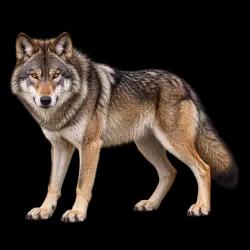
Eurasian Wolf at a glance
Mammal · Europe · Forest · Uncommon
Known for: Coat grey-brown mixed with buff and rust, Long-legged, Tail hangs straight down, Broad head with short ears and pale cheeks
Its Power
Lone Track
Leave the full house and walk until you reach ground nobody holds.
There is rarely room to build your own where you were raised, so new ground is found by leaving and travelling alone for a while.
“Leave to found.”
Capture a Eurasian Wolf, and it's yours when you finish one step it gives you.
Biological basis
Most young Canis lupus lupus leave the pack they were born into, usually between one and three years old, and travel alone in search of a mate and unoccupied ground. GPS-collared dispersers in Europe have covered more than a thousand kilometres, including a Slovenian wolf that crossed the Alps in 2011-12 and founded a new pack near Verona. This dispersal is how wolves have recolonised much of western and central Europe.
Put it into practice
A young baker leaves the family shop and opens her own in a town that has none.
What does the Eurasian wolf symbolize?
The Eurasian wolf symbolizes lone track: leave the full house and walk until you reach ground nobody holds. It represents self-reliance, exploration and solitude. Its AnimalDex motto: "Leave to found."
The Eurasian wolf as a spirit animal
If the Eurasian wolf is your spirit animal, the AnimalDex reading is Lone Track: there is rarely room to build your own where you were raised, so new ground is found by leaving and travelling alone for a while. It suggests a strength in self-reliance and exploration, and a reminder to use it on purpose.
What can the Eurasian wolf help you with in life?
The Eurasian wolf is a guide for self-reliance, exploration and solitude. Its lesson applies wherever self-reliance matters: there is rarely room to build your own where you were raised, so new ground is found by leaving and travelling alone for a while.
- Self-Reliance
- Exploration
- Solitude
In practice: A young baker leaves the family shop and opens her own in a town that has none.
What can we learn from the Eurasian Wolf?What does it mean to dream about or encounter a wild Eurasian wolf?
A wild Eurasian wolf, whether in a dream or in front of you, tends to show up when self-reliance or exploration is on your mind. In AnimalDex, the Eurasian wolf's principle is Lone Track: leave the full house and walk until you reach ground nobody holds. Read the moment through its core lesson: There is rarely room to build your own where you were raised, so new ground is found by leaving and travelling alone for a while.
Neither good nor bad on its own. How the Eurasian wolf acts matters: at ease, it reflects self-reliance; hostile, it flags self-reliance out of balance.
Spotting an Eurasian wolf in the wild
If an Eurasian wolf crosses your path, take it as a cue to look at where self-reliance fits your day. Its AnimalDex motto: "Leave to found."
An Eurasian wolf that keeps appearing
Seeing the Eurasian wolf again and again, in dreams or outside, suggests self-reliance is a theme you have not settled yet.
Dreaming of being chased by an Eurasian wolf
Being chased suggests you are avoiding the Lone Track the Eurasian wolf stands for: there is rarely room to build your own where you were raised, so new ground is found by leaving and travelling alone for a while. Ask what you keep postponing that needs self-reliance.
Dreaming that an Eurasian wolf attacks you
When the Eurasian wolf attacks, the dream may be about pressure: exploration or solitude applied too hard, by you or by someone close to you.
A calm or friendly Eurasian wolf
A relaxed Eurasian wolf near you, in a dream or in person, reads as readiness: Lone Track is available to you now, as its motto puts it, "Leave to found.".
A dead or injured Eurasian wolf
Seeing the Eurasian wolf hurt may point to exploration that has been neglected. Ask what it would take to restore it.
These readings are reflective prompts drawn from how the Eurasian wolf really lives, not predictions. If you meet one in the wild, watch from a distance and leave it undisturbed.
Capture your own Eurasian Wolf
Photograph or film one in the wild, at a zoo or at home with the app. It becomes yours: it remembers you, gives you steps, and can debate your problems with your other animals.
Animal field guide
Eurasian Wolf
Sign in to hear this read by a natural AI voice instead of your browser's.
The largest wild member of the dog family in Europe and northern Asia lives in family packs, each a breeding pair with their young of the last few years. Such journeys can cover hundreds of kilometres and have carried wolves back into much of western Europe.
Native range
Natural range, not this capture location
Forest, mountain, steppe and farmland mosaics from western Europe across Russia and Siberia towards the borders of Mongolia and northern China. It needs wild prey and undisturbed cover for denning more than any one vegetation type, and in parts of Europe now lives within sight of villages.
Search near meAnimalDex stats
Size scale
Understand the animal
Understand the Eurasian Wolf
Factual biology first: what this animal is like, where it lives, how it survives, and why those traits exist.
01
Introduction to Eurasian Wolf
The largest wild member of the dog family in Europe and northern Asia lives in family packs, each a breeding pair with their young of the last few years. Almost every young wolf leaves, usually before it is three, and travels alone until it finds a mate and ground no pack holds. Such journeys can cover hundreds of kilometres and have carried wolves back into much of western Europe.
How to identify a Eurasian Wolf
- Coat grey-brown mixed with buff and rust
- Long-legged, narrow-chested build, larger than most dogs
- Tail hangs straight down, never curled over the back
- Broad head with short ears and pale cheeks
- Slanted yellow to amber eyes
Why Eurasian Wolf are interesting
- A Slovenian wolf fitted with a GPS collar crossed the Alps in the winter of 2011 to 2012 and founded a new pack in the hills north of Verona.
- Pack territories commonly cover a few hundred square kilometres in central and southern Europe and around 1,000 in Scandinavia, where prey is thinly spread.
- Howls carry for several kilometres and serve to keep pack members in touch and to warn neighbouring packs away.
- Wolves were exterminated from most of western Europe by the early twentieth century and have spread back since legal protection began in the 1970s and 1980s.
- A wolf can eat several kilograms of meat at one meal and then go for days without feeding.
02
Adaptations and biological abilities
03
Why does Eurasian Wolf behave this way?
- Coat grey-brown mixed with buff and rust
- Long-legged, narrow-chested build, larger than most dogs
- Tail hangs straight down, never curled over the back
- Broad head with short ears and pale cheeks
- Slanted yellow to amber eyes
Mainly active from dusk to dawn in settled landscapes, and more by day in remote country. It lies up through the middle of the day in dense cover, and breeding females use a den in spring.
04
Why Forest?
Habitat: Forest, mountain, steppe and farmland mosaics from western Europe across Russia and Siberia towards the borders of Mongolia and northern China. It needs wild prey and undisturbed cover for denning more than any one vegetation type, and in parts of Europe now lives within sight of villages.
Native range: Europe, Central Asia, East Asia
Native range
Natural range, not this specific capture location.
Forest, mountain, steppe and farmland mosaics from western Europe across Russia and Siberia towards the borders of Mongolia and northern China. It needs wild prey and undisturbed cover for denning more than any one vegetation type, and in parts of Europe now lives within sight of villages.
05
Why this diet?
06
Activity, rest, and lifespan
07
Eurasian Wolf reproduction
Mating falls between January and March and gestation lasts about 63 days. A litter of usually four to six pups is born blind in a den in spring, suckled for six to eight weeks and then fed on regurgitated meat by the whole pack.
Males are larger and heavier than females, with a broader head; adult males range from about 30 kilograms in southern Europe to over 50 in the north and east. Coat colour does not differ between the sexes.
08
Predators, threats, and defense
09
Conservation and rarity
Rarity: Uncommon · 56/100. AnimalDex canonical rarity score: 56/100, maintained by the live indexed species profile.
- Observe from a respectful distance and avoid changing the animal's behavior.
- Do not block feeding, shelter, nesting, or travel routes.
- Use a live camera capture without handling or staging wildlife.
Talk to it
Talk to the Eurasian Wolf
It answers as itself: ask about how it lives, or bring it something of yours and hear what it would do, from its own Power.
Anonymous: 6/day. Signed-in: 10/day. Pro: 100/day.
Side by side
The Eurasian Wolf, side by side
Nothing written side by side for the Eurasian Wolf yet. Pick any animal to compare it with. Compare with any animal →
Where to find them
Where to find Eurasian Wolf
To find Eurasian Wolf in the wild, focus on the exact habitat patches that match its body design and daily behavior, not just the broad country where it exists. You usually do better by working one good piece of habitat inside europe, Central Asia, East Asia than by covering too much ground.
- Forest edge, canopy gaps, fruiting trees, or shaded trails where cover and food meet
- Rocky slopes, ridge lines, cliff ledges, or open mountain meadows with a wide view
- Open grassland edges, lightly wooded plains, or raised ground where you can scan long distances
In the Ark
2 Eurasian Wolves are aboard right now.
None have come aboard or left since November 17.
The Ark is a live, shared animal world. Animals come aboard when people capture them, and live there by rules based on their field guides.
Scientific name
Canis lupus lupus
Category
Mammal
Habitat
Forest, mountain, steppe and farmland mosaics from western Europe across Russia and Siberia towards the borders of Mongolia and northern China. It needs wild prey and undisturbed cover for denning more than any one vegetation type, and in parts of Europe now lives within sight of villages.
Rarity
Uncommon · 56/100
Native range
Europe, Central Asia, East Asia
Take the encyclopedia outside
AnimalDex helps you scan real animals, identify species, collect cards, and learn from nature wherever you are.