Animal field guide
European Pond Terrapin
Emys orbicularis
Females may walk hundreds of metres from water to dig a nest in sunny, sandy ground, and the temperature of that soil decides whether the hatchlings develop as males or females. It is the most widespread native freshwater turtle of Europe.
European Pond Terrapin at a glance
Animal · Europe · Still or slow · Uncommon
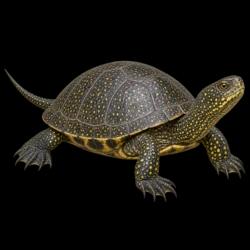
Known for: Dark, Head and legs speckled with yellow dots, Webbed feet with strong claws, No red or yellow patch behind the eye
Its Power
Mud Retreat
When overwhelmed, take a break to recharge.
The European Pond Terrapin buries itself in mud to escape harsh conditions, highlighting the importance of taking breaks to recharge.
“Retreat and Recharge.”
Capture a European Pond Terrapin, and it's yours when you finish one step it gives you.
Biological basis
During unfavorable conditions, the European Pond Terrapin buries itself in mud to conserve energy and protect itself.
Put it into practice
After a hectic meeting, Sarah steps outside for a quiet walk, allowing her mind to reset before tackling her next task.
What does the European pond terrapin symbolize?
The European pond terrapin symbolizes mud retreat: when overwhelmed, take a break to recharge. It represents recovery, energy management and self-regulation. Its AnimalDex motto: "Retreat and Recharge."
The European pond terrapin as a spirit animal
If the European pond terrapin is your spirit animal, the AnimalDex reading is Mud Retreat: the European Pond Terrapin buries itself in mud to escape harsh conditions, highlighting the importance of taking breaks to recharge. It suggests a strength in recovery and energy management, and a reminder to use it on purpose.
What can the European pond terrapin help you with in life?
The European pond terrapin is a guide for recovery, energy management and self-regulation. Its lesson applies wherever recovery matters: the European Pond Terrapin buries itself in mud to escape harsh conditions, highlighting the importance of taking breaks to recharge.
- Recovery
- Energy Management
- Self-Regulation
In practice: After a hectic meeting, Sarah steps outside for a quiet walk, allowing her mind to reset before tackling her next task.
What can we learn from the European Pond Terrapin?What does it mean to dream about or encounter a wild European pond terrapin?
Meeting a wild European pond terrapin, asleep or awake, is often a nudge toward recovery, the quality the European pond terrapin is built around. In AnimalDex, the European pond terrapin's principle is Mud Retreat: when overwhelmed, take a break to recharge. Read the moment through its core lesson: The European Pond Terrapin buries itself in mud to escape harsh conditions, highlighting the importance of taking breaks to recharge.
Mostly a prompt rather than a warning. A calm European pond terrapin suggests recovery you already have; a threatening one suggests recovery is being tested or pushed too far.
Spotting an European pond terrapin in the wild
A real encounter is the plainest version of the sign: notice what the European pond terrapin was doing. When overwhelmed, take a break to recharge. That is the recovery worth borrowing today.
An European pond terrapin that keeps appearing
Repeated sightings of an European pond terrapin usually mean the Mud Retreat lesson is still open: the European Pond Terrapin buries itself in mud to escape harsh conditions, highlighting the importance of taking breaks to recharge.
Dreaming of being chased by an European pond terrapin
If the European pond terrapin pursues you, look at where energy management is being asked of you and you are stepping away instead of meeting it.
Dreaming that an European pond terrapin attacks you
When the European pond terrapin attacks, the dream may be about pressure: energy management or self-regulation applied too hard, by you or by someone close to you.
A calm or friendly European pond terrapin
Meeting a peaceful European pond terrapin is usually encouraging: energy management and self-regulation are within reach.
A dead or injured European pond terrapin
Seeing the European pond terrapin hurt may point to energy management that has been neglected. Ask what it would take to restore it.
These readings are reflective prompts drawn from how the European pond terrapin really lives, not predictions. If you meet one in the wild, watch from a distance and leave it undisturbed.
Capture your own European Pond Terrapin
Photograph or film one in the wild, at a zoo or at home with the app. It becomes yours: it remembers you, gives you steps, and can debate your problems with your other animals.
Animal field guide
European Pond Terrapin
Sign in to hear this read by a natural AI voice instead of your browser's.
Females may walk hundreds of metres from water to dig a nest in sunny, sandy ground, and the temperature of that soil decides whether the hatchlings develop as males or females. It is the most widespread native freshwater turtle of Europe.
Native range
Natural range, not this capture location
Still or slow, well-vegetated fresh water: ponds, marshes, oxbow lakes, ditches and slow rivers with soft muddy bottoms, reedbeds, and fallen logs or banks for basking, mostly in lowlands across Europe, north-west Africa and western Asia.
Search near meAnimalDex stats
Size scale
Understand the animal
Understand the European Pond Terrapin
Factual biology first: what this animal is like, where it lives, how it survives, and why those traits exist.
01
Introduction to European Pond Terrapin
Females may walk hundreds of metres from water to dig a nest in sunny, sandy ground, and the temperature of that soil decides whether the hatchlings develop as males or females. It is the most widespread native freshwater turtle of Europe.
How to identify a European Pond Terrapin
- Dark, low oval shell with fine yellow spots or streaks
- Head and legs speckled with yellow dots
- Webbed feet with strong claws
- No red or yellow patch behind the eye, unlike introduced sliders
Why European Pond Terrapin are interesting
- Introduced North American red-eared sliders now compete with it for food and basking places in many European wetlands.
- Remains show it lived in Britain and southern Scandinavia during the warmer period that followed the last ice age.
- Turtles on Sicily are now usually treated as a separate species, Emys trinacris.
- After wetland drainage wiped out many northern populations, several reintroduction projects have released young turtles into restored wetlands.
02
Adaptations and biological abilities
03
Why does European Pond Terrapin behave this way?
- Dark, low oval shell with fine yellow spots or streaks
- Head and legs speckled with yellow dots
- Webbed feet with strong claws
- No red or yellow patch behind the eye, unlike introduced sliders
Nights are spent resting underwater on the bottom or among dense water plants. By day it basks in the morning sun and feeds later.
04
Why Still or slow?
Habitat: Still or slow, well-vegetated fresh water: ponds, marshes, oxbow lakes, ditches and slow rivers with soft muddy bottoms, reedbeds, and fallen logs or banks for basking, mostly in lowlands across Europe, north-west Africa and western Asia.
Native range: Europe, North Africa & Middle East, Central Asia
Native range
Natural range, not this specific capture location.
Still or slow, well-vegetated fresh water: ponds, marshes, oxbow lakes, ditches and slow rivers with soft muddy bottoms, reedbeds, and fallen logs or banks for basking, mostly in lowlands across Europe, north-west Africa and western Asia.
05
Why this diet?
Mostly animal food: aquatic insects and their larvae, snails, worms, crayfish, tadpoles, frogs, small fish and carrion, with some water plants. It hunts slowly along the bottom and swallows its food underwater.
06
Activity, rest, and lifespan
Nights are spent resting underwater on the bottom or among dense water plants. By day it basks in the morning sun and feeds later.
Wild adults can live 40 years or more, and some long-term studies suggest much greater ages; claims of over 100 years are not well verified.
07
European Pond Terrapin reproduction
Females lay one clutch, occasionally two, of about 3 to 16 eggs in early summer, in a hole dug with the hind feet and then covered and left. Incubation takes roughly 2 to 3 months, and in cool summers hatchlings may stay in the nest over winter.
Males have a concave underside, a longer, thicker tail and, in many populations, reddish eyes; females usually grow slightly larger, with a flat underside and pale yellowish eyes.
08
Predators, threats, and defense
09
Conservation and rarity
Rarity: Uncommon · 54/100. AnimalDex canonical rarity score: 54/100, maintained by the live indexed species profile.
- Observe from a respectful distance and avoid changing the animal's behavior.
- Do not block feeding, shelter, nesting, or travel routes.
- Use a live camera capture without handling or staging wildlife.
Talk to it
Talk to the European Pond Terrapin
It answers as itself: ask about how it lives, or bring it something of yours and hear what it would do, from its own Power.
Anonymous: 6/day. Signed-in: 10/day. Pro: 100/day.
Side by side
The European Pond Terrapin, side by side
Nothing written side by side for the European Pond Terrapin yet. Pick any animal to compare it with. Compare with any animal →
Where to find them
Where to find European Pond Terrapin
To find European Pond Terrapin in the wild, focus on the exact habitat patches that match its body design and daily behavior, not just the broad country where it exists. You usually do better by working one good piece of habitat inside europe, North Africa & Middle East, Central Asia than by covering too much ground.
- Quiet marsh edges, reedbeds, river bends, or shallow wetland margins
- Sunlit logs, exposed branches, warm rocks, or regular perch sites used for scanning
- Protected habitat blocks within europe, North Africa & Middle East, Central Asia
In the Ark
No European Pond Terrapin is aboard yet.
The Ark is a live, shared animal world. Each animal comes aboard after a step that worked, and lives there by rules based on its field guide.
See the ArkScientific name
Emys orbicularis
Category
Animal
Habitat
Still or slow, well-vegetated fresh water: ponds, marshes, oxbow lakes, ditches and slow rivers with soft muddy bottoms, reedbeds, and fallen logs or banks for basking, mostly in lowlands across Europe, north-west Africa and western Asia.
Rarity
Uncommon · 54/100
Native range
Europe, North Africa & Middle East, Central Asia
Take the encyclopedia outside
AnimalDex helps you scan real animals, identify species, collect cards, and learn from nature wherever you are.