Animal field guide
Red Junglefowl
Gallus gallus
The wild bird from which domestic chickens descend, domesticated in Asia several thousand years ago. Unlike farmyard birds it is slim, shy and a strong flier.
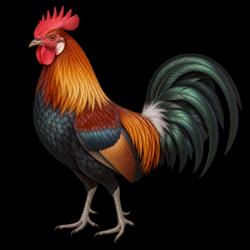
Red Junglefowl at a glance
Animal · Southeast Asia · Forest edges · Relatively common
Known for: Rooster's golden-orange neck hackles over dark, Long, Red comb and facial wattles, Slate-grey legs
Its Power
Alertness
Stay vigilant and aware of your surroundings.
The Red Junglefowl's keen sense of alertness helps it detect predators early, ensuring its survival in the wild.
“Stay sharp, stay safe.”
Capture a Red Junglefowl, and it's yours when you finish one step it gives you.
Biological basis
Red Junglefowl are known for their acute hearing and visual acuity, which allow them to detect threats quickly and react accordingly.
Put it into practice
A cyclist hears a car door click ahead and swerves wide a second before it swings open.
What does the red junglefowl symbolize?
The red junglefowl symbolizes alertness: stay vigilant and aware of your surroundings. It represents alertness, early warning and reading the room. Its AnimalDex motto: "Stay sharp, stay safe."
The red junglefowl as a spirit animal
If the red junglefowl is your spirit animal, the AnimalDex reading is Alertness: the Red Junglefowl's keen sense of alertness helps it detect predators early, ensuring its survival in the wild. It suggests a strength in alertness and early warning, and a reminder to use it on purpose.
What can the red junglefowl help you with in life?
The red junglefowl is a guide for alertness, early warning and reading the room. Its lesson applies wherever alertness matters: the Red Junglefowl's keen sense of alertness helps it detect predators early, ensuring its survival in the wild.
- Alertness
- Early Warning
- Reading the Room
In practice: A cyclist hears a car door click ahead and swerves wide a second before it swings open.
What can we learn from the Red Junglefowl?What does it mean to dream about or encounter a wild red junglefowl?
Meeting a wild red junglefowl, asleep or awake, is often a nudge toward alertness, the quality the red junglefowl is built around. In AnimalDex, the red junglefowl's principle is Alertness: stay vigilant and aware of your surroundings. Read the moment through its core lesson: The Red Junglefowl's keen sense of alertness helps it detect predators early, ensuring its survival in the wild.
Mostly a prompt rather than a warning. A calm red junglefowl suggests alertness you already have; a threatening one suggests alertness is being tested or pushed too far.
Spotting a red junglefowl in the wild
A real encounter is the plainest version of the sign: notice what the red junglefowl was doing. Stay vigilant and aware of your surroundings. That is the alertness worth borrowing today.
A red junglefowl that keeps appearing
A red junglefowl that keeps turning up points to early warning you keep circling back to. The repetition is the message.
Dreaming of being chased by a red junglefowl
If the red junglefowl pursues you, look at where early warning is being asked of you and you are stepping away instead of meeting it.
Dreaming that a red junglefowl attacks you
When the red junglefowl attacks, the dream may be about pressure: early warning or reading the room applied too hard, by you or by someone close to you.
A calm or friendly red junglefowl
Meeting a peaceful red junglefowl is usually encouraging: early warning and reading the room are within reach.
A dead or injured red junglefowl
Seeing the red junglefowl hurt may point to early warning that has been neglected. Ask what it would take to restore it.
These readings are reflective prompts drawn from how the red junglefowl really lives, not predictions. If you meet one in the wild, watch from a distance and leave it undisturbed.
Capture your own Red Junglefowl
Photograph or film one in the wild, at a zoo or at home with the app. It becomes yours: it remembers you, gives you steps, and can debate your problems with your other animals.
Animal field guide
Red Junglefowl
Sign in to hear this read by a natural AI voice instead of your browser's.
The wild bird from which domestic chickens descend, domesticated in Asia several thousand years ago. Unlike farmyard birds it is slim, shy and a strong flier.
Native range
Natural range, not this capture location
Forest edges, bamboo thickets, secondary growth, scrub and overgrown clearings, often near cultivation, from lowlands up into the Himalayan foothills.
Search near meAnimalDex stats
Dominance
32
Speed
51
Size
18
Intelligence
35
Rarity
19%
Total
155
Size scale
Understand the animal
Understand the Red Junglefowl
Factual biology first: what this animal is like, where it lives, how it survives, and why those traits exist.
01
Introduction to Red Junglefowl
The wild bird from which domestic chickens descend, domesticated in Asia several thousand years ago. Unlike farmyard birds it is slim, shy and a strong flier.
How to identify a Red Junglefowl
- Rooster's golden-orange neck hackles over dark underparts
- Long, arched, glossy green-black tail feathers in males
- Red comb and facial wattles, largest in males
- Slate-grey legs, spurred in adult males
- Slim, upright build, lighter than most farm chickens
Why Red Junglefowl are interesting
- A large genetic study published in 2020 pointed to the subspecies Gallus gallus spadiceus, of mainland Southeast Asia, as the main source of domestic chickens.
- Five subspecies are usually recognised across its range.
- A rooster that finds food calls and repeatedly picks it up and drops it, a display called tidbitting that draws hens to him.
- Birds dust-bathe in dry soil, working it through their feathers, which is thought to help control lice and mites.
02
Adaptations and biological abilities
03
Why does Red Junglefowl behave this way?
- Rooster's golden-orange neck hackles over dark underparts
- Long, arched, glossy green-black tail feathers in males
- Red comb and facial wattles, largest in males
- Slate-grey legs, spurred in adult males
- Slim, upright build, lighter than most farm chickens
Roosts at night well above the ground in trees or bamboo clumps. By day it is busiest in early morning and late afternoon.
04
Why Forest edges?
Habitat: Forest edges, bamboo thickets, secondary growth, scrub and overgrown clearings, often near cultivation, from lowlands up into the Himalayan foothills.
Native range: Southeast Asia, South Asia
Native range
Natural range, not this specific capture location.
Forest edges, bamboo thickets, secondary growth, scrub and overgrown clearings, often near cultivation, from lowlands up into the Himalayan foothills.
05
Why this diet?
06
Activity, rest, and lifespan
Roosts at night well above the ground in trees or bamboo clumps. By day it is busiest in early morning and late afternoon.
Wild lifespan is poorly documented and probably only a few years for most birds; captive junglefowl have lived about 10 years or more.
07
Red Junglefowl reproduction
The hen lays usually about four to seven eggs in a scrape hidden under vegetation and incubates alone for about three weeks. Chicks are downy and leave the nest soon after hatching, following the hen, who broods and guards them.
Hens are smaller and plain brown with a small comb and no long tail. After breeding, roosters replace their bright neck hackles with short dark feathers for a few months, an eclipse plumage domestic cockerels lack.
08
Predators, threats, and defense
09
Conservation and rarity
Rarity: Relatively common · 19/100. AnimalDex canonical rarity score: 19/100, maintained by the live indexed species profile.
- Observe from a respectful distance and avoid changing the animal's behavior.
- Do not block feeding, shelter, nesting, or travel routes.
- Use a live camera capture without handling or staging wildlife.
Talk to it
Talk to the Red Junglefowl
It answers as itself: ask about how it lives, or bring it something of yours and hear what it would do, from its own Power.
Anonymous: 3/day. Signed-in: 10/day. Pro: 100/day.
Side by side
The Red Junglefowl, side by side
Nothing written side by side for the Red Junglefowl yet. Pick any animal to compare it with. Compare with any animal →
Where to find them
Where to find Red Junglefowl
To find Red Junglefowl in the wild, focus on the exact habitat patches that match its body design and daily behavior, not just the broad country where it exists. You usually do better by working one good piece of habitat inside southeast Asia, South Asia than by covering too much ground.
- Forest edge, canopy gaps, fruiting trees, or shaded trails where cover and food meet
- Protected habitat blocks within southeast Asia, South Asia
Where explorers saw it
- Kecamatan Kawunganten, Jawa Tengah, IndonesiaAug · 1 sighting
Scientific name
Gallus gallus
Category
Animal
Habitat
Forest edges, bamboo thickets, secondary growth, scrub and overgrown clearings, often near cultivation, from lowlands up into the Himalayan foothills.
Rarity
Relatively common · 19/100
Native range
Southeast Asia, South Asia
Take the encyclopedia outside
AnimalDex helps you scan real animals, identify species, collect cards, and learn from nature wherever you are.