
Animal field guide
Sambar Deer
Rusa unicolor
Generally regarded as the largest deer native to South and Southeast Asia: a big stag can stand 1.5 metres at the shoulder and weigh around 300 kilograms. For all that bulk it is secretive, and in most forests it is heard far more often than it is seen.
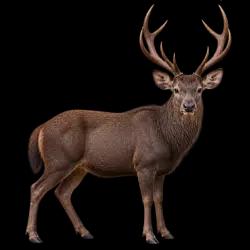
Sambar Deer at a glance
Mammal · South Asia · Forest with water close by · Uncommon
Known for: Coarse, Large, Stout antlers with three points on each side, Bushy tail
Its Power
Steady Movement
Move with purpose and calm, even in dense environments.
Sambar Deer navigate dense forests with a calm and steady pace, showing that moving purposefully can help you traverse challenging environments.
“Move with calm purpose.”
Capture a Sambar Deer, and it's yours when you finish one step it gives you.
Biological basis
Sambar Deer are known for their ability to move quietly and steadily through dense forest undergrowth, using their size and strength to push through obstacles.
Put it into practice
A mother with a pram moves through the packed station at an even pace and reaches the platform calm.
What does the sambar deer symbolize?
The sambar deer symbolizes steady movement: move with purpose and calm, even in dense environments. It represents composure, purpose and early warning. Its AnimalDex motto: "Move with calm purpose."
The sambar deer as a spirit animal
If the sambar deer is your spirit animal, the AnimalDex reading is Steady Movement: sambar Deer navigate dense forests with a calm and steady pace, showing that moving purposefully can help you traverse challenging environments. It suggests a strength in composure and purpose, and a reminder to use it on purpose.
What can the sambar deer help you with in life?
The sambar deer is a guide for composure, purpose and early warning. Its lesson applies wherever composure matters: sambar Deer navigate dense forests with a calm and steady pace, showing that moving purposefully can help you traverse challenging environments.
- Composure
- Purpose
- Early Warning
In practice: A mother with a pram moves through the packed station at an even pace and reaches the platform calm.
What can we learn from the Sambar Deer?What does it mean to dream about or encounter a wild sambar deer?
A wild sambar deer, whether in a dream or in front of you, tends to show up when composure or purpose is on your mind. In AnimalDex, the sambar deer's principle is Steady Movement: move with purpose and calm, even in dense environments. Read the moment through its core lesson: Sambar Deer navigate dense forests with a calm and steady pace, showing that moving purposefully can help you traverse challenging environments.
It depends on how the sambar deer behaved. Calm or close by, it reads as purpose within reach; aggressive or fleeing, it points to composure you are resisting.
Spotting a sambar deer in the wild
Coming across a sambar deer in person asks for attention more than interpretation. Watch it for a minute; the sambar deer's way of working is Steady Movement, and the lesson is: sambar Deer navigate dense forests with a calm and steady pace, showing that moving purposefully can help you traverse challenging environments.
A sambar deer that keeps appearing
A sambar deer that keeps turning up points to purpose you keep circling back to. The repetition is the message.
Dreaming of being chased by a sambar deer
A chase often means a demand for composure is catching up with you. The sambar deer's lesson, "Sambar Deer navigate dense forests with a calm and steady pace, showing that moving purposefully can help you traverse challenging environments", is the part you may be running from.
Dreaming that a sambar deer attacks you
When the sambar deer attacks, the dream may be about pressure: purpose or early warning applied too hard, by you or by someone close to you.
A calm or friendly sambar deer
A calm sambar deer suggests you have made peace with composure and can use it without force.
A dead or injured sambar deer
Seeing the sambar deer hurt may point to purpose that has been neglected. Ask what it would take to restore it.
These readings are reflective prompts drawn from how the sambar deer really lives, not predictions. If you meet one in the wild, watch from a distance and leave it undisturbed.
Capture your own Sambar Deer
Photograph or film one in the wild, at a zoo or at home with the app. It becomes yours: it remembers you, gives you steps, and can debate your problems with your other animals.
Animal field guide
Sambar Deer
Sign in to hear this read by a natural AI voice instead of your browser's.
Generally regarded as the largest deer native to South and Southeast Asia: a big stag can stand 1. For all that bulk it is secretive, and in most forests it is heard far more often than it is seen.
Native range
Natural range, not this capture location
Forest with water close by, from India and Sri Lanka through Southeast Asia: dry deciduous woodland, evergreen rainforest, swamp margins and montane forest, reaching about 3,500 metres on the southern slopes of the Himalayas. It favours hillsides and dense undergrowth over open plains.
Search near meAnimalDex stats
Size scale
Understand the animal
Understand the Sambar Deer
Factual biology first: what this animal is like, where it lives, how it survives, and why those traits exist.
01
Introduction to Sambar Deer
Generally regarded as the largest deer native to South and Southeast Asia: a big stag can stand 1.5 metres at the shoulder and weigh around 300 kilograms. For all that bulk it is secretive, and in most forests it is heard far more often than it is seen.
How to identify a Sambar Deer
- Coarse, shaggy coat of uniform dark brown
- Large, broad, rounded ears
- Stout antlers with three points on each side
- Bushy tail, blackish above and pale beneath
- Deep scent gland in front of each eye
Why Sambar Deer are interesting
- Many adults develop a bare, blood-red patch on the throat, known as the sore spot, which may ooze fluid in the breeding season; its function is not certain.
- Rutting stags do not gather harems; each holds a small territory, wallows in mud and draws hinds in with scent and calls.
- Fighting stags sometimes rear up on their hind legs and crash down onto each other, a style more usual among goat-like antelopes.
- Animals shipped to Australia and New Zealand in the 1800s founded wild herds that are still hunted there today.
02
Adaptations and biological abilities
03
Why does Sambar Deer behave this way?
- Coarse, shaggy coat of uniform dark brown
- Large, broad, rounded ears
- Stout antlers with three points on each side
- Bushy tail, blackish above and pale beneath
- Deep scent gland in front of each eye
Mostly active from dusk to dawn, and more strictly nocturnal where it is hunted. The day is spent lying up in dense thickets or tall grass.
04
Why Forest with water close by?
Habitat: Forest with water close by, from India and Sri Lanka through Southeast Asia: dry deciduous woodland, evergreen rainforest, swamp margins and montane forest, reaching about 3,500 metres on the southern slopes of the Himalayas. It favours hillsides and dense undergrowth over open plains.
Native range: South Asia, Southeast Asia
Native range
Natural range, not this specific capture location.
Forest with water close by, from India and Sri Lanka through Southeast Asia: dry deciduous woodland, evergreen rainforest, swamp margins and montane forest, reaching about 3,500 metres on the southern slopes of the Himalayas. It favours hillsides and dense undergrowth over open plains.
05
Why this diet?
Both browses and grazes, taking grasses, leaves, shoots, fallen fruit, bark and herbs according to season. It feeds mostly along forest edges and in clearings, and visits mineral licks regularly.
06
Activity, rest, and lifespan
Mostly active from dusk to dawn, and more strictly nocturnal where it is hunted. The day is spent lying up in dense thickets or tall grass.
Seldom more than about 12 years in the wild; captive animals have lived into their mid-twenties.
07
Sambar Deer reproduction
Usually a single calf, born after a pregnancy of about eight months. It lies hidden in thick cover for its first weeks, starts on solid food within a fortnight or so, and stays with its mother for a year or more.
Stags are much larger and carry antlers, which are shed and regrown, and grow a thick mane on the neck in the rut. Hinds are smaller and antlerless. Hinds and young live in small groups, while adult stags are mostly solitary.
08
Predators, threats, and defense
Tigers, leopards, dholes and crocodiles all hunt sambar, and people hunt it throughout its range. An alarmed animal stamps a forefoot, raises its tail and gives a loud, ringing bark. Pursued by dholes, it often backs into water and strikes out with its forefeet.
09
Conservation and rarity
Rarity: Uncommon · 56/100. AnimalDex canonical rarity score: 56/100, maintained by the live indexed species profile.
- Observe from a respectful distance and avoid changing the animal's behavior.
- Do not block feeding, shelter, nesting, or travel routes.
- Use a live camera capture without handling or staging wildlife.
Talk to it
Talk to the Sambar Deer
It answers as itself: ask about how it lives, or bring it something of yours and hear what it would do, from its own Power.
Anonymous: 6/day. Signed-in: 10/day. Pro: 100/day.
Side by side
The Sambar Deer, side by side
Nothing written side by side for the Sambar Deer yet. Pick any animal to compare it with. Compare with any animal →
Where to find them
Where to find Sambar Deer
To find Sambar Deer in the wild, focus on the exact habitat patches that match its body design and daily behavior, not just the broad country where it exists. You usually do better by working one good piece of habitat inside south Asia, Southeast Asia than by covering too much ground.
- Quiet marsh edges, reedbeds, river bends, or shallow wetland margins
- Forest edge, canopy gaps, fruiting trees, or shaded trails where cover and food meet
- Open grassland edges, lightly wooded plains, or raised ground where you can scan long distances
In the Ark
2 Sambar Deer are aboard right now.
None have come aboard or left since November 17.
The Ark is a live, shared animal world. Animals come aboard when people capture them, and live there by rules based on their field guides.
Scientific name
Rusa unicolor
Category
Mammal
Habitat
Forest with water close by, from India and Sri Lanka through Southeast Asia: dry deciduous woodland, evergreen rainforest, swamp margins and montane forest, reaching about 3,500 metres on the southern slopes of the Himalayas. It favours hillsides and dense undergrowth over open plains.
Rarity
Uncommon · 56/100
Native range
South Asia, Southeast Asia
Take the encyclopedia outside
AnimalDex helps you scan real animals, identify species, collect cards, and learn from nature wherever you are.