bird identificationfield marksbird photography
Identify a Bird by Photo: Why Even Experts Sometimes Can't
Some birds stump experts even in the hand, and one AI looked brilliant by seeing the same few birds. Here's how to identify a bird by photo the right way.
The short version · 0:16
BIRD PROS CAN'T NAME THIS BIRD
This article in under a minute. Watch it here, then read on for the detail and sources.
AI-narrated, with motion added to some photos. Photo credits are with each image in the article.
In this guide
- Why do two birds look identical until you check the eye?
- How does AI identify a bird from a photo?
- Should you identify a bird by colour or shape first?
- How do you tell a Downy from a Hairy Woodpecker?
- How do you photograph small birds that keep moving?
- Which birds can't be identified from a photo?
- How to identify a bird by photo with AnimalDex
- Why does a bird ID app give the wrong bird?
The short answer
Quick answer
Some birds can't be identified from a photo at all. Even a bander holding one often can't tell which species it is; only the song settles it. To identify a bird by photo, judge size and shape, narrow it to species likely for your place and season, then check bill, eye ring, wing bars and tail against the AI's suggestion.
The hook
Why do two birds look identical until you check the eye?
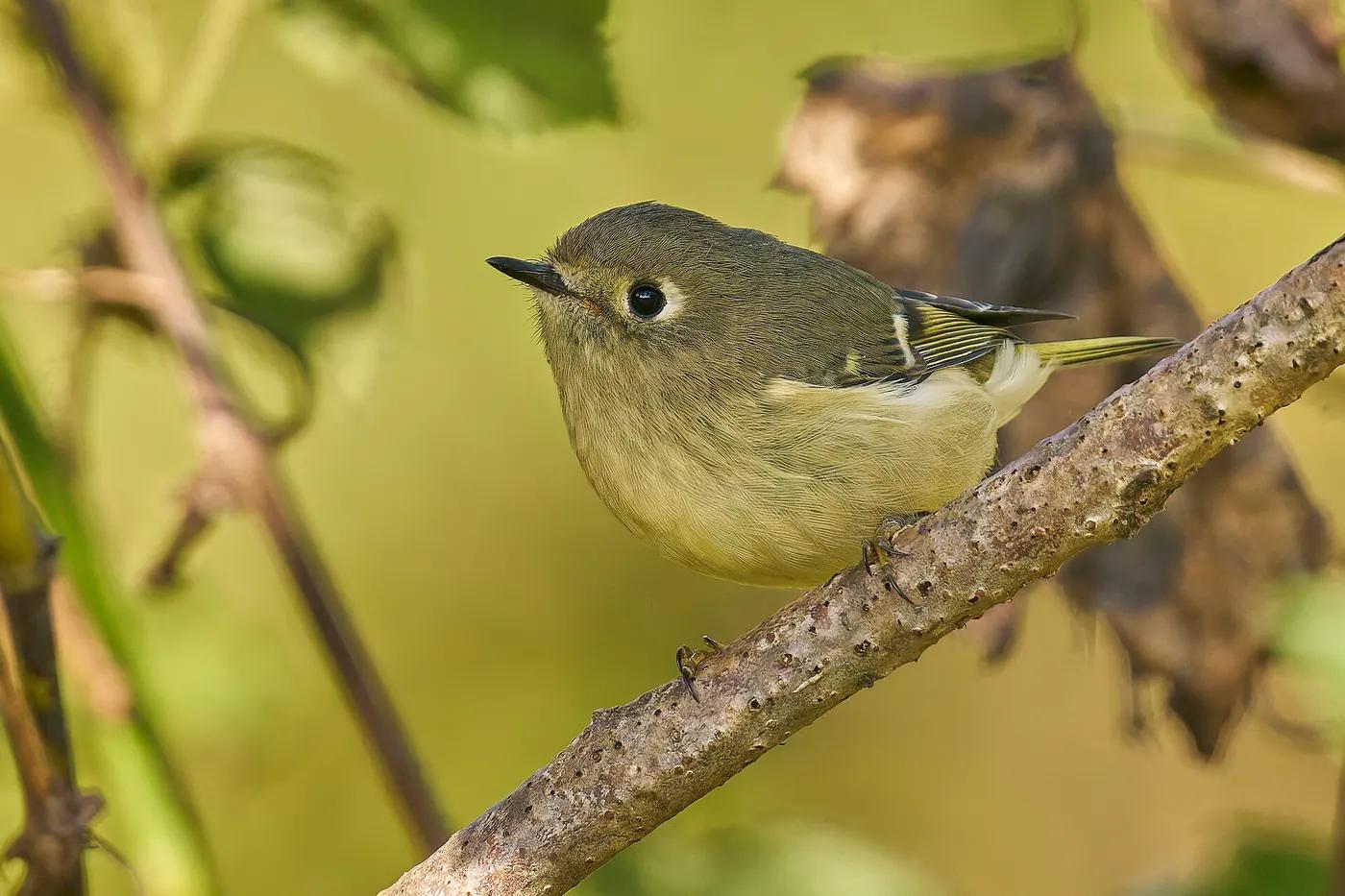
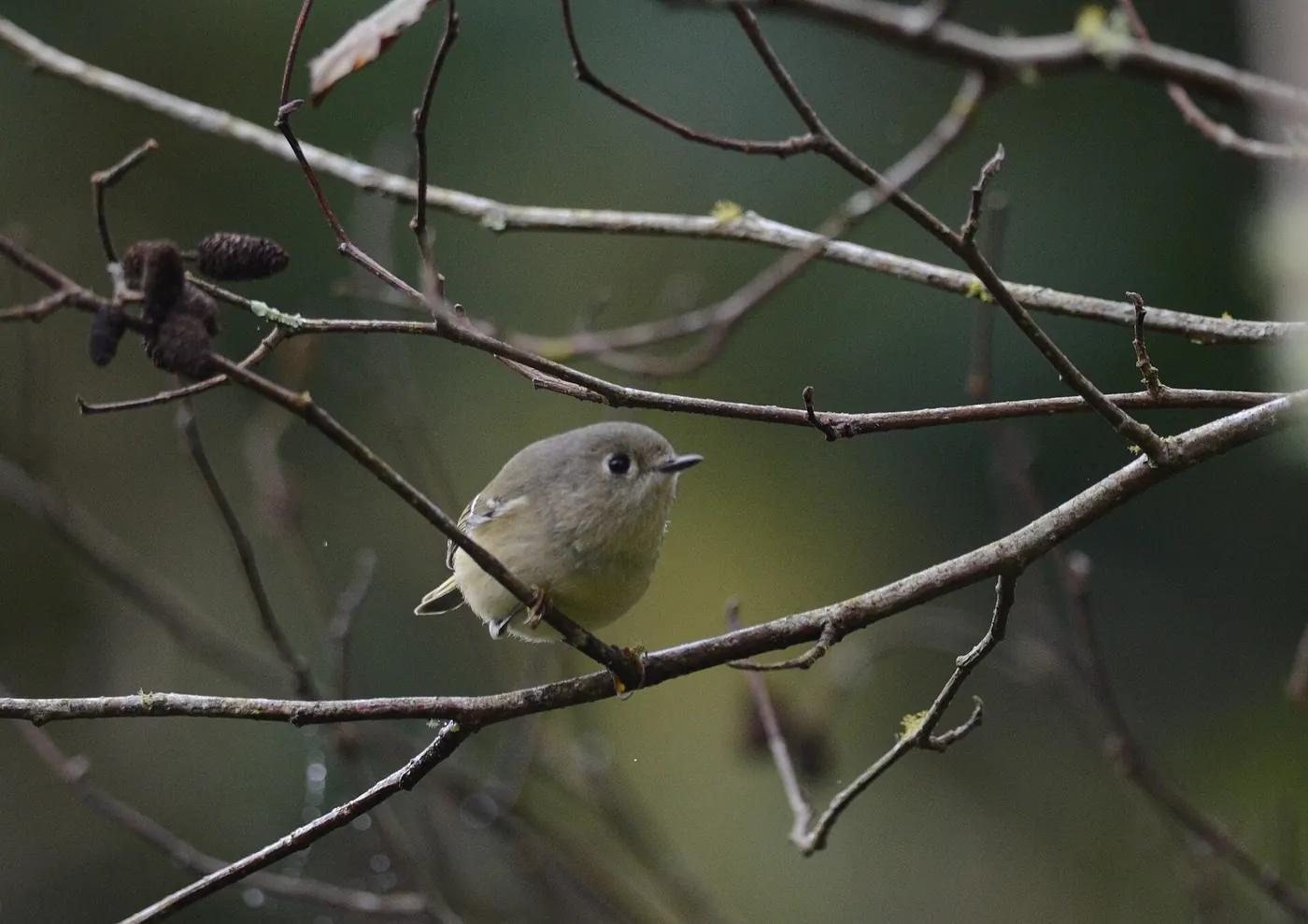
The Ruby-crowned Kinglet's white eye ring is broken at the top and the bottom. The Hutton's Vireo's is broken only at the top. They are two small olive birds from entirely different families, both with wing bars and a pale ring round the eye, and that one extra gap is often the quickest clue that you're looking at a kinglet rather than a vireo.
Once you know to look, the evidence piles up. The vireo has a thicker, slightly hooked bill, while the kinglet's is thin. The kinglet has black legs and yellow feet, and the vireo's legs are blue-grey. Only the kinglet has a black bar behind its lower wing bar.
Then there's the face. BirdFellow's side-by-side guide points out that Hutton's Vireo has a broad pale stripe between bill and eye that joins the eye ring, giving it a 'spectacled' look. It also has a horn-coloured bill on a head that looks too big for its body. The kinglet's face is plain apart from that broken ring, and its bill is all black.
Behaviour can help before you even raise your phone. Seattle Audubon's BirdWeb notes that kinglets are constantly moving, while Hutton's Vireos are more sluggish. A bird that won't stop flicking about is a point for the kinglet.
That's the whole game when you identify a bird by photo. Your picture isn't the ID. The tiny mark is. And sometimes, as you'll see further down, even the tiny mark isn't enough.
| Mark | Ruby-crowned Kinglet | Hutton's Vireo |
|---|---|---|
| Eye ring | Broken top AND bottom | Broken top only |
| Bill | Thin, all black | Thicker, slightly hooked, horn-coloured |
| Legs and feet | Black legs, yellow feet | Blue-grey |
| Black bar behind lower wing bar | Yes | No |
| Face | Plain apart from eye ring | Pale loral stripe, 'spectacled' look |
| Behaviour | Constantly moving | More sluggish |
One extra gap in a white eye ring is often the quickest clue you're looking at a kinglet, not a vireo.
The AI that cheated
How does AI identify a bird from a photo?
During testing, the Cornell Lab's newest Merlin model was 'unusually good' at identifying Nutting's Flycatcher, a bird humans struggle to tell apart from the Ash-throated Flycatcher. As it turned out, it was suspiciously good.
About a quarter of all the Nutting's photos came from a handful of individual birds in Arizona. The model was effectively being tested on the same few birds, which made it look better than it was. The engineers retrained it.
That story comes from Cornell's November 2024 announcement of Merlin Photo ID v3.5. The model is a convolutional neural network trained on Macaulay Library photos, and more than 1,300 birders annotated those photos by drawing boxes around each bird. Every photo goes in as a 224×224-pixel square split into red, green and blue. In the words of Macaulay Library machine learning engineer Sam Heinrich, the model 'does an enormous amount of math on those pixels.'
The scale is absurd. The model saw six million photos, each one 200 times. At one flashcard per second, a human would need 38 years to get through them. The computers take 8 days, and the result covers 6,900 species in a download of about 50 MB.
It also checks where you are. After reading colour, body shape and edges, Merlin uses eBird data on which species are common at the photo's location. That matters because one species can look different in different places. The Merlin falcon is heavily and darkly streaked in the Pacific Northwest but has only faint reddish streaks in Eurasia.
Cornell reports 95% average accuracy, with the error rate cut by about two-thirds compared with its 2019 predecessor. That average hides a wide spread. Northern Cardinals are easy for the model, while Empidonax flycatchers, with few distinguishing features, are hard. And 95% is Merlin's number for Merlin, not a benchmark for any other app.
At one flashcard per second, a human would need 38 years to see Merlin's training photos. The computers take 8 days.
Myth bust
Should you identify a bird by colour or shape first?
If your first move is to match the colour, you're doing it backwards. The Cornell Lab of Ornithology's four keys to visual ID are size and shape, colour pattern, behaviour and habitat, and size and shape come first. Cornell's reasoning is simple: finches can be red, yellow, blue, brown or green, 'but they're always shaped like finches.'
Here's the twist. Cornell's 'Building Skills' guide warns against starting with field marks, and the example it picks is the Ruby-crowned Kinglet's eye ring. Field marks are small, consistent details: the bill, the eye ring, the lores between bill and eye, the wing bars and the tail. They clinch an ID once you've narrowed it to a few look-alikes, but they don't start one. Most also only work from one angle. A bill-to-head comparison needs the head in profile, and the kinglet's black bar behind its lower wing bar needs the folded wing in view.
Size is hard to judge on its own, so use reference birds. Is it bigger or smaller than a sparrow, an American Robin or a crow? A Cedar Waxwing sits between sparrow and robin, and a Blue Jay between robin and crow. For shorebirds, seabirds and waterfowl, Cornell calls a known bird beside the mystery one crucial, such as a gull standing next to a Ring-billed Gull.
Then add likelihood. The U.S. and Canada have more than 800 bird species, so Cornell suggests keeping a mental tally of which ones are likely at your location and time of year. Habitat can still catch you out. The Killdeer, with two dark bands across a white breast, often turns up far from water, in parking lots and on lawns and driveways.
American RobinCedar WaxwingRing-billed GullKilldeer
Look-alikes
How do you tell a Downy from a Hairy Woodpecker?
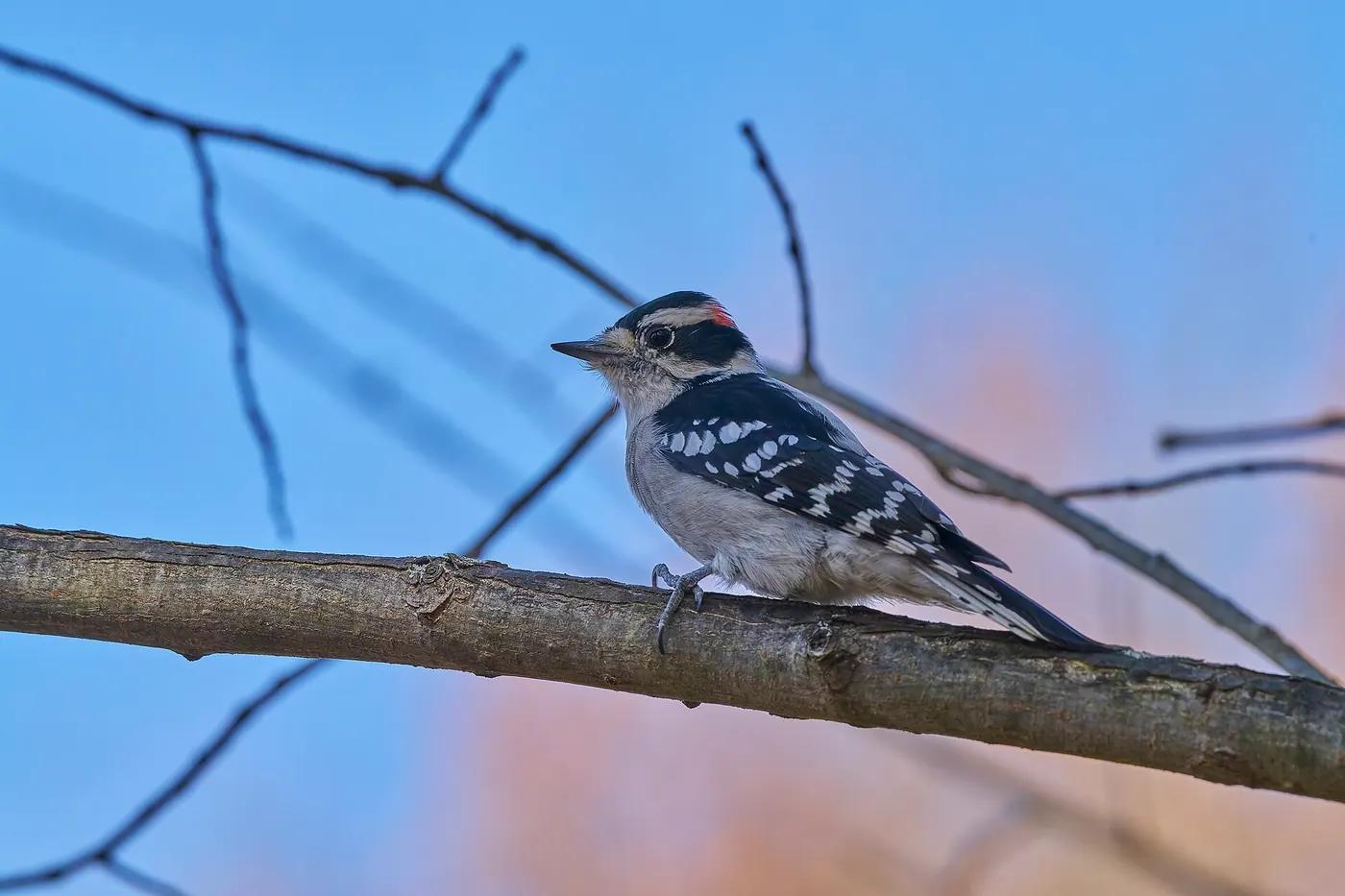
Both have the same black-and-white pattern, and males of both have a red spot on the back of the head. The Cornell Lab's Bird Academy says the 'real trick' is the bill. A Downy Woodpecker's bill is shorter than its head, while a Hairy Woodpecker's is about as long as its head.
Size backs this up if there's something to compare against. The Downy is about 6.5 inches long and the Hairy about 9.25, roughly the size of a robin. Alone on a bare trunk, though, that difference is hard to judge, which is why 'the smaller one is the Downy' only roughly works.
Two more marks help. Both have a black 'comma' running from the shoulder into the breast, which is clearly defined on the Hairy and poorly defined on the Downy. The outer tail feathers are white on most eastern Hairies but barred black on the Downy, although some Pacific and Newfoundland Hairies have barred tails too.
Look-alike pairs like Black Vulture vs Turkey Vulture reward the same habit: check proportions first and details second, and never rely on one mark on its own.
| Measure | Downy Woodpecker | Hairy Woodpecker |
|---|---|---|
| Length | About 6.5 in | About 9.25 in |
| Bill vs head | Shorter than head | About equal to head |
| Outer tail feathers | Black-barred or spotted | White (most eastern birds) |
| Shoulder 'comma' | Poorly defined | Clearly defined |
Downy WoodpeckerBlack Vulture vs Turkey Vulture
Fieldcraft
How do you photograph small birds that keep moving?
Remember the kinglet that never stops moving? That habit is why so many bird photos fail as evidence, because the one mark you need ends up as a blur.
The usual rule of thumb says your shutter speed should at least match your lens, so 1/300 s on a 300 mm lens. ExpertPhotography notes that moving birds usually need around 1/1000 s, more than three times faster. Tamron's beginner's guide suggests starting at 1/2000 s for birds in flight.
1. Let the camera track the bird. Use continuous autofocus (AF-C or AI Servo) and burst mode, and put the focus point on the eye.
2. Shoot for the marks, not the portrait. A sharp side view of the head, the folded wing and the tail beats one pretty frame that hides the face. Keep your distance too: our guide to wildlife photography without stressing animals covers how to get close without causing trouble.
3. Record the sound. If the bird calls or sings, record it or write down what you hear. For the next pair of birds, sound is the only evidence that settles it.
wildlife photography without stressing animals
The twist
Which birds can't be identified from a photo?
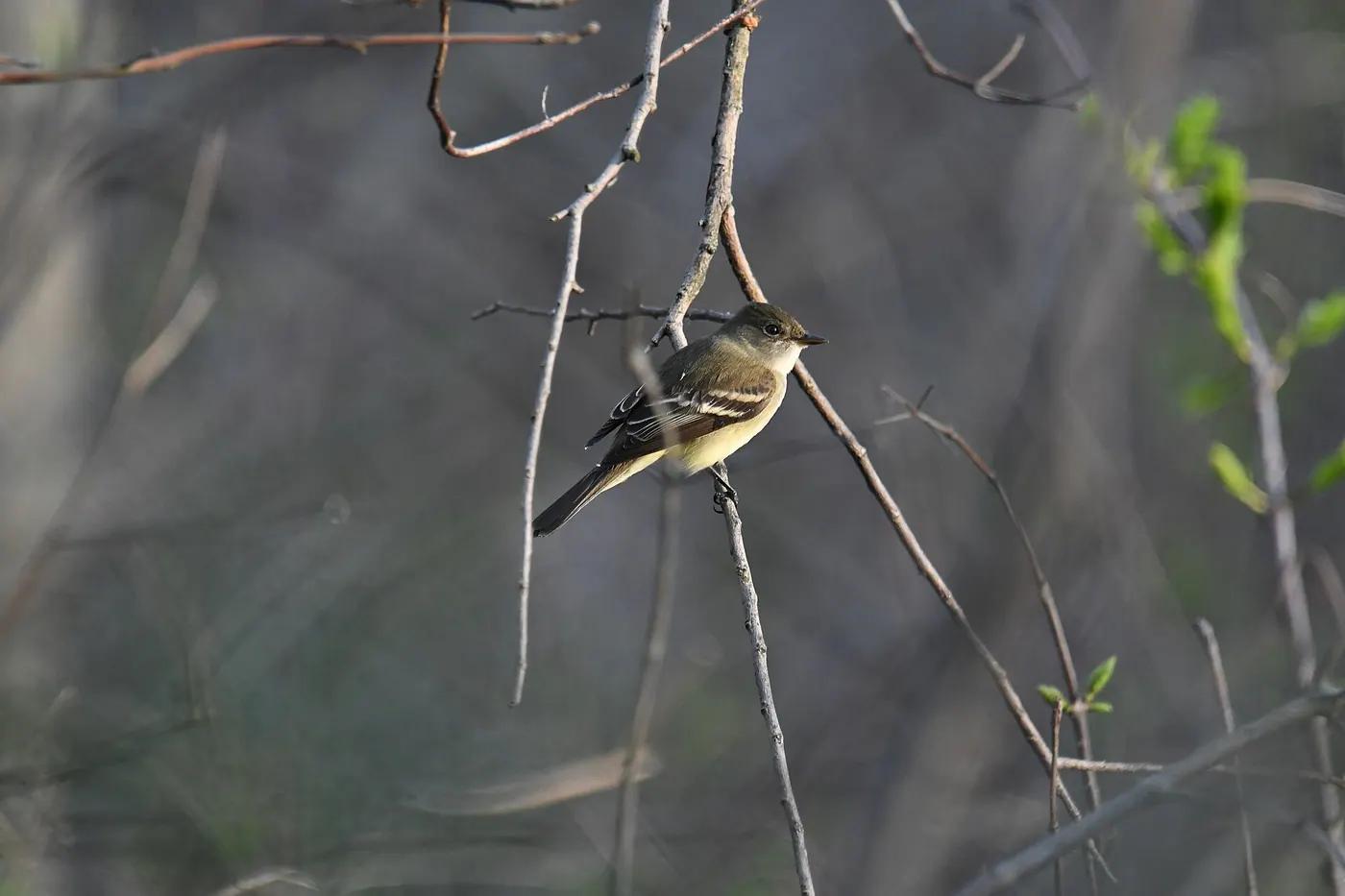
Alder and Willow Flycatchers look so alike that bird banders with one in the hand often can't reliably say which species it is. Only the song settles it.
For more than a century, they weren't even officially two birds. Audubon gave the name 'Traill's Flycatcher' in honour of Thomas Stewart Traill, the Scottish physician who helped him find a publisher. The bird stayed one species for more than 100 years, hiding in plain sight, until the American Ornithologists' Union split it in 1973.
Both are unusual among Empidonax flycatchers for having only a faint pale eye ring. Cornell says that out of season they can be separated only by voice or breeding range.
When they sing, though, they're obviously different birds. The Willow sings an emphatic 'fitz-bew', with the stress on the first syllable. The Alder sings a softer 'fee-bee-o', stressed on the second, which Cornell renders as 'free-beer'.
The songs don't rub off on each other, either. Young Alder Flycatchers that were 'tutored' only with Willow Flycatcher songs still sang normal Alder songs the next spring, and the two species ignore each other's songs. The birds know exactly who they are. The photo doesn't.
By late summer they stop singing, and birders fall back on 'Traill's Flycatcher' again. The honest lesson is that some birds can't be identified from a photo at all, and a recording, or even a note of the call, is part of the evidence.
Banders with one in the hand often can't tell which species it is. Only the song settles it.
Step by step
How to identify a bird by photo with AnimalDex
The AnimalDex bird ID page opens with a line Cornell would agree with: 'Bird identification is strongest when a quick photo scan is checked against shape, plumage, behavior, and habitat.' The scan offers AI-assisted suggestions as a starting point, and the checking is up to you.
1. Tap the scan action and allow camera and location access. Location adds habitat and sighting context, such as whether the area is wild or urban, which can improve the analysis.
2. Frame the bird clearly, getting as many of its marks in view as you can, and take a photo or a supported loop.
3. Review the shot and tap confirm. Then check the suggestion and its confidence value against silhouette, beak, wings, tail, posture, call, flight style, location and season.
The help centre explains how to scan an animal in full. If the bird is already in your camera roll, you can submit a photo you took yourself through the gallery button, with firm rules: no screenshots, no photos of screens and nothing taken by someone else.
Troubleshooting
Why does a bird ID app give the wrong bird?
Because a photo only captures part of a bird. AnimalDex's help centre says accuracy depends on lighting, focus, angle, visible body features and how similar related species are, with rare, juvenile, hybrid and look-alike birds the hardest to get right. In its own words, 'no AI identification is perfect.'
Usually the fix is a better shot: more light, more of the bird in view, or re-analysis. The page on what to do if the identification is wrong covers the next steps, and there's a separate page for when a capture is still processing.
A low confidence score isn't a failure. Treat it as a starting point and work through the order in this article: shape first, then the species likely for your place and season, then the mark that clinches it. Stuck on Alder versus Willow? That isn't you or the app. That's the bird. For AI mix-ups beyond birds, see how to identify any animal from a photo.
Never rely on any result for safety-critical wildlife, medical, handling or edibility decisions. Keep a safe distance and follow local guidance.
Then start with the birds outside your window. When a woodpecker lands on the feeder, compare its bill with its head before anything else, and record any song you can't place. Capture it live with your phone camera in AnimalDex and it joins your collection as a card. Over a season, those cards add up to a record of every animal you've seen.
identify any animal from a photoevery animal you've seen
Quick questions
Short answers to common questions readers ask on this topic.
- Can I identify a bird from a photo on my phone?
- Yes. AI tools such as Cornell's Merlin and the AnimalDex bird scan suggest species from a photo. Treat the suggestion as a starting point and check it against size, shape, location, season and field marks.
- What is the most accurate bird identification app?
- None of our sources compares apps head to head. Cornell reports that its Merlin Photo ID v3.5 model averages 95% accuracy across 6,900 species, while AnimalDex shows a confidence value with each result and its help centre notes that no AI identification is perfect. For any tool, look-alikes such as Empidonax flycatchers are the hardest.
- Why does a bird ID app give the wrong bird?
- Accuracy depends on lighting, focus, angle, visible body features and how similar related species are, and rare, juvenile, hybrid and look-alike birds are the hardest. Retake the photo with better light and more of the bird visible, or use re-analysis. Some pairs, such as Alder and Willow Flycatchers, can only be separated reliably by voice or breeding range.
- How do I tell a Downy from a Hairy Woodpecker?
- Check the bill first: a Downy's is shorter than its head, while a Hairy's is about as long as its head. The Hairy is also bigger, at about 9.25 inches against the Downy's 6.5, has a clearly defined shoulder 'comma' and, in most eastern birds, white outer tail feathers.
- Why does a bird ID app ask for my location?
- Location tells the AI which species are likely where you are. Merlin uses eBird data on which species are common at the photo's location. AnimalDex uses location for habitat and sighting context, such as whether the area is wild or urban, which can improve the analysis.
- Can you identify a bird from a blurry photo?
- Sometimes shape alone narrows down the group, but small marks such as a broken eye ring or a bill-to-head ratio need a sharp image. AnimalDex's help centre lists focus among the factors that affect accuracy and recommends retaking with better light and more of the animal visible. For moving birds, a shutter speed of around 1/1000 s helps prevent blur.
Animals mentioned
Jump from this article into the species pages behind the examples, systems notes, and field-guide references.
Sources and further reading
- eBird / Cornell Lab: Merlin's Photo ID has a new update
- Cornell Lab All About Birds: Building Skills: The 4 Keys to Bird Identification
- Cornell Lab Bird Academy: Downy and Hairy Woodpeckers
- Cornell Lab All About Birds: Alder Flycatcher Overview
- Seattle Audubon BirdWeb: Hutton's Vireo
- Northern Woodlands: Alder and Willow Flycatchers: Sibling Species
- NH Audubon: Willow Flycatcher
- Tamron: How to Photograph Birds: A Beginner's Guide
- ExpertPhotography: Camera Settings for Bird Photography
Answer guides related to this topic
If you want direct comparisons and clear recommendations, continue with these answer-focused pages.
Best Animal Identification Apps
Compare the best animal identification apps by features like photo/video identification, species coverage, collection capabilities, offline use, and more.
What Is Animal Collecting
Learn what animal collecting means in modern apps and how AnimalDex turns real-world sightings into cards, sets, rarity, and species learning.
Pokemon-Like Animal App
Looking for a Pokemon-like animal app with real species? AnimalDex combines creature-collection energy with AI scanning and wildlife learning.